Pulitzer Prize-winning Brown historian Gordon Wood dies at 92 after being struck by car
Jun 08, 2026 | 6:04 pm ET
Description
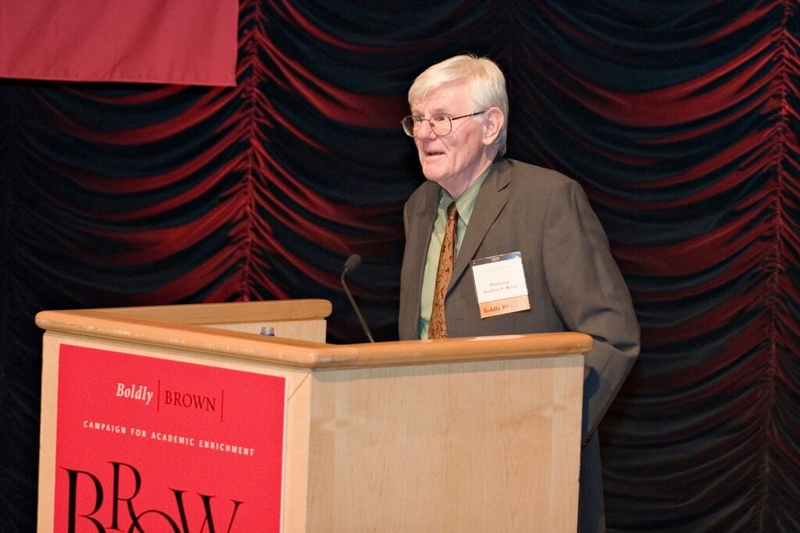
Historian Gordon S. Wood, pictured here at a 2010 event at Brown University, died on Sunday, June 7, at age 92. (Photo courtesy of Brown University)
Tributes are pouring in for Gordon Wood, the Pulitzer prize-winning author and historian of the American Revolution, who died Sunday after he was struck by a car in a parking lot in East Providence. He was 92.
Brown University, where Wood was professor emeritus of history, confirmed his death in a statement from President Christina H. Paxson on Monday.
“A preeminent scholar of American history, Gordon Wood helped countless readers understand the events and forces that led to the birth of the United States with depth, nuance and clarity,” Paxson said. “He was an inspiring teacher, a generous mentor and a deeply treasured member of the Brown University community for decades. We mourn the loss of a towering historian whose insights will inform both academic scholarship and public understanding for generations to come.”
In a Facebook post, East Providence police said officers were dispatched to the Shaw’s Supermarket parking lot on Taunton Avenue Sunday morning for a report of a pedestrian struck by a motor vehicle. When they arrived, they found Wood with serious injuries after a driver hit him while he was walking.
He later died at Rhode Island Hospital. As of Monday afternoon, no charges had been filed against the driver, who is cooperating with police, the post stated.
Wood was a native of Concord, Massachusetts, which along with Lexington, was the site of the opening battle of the American Revolution in April 1775. He deemed the eight-year war to secure independence from Great Britain “the most radical and far-reaching event in American history” for the way it dignified menial labor and empowered ordinary citizens and voters.
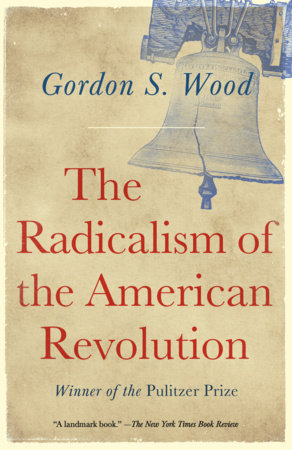
“To focus, as we are today apt to do, on what the Revolution did not accomplish—highlighting and lamenting its failure to abolish slavery and change fundamentally the lot of women—is to miss the great significance of what it did accomplish,” Wood wrote in his 1991 book, “The Radicalism of the American Revolution,” awarded the Pulitzer Prize in 1993.
“Indeed, the Revolution made possible the anti-slavery and women’s rights movements of the nineteenth century and in fact all our current egalitarian thinking. The Revolution not only radically changed the personal and social relationships of people, including the position of women, but also destroyed aristocracy as it had been understood in the Western world for at least two millennia.”
Wood joined Brown’s faculty in 1969 after previously teaching at Harvard and the University of Michigan. That same year he published his first book: “The Creation of the American Republic, 1776-1787,” which went on to win the Bancroft Prize in 1970.
He retired from Brown in 2008, but returned to campus frequently for speaking engagements. He most recently participated in a March 2025 conversation titled “Creation of the American Republic” at the John Carter Brown Library with its director and librarian Karin Wulf.
Wood’s epic “Empire of Liberty” was a finalist for the Pulitzer in 2009. His most recent book, “Power and Liberty: Constitutionalism in the American Revolution” was published by Oxford University Press in 2021.
In 2011, President Barack Obama presented Wood with a National Humanities Medal “for scholarship that provides insight into the founding of the nation and the drafting of the U.S. Constitution.”
But among his most lasting legacies is his name-drop in the monologue delivered by Matt Damon’s title character in the 1997 film “Good Will Hunting,” where he taunts a Harvard undergraduate.
“You’re gonna be in here regurgitating Gordon Wood, talking about, you know, the pre-revolutionary utopia and the capital-forming effects of military mobilization,” Damon’s character said.
Brown officials said Wood was scheduled to receive an award for his “unparalleled contributions to history and to education” at a June 27 gala commemorating the United States’ semiquincentennial anniversary.
“Gordon is genuinely the preeminent historian of the American founding period, which makes the timing of his death in this semiquincentennial year all the more tragic,” Wulf, a history professor, said in a statement. “He was deeply publicly engaged and was writing for the public up until his last few months.”
Wulf said reading “The Creation of the American Republic” as a college undergraduate inspired her to become a historian.
“I read it over a weekend, which is saying something because it’s a big book and because it’s an incredibly powerful depiction of the politics of the early republic and what it took to wrestle a constitution out of a really complex situation,” she said.
U.S. Rep. Seth Magaziner recalled having Wood as a professor at Brown, crediting him as the reason he chose to major in history.
“My time studying under him helped shape me into the person I am,” Magaziner said in a statement. “As we celebrate the 250th anniversary of our nation’s founding, Wood’s scholarship provides a vital telling of how exceptional the American experiment is. Gordon Wood reminded us that our founders wanted an America in which the true power rests with the people, and I have hope that their words, and his, will never be forgotten.”
Secretary of State Gregg Amore, a history teacher, lauded Wood for his expertise and historical perspective on the American Revolution in a post on X.
“I had the honor of listening to him lecture on more than one occasion, and I was beyond impressed by his intelligence and commitment to preserving our state and nation’s history,” Amore said in a statement. “I am deeply saddened to hear of his passing and I know he will sorely be missed.”

Providence, RI