UI Center for Intellectual Freedom council begins planning for required civics courses
Jun 08, 2026 | 6:02 pm ET
Description
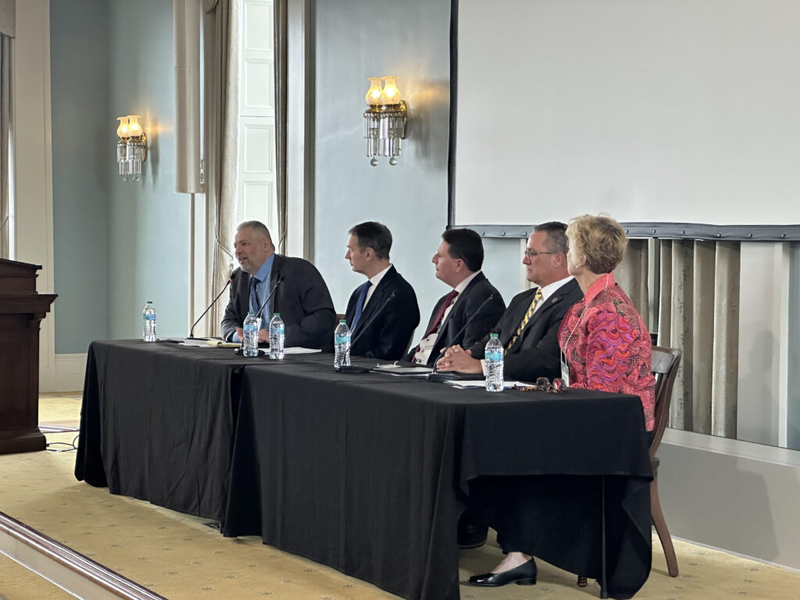
University of Iowa Center for Intellectual Freedom Advisory Council member Christine Hensley, right, led discussion June 8, 2026, with the council on the implementation of a new law requiring six hours of core civics classes for state university undergraduate students. Shown here are panelists speaking Dec. 6, 2025, at the Center for Intellectual Freedom at the University of Iowa. (Photo by Brooklyn Draisey/Iowa Capital Dispatch)
The advisory council for the University of Iowa Center for Intellectual Freedom discussed Monday how the center could implement Iowa’s new civics course requirement for public universities.
The meeting took place six days after Gov. Kim Reynolds signed House File 2800 into law, requiring undergraduate students at UI, Iowa State University and the University of Northern Iowa to take six credit hours of core civics courses.
The bill will not take effect until July 2028, and the UI Center for Intellectual Freedom will be the sole academic unit responsible for administering the required courses at University of Iowa. Iowa State’s Center for Cyclone Civics and UNI’s Center for Civics Education will designate courses at those universities, HF 2800 stats.
“We have two years to develop the core curriculum and implement it,” Christine Hensley, Regent and advisory council chair, said. “There’s going to be a need for a lot of support and assistance from the advisory council to ensure that this is successful.”
Hensley said the advisory council will also need to work hard to ensure that the implementation of civic courses goes smoothly by hiring enough staff members to accommodate the increased demand for the center’s courses.
“If you have the incorporation of courses going through the center, that will require a significant amount of faculty being hired and they’ll have to be hired before the courses start in the fall of 2028,” Hensley said.
Hensley said the passage of the legislation put the council’s other agenda items on hold, and they have accelerated plans for the UI Center of Intellectual Freedom to hire a permanent executive director, who will oversee the development of the curriculum.
“As we’re looking at hiring an executive, a permanent executive director, and we’re developing a core curriculum, everything else will be on pause, with the exception of developing the speaker series, and we just feel that that’s the most appropriate direction at this particular time,” Hensley said.
Hensley added that it will be crucial for the council to have a positive relationship with the universities.
“We don’t want the center to be subordinate to the university; however, it’s going to be more critical than ever that we have a strong, good relationship with the university, and there’s going to have to be a lot of work with the various individuals at the university,” Hensley said.
Advisory council members also emphasized the need to begin working on course design immediately, citing the two-year timeline before the requirement takes effect.
Advisory members debate intellectual freedom of students
Former state Sen. Liz Mathis criticized the idea of mandatory civics courses, arguing that requiring students to take specific courses is contradictory to the center’s purpose of ensuring their intellectual freedom on campus.
“It’s mandatory that students have to take this class, but we are supposed to be a center for intellectual freedom,” Mathis said. “It feels a little disjointed to me.”
Hensley said she understands Mathis’s point, but argued that it is necessary to prioritize civics education at universities more than some elective courses she described as “suspect.”
“If you look at general electives and what students can take, there are some that are really suspect as to why they’d even be courses,” Hensley said. “There’s a report out there that underscores the lack of knowledge students have in regards to the history of the United States and American freedom. It needs to be emphasized that civic courses are an important part of our culture and history.”
Scholar committee chair and associate professor of finance at the University of Texas Richard Lowery, said mandatory curriculum does not prohibit intellectual freedom among students.
“The idea of intellectual freedom is you don’t prejudge intellectual results, like if you want to propose that we eliminate all requirements from the University of Iowa because the student should be free to pick everything else, that’s very different than the sort of the intellectual freedom that we have in mind with this center,” Lowery said.
Branstad steps down from council
Hensley also announced that former Iowa Gov. Terry Branstad, who was a member of the council’s executive committee, will no longer serve due to health issues.
“He’s had to limit his activities, so in his place I had asked former Rep. Greg Ganske if he would step into the executive committee role,” Hensley said. That was approved at the advisory council level, so we will move forward with that.”

Des Moines, IA