Nebraska officials certify results for May 12 primary election that ran ‘very smoothly’
Jun 08, 2026 | 5:26 pm ET

Description
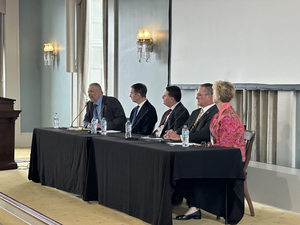
The Nebraska Board of State Canvassers, composed of State Treasurer Joey Spellerberg, Secretary of State Bob Evnen, Gov. Jim Pillen, Attorney General Mike Hilgers and Auditor of Public Accounts Mike Foley, from left, meets to certify Nebraska's May 12 primary election. June 8, 2026. (Zach Wendling/Nebraska Examiner)
LINCOLN — Nebraska’s top state officials finalized the state’s May primary election results Monday, which also set a countdown clock on when one such official will leave his post.
The Nebraska Board of State Canvassers, composed of the governor, attorney general, secretary of state, treasurer, and auditor of public accounts, voted unanimously to certify the May 12 election. The typically routine procedure of making vote totals official continued to be uneventful this year, even as the state’s elections became a central issue in one primary race.
Nebraska Secretary of State Bob Evnen, the state’s top elections official, certified his own defeat to Republican businessman Scott Petersen of Omaha. Petersen has echoed President Donald Trump in calling for changes to how the state runs its elections.
Evnen will leave his office after eight years come January. He said the May 12 election ran “very smoothly” with very few problems statewide.
‘The gold standard’
Evnen credited the election success to his office and local election commissioners and county clerks, telling the Nebraska Examiner after Monday’s meeting: “Nebraskans really owe them a debt of gratitude for the outstanding work that they do in conducting our elections.”
“They did so very well, as we anticipated,” Evnen told his colleagues Monday. “Nebraska is and remains the gold standard for the conduct of elections by states in the United States.”

Deputy Secretary of State Wayne Bena told the constitutional board that in his approximate 16 years conducting elections at the county or state level, this was “probably the smoothest election I’ve seen from start to finish.”
“Very little issues in regards to ballots and proofing leading up to the election, and a very quiet election day across the State of Nebraska,” Bena said.
Barring candidates dropping out or nonpartisan candidates petitioning to get on the Nov. 3 general election ballot, candidates are now set across four federal races, the various state-level constitutional offices, 25 legislative districts and seven state education races, among others.
Evnen’s final six months
Evnen told the Examiner that Nebraskans had gone to the polls and spoken. He noted turnout was “very low,” at 28.5%, and encouraged all voters to participate more in the future. He predicted a “lot greater participation” in November.
Asked whether he had endorsed Petersen, a fellow Republican, for the secretary of state’s post, Evnen said, “I haven’t made any endorsements in any races.”

Change in who oversees come next year in Nebraska is guaranteed after Petersen beat Evnen by more than 16,500 votes and more than nine percentage points, despite Evnen being the incumbent secretary of state and having outraised and outspent Petersen.
Petersen has pledged to seek changes, and Republicans have credited his win to tapping into some Republican voters’ concerns about election integrity, in part since Trump falsely claimed he won the 2020 presidential election. Experts and local election officials, including Evnen and others in Nebraska, have said voter fraud is exceedingly rare.
Petersen’s opponent, Democrat Sarah Slattery of Plattsmouth, a small business owner and professional chef, has said she wants to bring “neutrality back” to the office. The two will face off in the Nov. 3 general election.
Evnen will sit on the canvassing board one last time in December to certify the general election.
Of his final six months as the state’s top elections official, Evnen said Nebraskans can expect the “same thing that they’ve expected of me the whole time that I’ve served.”
Election verification
According to the canvassing board’s official report, there was only one reported election problem during the May 12 primary, and it didn’t change election results.
That was in Washington County, where election officials noticed, shortly after early voting ballots were issued, that the Learning Community Coordinating Council Subcouncil 1 contest had been mistakenly included on all ballots in the county, instead of the four ballot types where voters could vote in the nonpartisan election. Revised ballots were created for all affected voters.

The specific coordinating council subdistrict included four candidates vying for four nominations to the Nov. 3 general election, so the error did not affect the outcome of the race.
Bena also provided the results of a manual hand-count that the Secretary of State’s Office does after all state elections. In this case, the office selected a random sampling of 3% of the state’s 1,322 precincts, or 40 precincts, and manually hand-counted one federal race, one state race and one local race, as chosen by the county election office, in each precinct.
In total, 7,317 ballots were hand-counted across 37 counties, and there were just three discrepancies, Bena said. One was a “hesitation mark” that might have been counted differently versus the machine count, and two more likely “missed ballots” in another county.
“An error rate of four ten-thousandths of one percent,” Bena said, or 0.0004% of the votes.
Said Bena: “Our election ballot counting machines are accurate and doing the job that they’re supposed to do.”
After this November’s general election, state election officials plan to repeat the process and randomly sample 10% of precincts, including at least one in each of Nebraska’s 93 counties.
Lincoln, NE