Skepticism looms as an obstacle over Alaska Legislature’s special gasline session
May 21, 2026 | 9:00 pm ET
Description
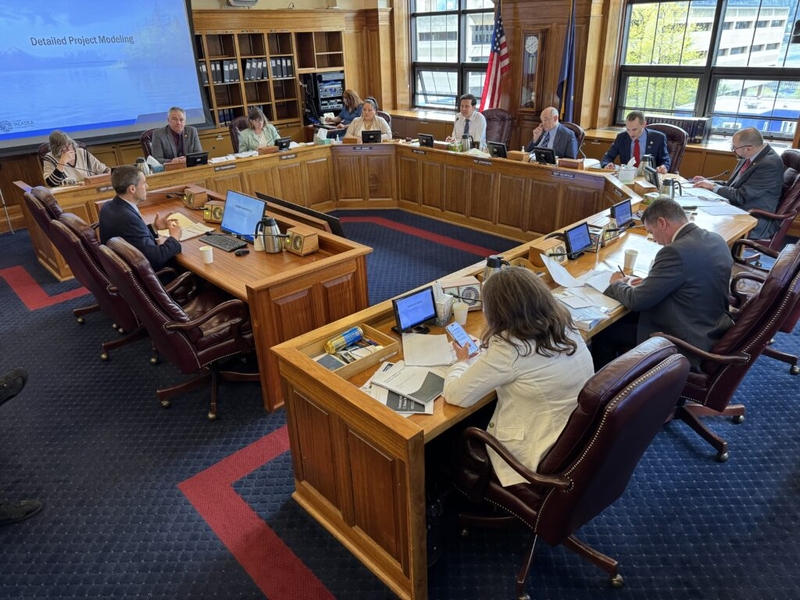
The House Finance Committee meets Thursday, May 21, 2026. (James Brooks photo/Alaska Beacon)
The Alaska Legislature on Thursday opened a 30-day special session on a proposal to cut taxes on the proposed trans-Alaska natural gas pipeline in order to encourage its construction.
Gov. Mike Dunleavy called the session, but one of the first challenges facing him and other tax-cut proponents is convincing skeptical legislators that a tax break is needed at all.
During the just-concluded regular session, lawmakers were unable to pass any version of a Dunleavy-backed bill.
While Dunleavy and pipeline developer Glenfarne have called the tax break a critical step toward construction, senior legislators have reason for skepticism.
To date, Glenfarne has not released an updated estimate for how much the pipeline will cost. The last public estimate is more than a decade old. It also has not released estimates for the price of gas to be carried by the pipeline.
“There’s that whole thing about buying a pig in a poke,” said Senate President Gary Stevens, R-Kodiak. “That’s the problem we’re facing. The farmer buying a pig in a bag has never seen the pig, never known how healthy it was. And that’s what we’re being asked to do. We’ve got to see the pig, we’ve got to know the details, and that’s what I think you’ll be seeing in our finance committee this coming special session.”
The pipeline project, formally called Alaska LNG or AKLNG, envisions an 800-mile pipeline from the North Slope to Cook Inlet.
At the northern end would be a gas treatment facility that collects gas from feeder pipelines connected to oil and gas wells across the North Slope.
That facility would strip carbon dioxide from the raw natural gas, allowing the gas to be shipped down the pipeline. The carbon dioxide would either be released into the atmosphere or injected deep underground.
At the southern end of the pipeline would be an export terminal on the Kenai Peninsula. The gas would be kept super-cooled and loaded onto tankers for shipment to Asia and other users.
Glenfarne envisions construction in two phases. The pipeline and a small North Slope gas treatment plant would be built between 2027 and 2029 during the first phase. That would allow limited amounts of gas to be shipped south for in-state use.
The second, more expensive, phase would involve constructing the export terminal on the Kenai Peninsula and the full-scale processing plant on the North Slope.
The state-owned Alaska Gasline Development Corp., which owns 25% of the project, has previously estimated that both phases will cost a combined $46 billion, but that prediction is more than a decade old.
During the just-completed legislative session, legislators heard estimates in excess of $65 billion, and Glenfarne officials said the first phase alone will cost in the “mid teens” of billions of dollars.
In a presentation to the House Finance Committee on Thursday, the Alaska Department of Revenue estimated that under the state’s current petroleum property tax system, AKLNG gas would have to sell to international buyers for at least $7.63 per thousand cubic feet (mcf) in order for the project to make financial sense.
Southcentral Alaskans would expect to pay at least $4.09 per mcf.
The governor has proposed cutting the property tax and partially replacing it with a tax on gas through the pipeline. That cuts expected state revenue by $7 billion through 2063. Cities and boroughs who collect the bulk of the property tax revenue would lose out on another $13 billion during that period.
The Department of Revenue expects that the tax breaks would cause the break-even price for the pipeline to fall to $7.13 mcf for exports and $3.73 for Alaskans.
In 2024, Canadian consulting firm Rystad Energy conducted a study of planned LNG projects in North America. The break-even prices for Canadian projects ranged between $7.18 and $8.64 per mcf, it found.
While AKLNG fits in that range under Glenfarne’s stated pipeline cost, it becomes more expensive if the pipeline construction is more expensive than Glenfarne has publicly stated.
Demand for Cook Inlet natural gas is beginning to surpass available supply, and Southcentral Alaska could begin importing gas soon to fill the gap.
Dan Stickel, chief economist for the Department of Revenue, told legislators Thursday that the department’s estimate for the cost of imported gas in 2033 — AKLNG’s planned completion date — “came to about $17 per thousand cubic feet price range.”
He said the department based that figure on an estimate compiled by ENSTAR in 2023, extrapolated to 2033.
Even if the pipeline is significantly more expensive than planned, in-state gas prices would be cheaper with AKLNG than without it, those estimates show.
But that’s only if the pipeline project is built to completion, effectively allowing exports to subsidize the cost of in-state gas.
The risk is if only Phase 1 is built. In that scenario, the Department of Revenue estimates, Southcentral Alaskans could end up paying more than $27 per mcf under current law and almost $23 per mcf under the governor’s proposal.
Last year, Mike Chenault — a former Speaker of the House and now a member of the board for AGDC — advised legislators that they should not take any action on legislation for the pipeline.
Uncertainty would deter investors, he said.
“I believe that if the Legislature gets involved, that this project will go away,” he said. “I believe that if we start changing the terms of the statutes, then that creates indecision and that will cause the project to possibly go away.”
In a news conference with reporters on Wednesday, Sen. Bill Wielechowski, D-Anchorage, said he recalls a Glenfarne representative saying last year that no tax breaks were needed.
Wielechowski could not provide a source for that comment, nor could five other legislators who recalled a similar position.
Speaking Thursday during the Alaska Sustainable Energy Conference, Glenfarne CEO Brendan Duval offered conflicting statements about the pipeline’s financing.
At one point, he said that he had sufficient investments to construct the first phase without any tax break.
“I can confirm I’ve received enough proposals of private financing on terms and conditions that once we convert that into long form documentation, we can build the domestic pipeline, and that’s very exciting,” he said.
Speaking about the project as a whole, he said that once he finishes finalizing the terms of some agreements, “I can make a final investment decision here.”
The agreements “possibly” include “this tax bill out of Juneau.”
Later, talking with Dunleavy, he said the tax bill is “a critical condition” for pipeline construction, as is a gas-purchase agreement with ENSTAR, the middleman that supplies most of Southcentral Alaska with natural gas.
“Please talk to your, your mayors, your elected officials, your legislators, your community leaders, your union leaders, and get them behind (this) to call to arms. Let’s get this thing over the line, and we can get this state the gas that it needs right now,” he said.

Juneau