Rough road ahead for bill requiring utilities to coordinate with state repaving work
Apr 10, 2024 | 3:09 pm ET
Description
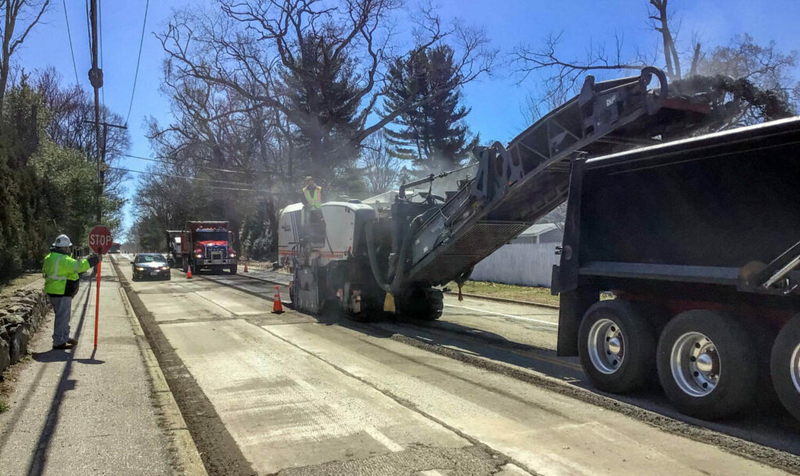
Road crews repave Route 1A in North Kingstown in this file photo. (Courtesy Rhode Island Department of Transportation)
Gov. Dan McKee blocked a bill last fall from becoming law that would have required utility companies to coordinate road repair projects with state road repaving work.
A revised version of the legislation aimed at reducing how often state roads get torn up has returned to the Rhode Island State House. Again, it’s hit a rough patch.
Rhode Island Energy and Verizon in separate letters to the Senate Finance Committee on Tuesday urged lawmakers to reject the proposal, sponsored by Sen. Robert Britto.
Whether their pleas will again persuade McKee to exercise his veto power remains unclear. In an emailed statement Tuesday, Olivia DaRocha, a spokesperson for McKee’s office, was noncommittal.
McKee vetoes roadway repair bill over objections from utility companies
“Should this bill move through the General Assembly this year, the Governor will review the version that reaches his desk,” DaRocha said.
Britto, an East Providence Democrat, is undeterred. On Tuesday, a couple hours before a State House hearing on the bill, he maintained the bill was a good one, worth trying to pass again.
“All I am looking for is communication and coordination,” he said. “These are reasonable requests.”
The proposal is modeled after a local resolution passed by the East Providence City Council, where Britto served as a member before he was elected to state office in 2022. As written, the state legislation aims to stop newly repaved state roads from being dug up for utility work, requiring utility companies to coordinate their long-term projects with the Rhode Island Department of Transportation.
If the work schedules don’t align, or an emergency occurs, utility companies can ask for a waiver to do their work anyway.
Emergency situations, or those reliant on federal funding, are also exempt from restrictions preventing work in newly repaved roads. In ordinary circumstances, however, utility companies that dig up recently refinished state roads risk financial penalties, imposed at the discretion of the state transportation director.
The 2023 legislation also stipulated utility companies could not pass on the costs of road repairs to customers or ratepayers, a clause which rankled companies like Rhode Island Energy and Verizon. That provision was removed from this year’s version of the bill.
The 2024 legislation also reduces the scope of the long-term project schedule that utility companies would have to provide to the state, from a five-year outlook to two years.
Still, neither Rhode Island Energy or Verizon are satisfied.
“Importantly, the absence of any standards for determining the existence of an “emergency situation” or for calculating a penalty for roadway alterations where no emergency existed would prevent courts from effectively considering whether DOT acted arbitrarily, capriciously or beyond the bounds of its delegated authority,” Nicholas Ucci, government affairs director for Rhode Island Energy, wrote in an April 9 letter to lawmakers.
Michele Cinquegrano, regional director of Verizon, expressed similar concerns in a separate letter.
“Curtailing business activity just to preserve a road surface is very poor policy that curtails business and residence needs,” she wrote.
Both companies also said they already communicate regularly with the state transportation department to discuss project schedules, making the legislation unnecessary.
No one spoke in favor or against the bill during the hearing Tuesday night. The bill remains under review in the Senate Finance Committee.
No companion legislation had been filed in the Rhode Island House as of Wednesday, though Britto said he expected that Rep. Mary Ann Shallcross Smith, who sponsored the legislation last year, would submit one shortly.
Shallcross Smith, a Lincoln Democrat, did not return calls for comment on Wednesday.
If approved, the legislation would take effect Jan. 1, 2026.
Providence, RI