One year after high-profile ICE raid, Omaha immigrant advocates say community not safer
Jun 09, 2026 | 9:11 pm ET
Description
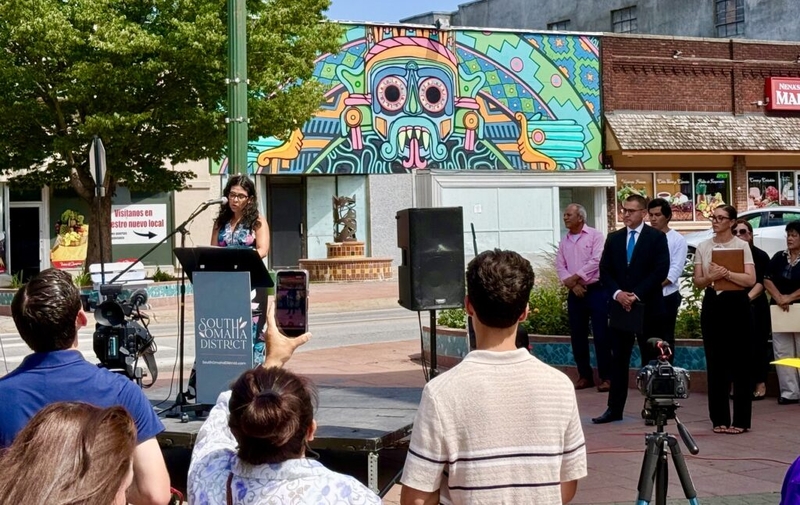
Lina Traslaviña Stover is among a slate of speakers at a South Omaha rally reflecting on the impact of an ICE raid a year ago. (Cindy Gonzalez/Nebraska Examiner)
OMAHA — A year has passed since roughly 80 federal and local agents plus a canine unit converged on Omaha’s Glenn Valley Foods and in buses hauled away roughly 75 undocumented workers. It was the biggest immigration raid in Nebraska since 2018.
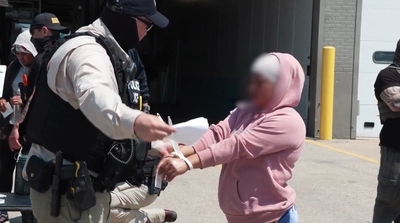
U.S. Immigration and Customs Enforcement, which invited a national TV crew to film, at the time emphasized the Trump administration’s priority to “protect the nation’s workforce” and hold employers accountable for encouraging illegal immigration.
ICE officials touted a focus on “identifying public safety and national security threats.”
Tuesday, however, a group representing elected officials, service-providers and immigrant advocates held a news conference to collectively say the June 10, 2025 raid and ongoing enforcement tactics have not made their community safer.
“If they’re meant to make our community safer, they’re not doing that,” said Douglas County Board Chair Roger Garcia. “They do the opposite by taking breadwinners away, detaining moms, creating tension.”
He told the Nebraska Examiner that he and others believe drug dealers and violent people should “by all means” face legal consequences.
But seven speakers, including Omaha Mayor John Ewing Jr., reflected on ways the Glenn Valley raid — and, more broadly, President Donald Trump’s evolving and ramped up immigration policies — have impacted immigrant families and the city overall.
Waning commerce
A long burn, merchants said, has been a hit on business activity in South Omaha, an area traditionally known as the landing place of immigrants.
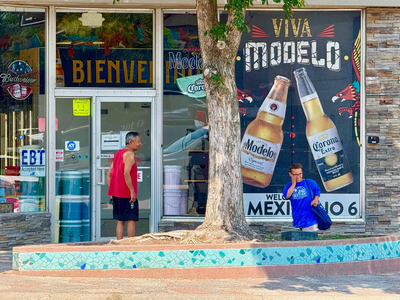
As one response, the group announced an effort, Dia de Alegria, or Day of Joy, that will take place Wednesday to bring attention and business to the South Omaha historic business district. Tours, live music and other activities will be featured. Ewing also proclaimed June “Immigrant Heritage Month.”
Ewing, a Democrat, noted that the Glenn Valley raid took place one day after he was sworn in and he said it became his first challenge as mayor. His election ousted Jean Stothert, a Republican who was seeking her fourth term.
The mayor echoed others in urging federal officials to adopt a “comprehensive and humane immigration policy” that includes a path to legal citizenship for nonviolent migrants.
Of the Tuesday rally-like event at La Plaza de la Raza, Ewing said: “This is about making Omaha the best and most inclusive community we can make it.” He said he wants the city to rebound from “damage” of the ICE enforcement and build hope.
Roxana Cortes-Mills, legal director at the Center for Immigrant and Refugee Advancement, noted that the Glenn Valley raid was rooted in an investigation about alleged stolen or fraudulent identities and Social Security numbers to work. Federal officials have said a March 2025 audit pointed to 107 suspicious documents and triggered the worksite enforcement.
In the end, available public documents showed only one Glenn Valley worker charged and convicted of an identity fraud-related crime.
Some workers self-deported rather than stay in jail or go through further proceedings to try and stay. Others eventually were allowed out on bond to be with families while they build legal cases.
Glenn Valley Foods was never charged criminally. Company executives said they used the federal E-Verify system for hiring.
Uncertainty continues
To Cortes-Mills, the results point to a misuse of limited public funds. She said most of the detainees were accused of civil violations, not criminal or fraudulent activity.
“They didn’t deliver 70-something criminal convictions,” Cortes-Mills said in an interview.
Three months after Omaha raid: One ICE detention chapter winds down, another heats up
“The result was they startled an entire community and at least for a period of time split apart families that staffed operations in a large packing plant in a city that produces meat for the entire country. And it spread fear.”
Uncertainty continues for migrants, she said, as shifting policies and practices have put people of different legal statuses in fear of removal.
ICE did not respond to a reporter’s request for comment, nor did the U.S. Attorney’s Office in Nebraska, which worked on the Glenn Valley cases. Gov. Jim Pillen’s Office did not respond to a query Tuesday, though last year after the raid he said he backed federal partners and blamed the Biden administration’s past policies for a border crisis.
Pillen later said that he saw a problem at the Glenn Valley operation because of “concentration of folks doing criminal activity of stealing people’s ID — that’s a grave offense.”
Lina Traslaviña Stover, executive director of the Heartland Workers Center, said during the rally that her team witnessed first-hand pain of family separations. She said families continue to be “villainized” and live with fear and instability.

“We saw young people take on responsibilities far beyond their years, becoming providers and caretakers for their households. We watched hardworking Nebraskans live with the fear that a simple drive to work, school or a doctor’s appointment could change everything.”
But there is a resilient effect as well, Stover said. Organizations including hers, the Center for Immigrant and Refugee Advancement, and the American Civil Liberties Union of Nebraska, continue to help affected families.
Families are creating “safety plans” to protect their children in case a parent was detained, she said. Young people such as Luis Mejia have been motivated to take action.
Caring for siblings
Mejia, 20, was among the speakers. He said on June 10 last year he and his mom went to work thinking it would be a “normal day” until ICE agents entered and he saw some people run.
“My mom hugged me and told me to take care of my younger siblings,” Mejia said.

He eventually was escorted outside after an officer asked him for proof of citizenship and ran his name through a computer. “I was born here, I don’t know what you need from me,” Mejia recalled saying.
Mejia drove around the plant looking for his mom, who was in ICE custody. “Suddenly my (three) siblings and I were without our mom, and I felt responsible for stepping up and taking care of them as my mom was our sole provider.”
For a month, the mother was detained with co-workers at a North Platte jail four hours away. She eventually was released on bond while she fights deportation.
Luis Mejia said he has since gotten involved with Heartland Worker to help other families. He registered to vote and said he will be voting for the first time in November.
Among those clapping for Mejia were state Sens. Margo Juarez and Dunixi Guereca, both of Omaha. Also in the group was former state lawmaker Tony Vargas.
Laura Contreras, board president of the Latino Economic Development Council, encouraged the gathering to support and shop South Omaha businesses during the Day of Joy, which will feature music and activities based at the plaza.
The event is billed as a dedication to transforming hardship into opportunity.
Lincoln, NE