Report shows small improvement in child wellbeing, but Oklahoma still lags behind other states
Jun 08, 2026 | 4:24 pm ET
Description
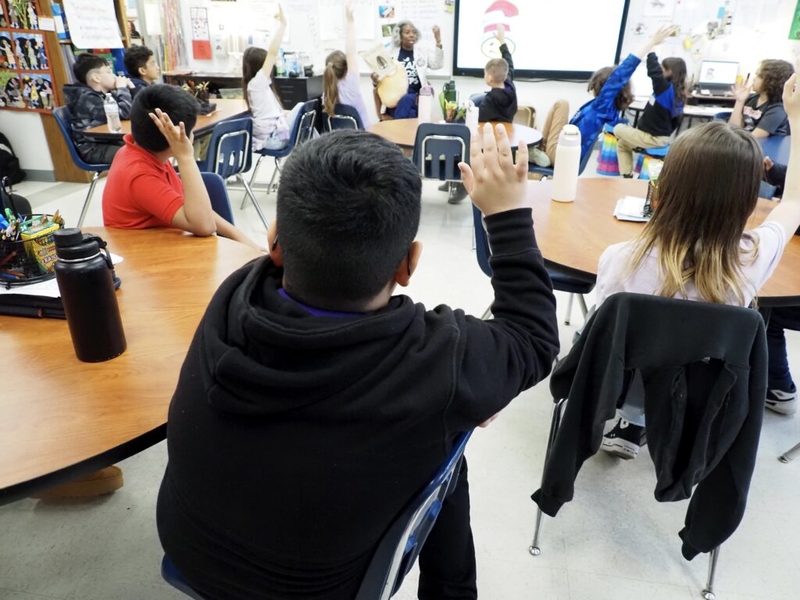
Students raise their hands in a fourth-grade classroom at Cleveland Elementary in Oklahoma City on March 6, 2026. (Photo by Nuria Martinez-Keel/Oklahoma Voice)
OKLAHOMA CITY – Oklahoma has made slight progress in improving overall child wellbeing, according to a new report, but still ranks as one of the worst states in the country for education and other factors.
In its annual Kids Count report, the Annie E. Casey Foundation ranks child wellbeing in each state. It uses metrics like economic status , education, health and family and community outcomes to assess each state. This year, Oklahoma tied with Texas at 44th overall, a small improvement from 46th in last year’s report.
Nevada, Alaska, Louisiana, New Mexico and Mississippi ranked below Oklahoma. This year’s ranking uses data from 2024, the most recent available.
“These rankings aren’t inevitable,” said Carly Putnam, the policy director at the Oklahoma Policy Institute. “They reflect decisions about what we choose to prioritize and invest in. And what these rankings show is that we are not investing in children and families, and that’s being borne out in the results.”
Oklahoma’s best ranking, and the category it made a 10-state jump in this year, is economic wellbeing. Putnam highlighted lower housing prices as one factor leading to the improvement, but also noted the state’s high eviction rates as a limit to economic wellbeing.
She also pointed towards bills the Legislature nixed this session that could have improved economic wellbeing. Measures that failed included a bill to require mediation in eviction cases involving children, a proposal to lengthen the timeline for evictions and bill outlining legal recourse if a landlord does not honor a contract, she said.
The state’s worst ranking was education. Oklahoma ranked 48th for the second year in a row.
“It is frustrating to see that year after year, and it’s dejecting to know that so many Oklahomans are facing these struggles,” said Joe Dorman, the CEO of the Oklahoma Institute for Child Advocacy.
Dorman said he is optimistic that some laws passed this session can improve the state’s future rankings. He noted increased funding towards reading resources for young students and the state’s new extended foster care program as two positive measures.
Oklahoma made a positive jump in its health score. It is now ranked 37th in the country, compared to 43rd last year, and has seen some improvements in the insurance rate for the state’s children. Putnam pointed to long term enrollment on Medicaid following the COVID-19 pandemic and Medicaid expansion as two positive factors.
However, she warned that new federal changes to Medicaid and SNAP could result in many Oklahomans losing benefits, which could harm the state’s health score in the future. Both the Oklahoma Department of Health and Healthcare Authority asked for more money to manage these issues, Putnam said, but they did not receive their full request.
“We could be doing worse, but I’m afraid that by consistently underfunding and under-resourcing ourselves, we’ve almost made that inevitable,” Putnam said.
The foundation this year issued a new comprehensive score for each state based on 16 indicators of wellbeing. Oklahoma received an overall score of 425 out of 1,000, coming in 122 points below the national average.
Oklahoma hasn’t ranked better than the bottom fifth in a Kids Count ranking since 2018, Putnam said. Putnam and Dorman emphasized it will take time for policies to impact child wellbeing and improve the state’s scores, but both encouraged lawmakers to invest in Oklahoma’s youth.
“If lawmakers are looking at education and healthcare and family stability not as just expenses to be cut, but as investments that create long-term returns, I think we have a whole different ball game,” Putnam said.
Dorman said that though it is “daunting” to try to improve all the state’s poorly-ranked categories, groups like OICA and lawmakers need to keep pushing for better outcomes for the state’s children.
“It’s going to take a generation of effort to try and see improvement,” Dorman said, “working with families, working with these children, working with policymakers to see what’s best for families in Oklahoma.”
Oklahoma City, OK