Report: Arkansas child well-being improves in some areas but lags behind overall
Jun 08, 2026 | 6:00 am ET

Description
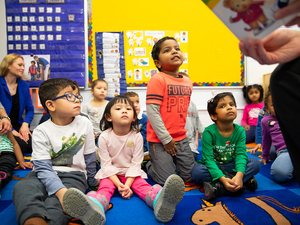
A child care teacher and four children use rainbow-colored educational toys. (Photo from Getty Images)
Child well-being in Arkansas has improved in some areas but backslid in others, according to an annual report released Monday by the Annie E. Casey Foundation.
After ranking in the bottom five for several years, Arkansas improved to 43th nationwide for childhood wellbeing based on the 2026 KIDS COUNT Data Book’s analysis of 2024 data.
Researchers with Arkansas Advocates for Children and Families, a member of the Casey Foundation’s KIDS COUNT network, said the data shows room for more improvement. With federal cut to benefit programs looming, advocates urged state policy changes focused on child health and education.
The report measures child well-being in four categories: education, health, economic well-being, and family and community. Arkansas improved in two categories from 2023 to 2024 and fell in the others.
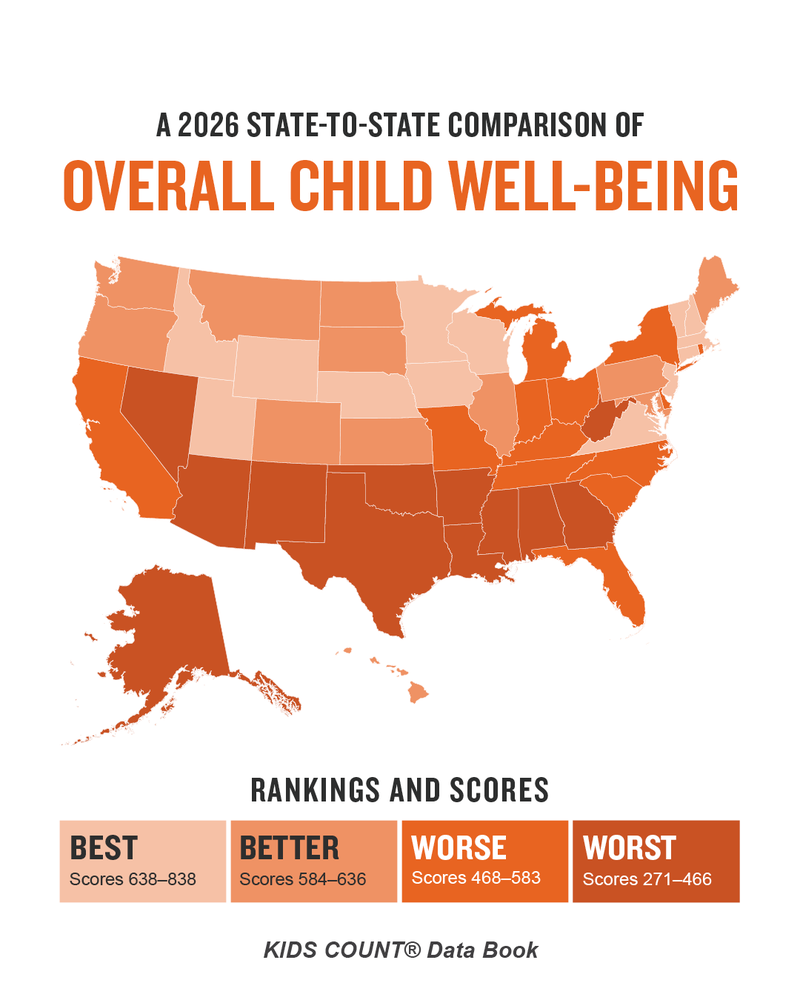
The report ranked Arkansas:
- 40th in education, down from 36th
- 33rd in economic well-being, up from 45th
- 45th in family and community, up from 46th
- 48th in child health, down from 47th
Improvement in these areas is an uphill battle, AACF administrators told reporters in a Wednesday news conference.
The federal tax and spending cuts measure known as the One Big Beautiful Bill Act of 2025 slashes rural Medicaid spending by $15.5 billion annually over the next decade and eventually puts Arkansas on the hook for $24 million more in Supplemental Nutrition Assistance Program spending. The impact won’t be reflected in data for another few years.
Fewer families are participating in Medicaid and SNAP, said AACF Economic Policy Director Pete Gess, who noted the data also doesn’t capture ongoing affordability challenges caused by high rates of inflation.
“It’s safe to say it’s time for the state to really invest and focus on policies that lift children out of poverty,” Gess said.
Arkansas’ high percentage of uninsured children and low pre-K spending are particularly concerning because the state used to actively invest in those issues, AACF Executive Director Keesa Smith-Brantley said.
“Logically, as we stopped making investments, we are going backwards on the things that we had formerly prioritized,” Smith-Brantley said.
Healthcare and childcare
Arkansas’ rate of uninsured children held steady at 6% from 2019 to 2022, but increased to 7% in 2023 and 8% in 2024, according to Casey Foundation data. This increase is “one of the clearest examples of Arkansas losing ground after years of progress,” AACF Health Policy Director Camille Richoux said.
“We’ve not made enough effort to ensure families know about and are able to actually enroll in programs like ARKids First,” she said.
Then-Gov. Mike Huckabee, father of current Gov. Sarah Huckabee Sanders, signed ARKids First into law in 1997. The insurance program covers children whose families make too much money to be eligible for Medicaid but not enough to afford private health insurance.
The One Big Beautiful Bill Act’s Medicaid cuts will likely leave more Arkansas children uninsured, because children are less likely to be covered if their parents are not covered, Richoux said.
It’s safe to say it’s time for the state to really invest and focus on policies that lift children out of poverty.
Arkansas also consistently has among the highest rates of maternal and infant mortality nationwide but remains the only state that has taken no action to adopt the federal option of extending postpartum Medicaid coverage from 60 days to 12 months after birth. AACF has repeatedly urged state lawmakers to adopt this policy. More than half of Arkansas births are covered by Medicaid.
Additionally, more than 43,000 children aged 3 and 4 were not in early childhood education programs in 2024, a slight increase from 2023.
The Arkansas Department of Education made moves last year to change both the reimbursement rates and families’ copayments for its financial assistance program for low-income families to access childcare. Providers expressed concern that the changes would make childcare unaffordable for those families, and the state and providers reached a compromise in November.
Last month, the federal government rescinded a requirement that no more than 7% of a family’s income should be spent on federally-funded childcare. In Arkansas, families spend between 8% and more than 35% on childcare, “which is just completely unsustainable,” AACF Education Policy Director Nicole Carey said.
Child care costs preventing Arkansas mothers from seeking or retaining full-time work, report says
The average cost of childcare in Arkansas is $17,500 per year for a family with two young children, or 27% of Arkansans’ annual median household income, according to a report released in March by the Women’s Foundation of Arkansas.
Smith-Brantley noted that Arkansas officials regularly cite the state’s budget surplus as a reason to continue phasing out the income tax. AACF’s policy recommendations based on the report include urging the state to stop cutting tax revenue that could be used for supportive services such as childcare assistance.
Small gains lag behind national trends
Just under 13,000 Arkansas teenagers were neither working nor attending school in 2024, a decrease of roughly 4,000 from 2023, and Arkansas’ child and teen death rate improved from 300 to 260 per 10,000.
Arkansas’ teen birth rate dropped from 24 to 22 births per 1,000 females aged 15 to 19 in 2024. The national teen pregnancy rate remains at 13 births per 1,000 females, and Arkansas has the second-highest teen pregnancy rate behind Mississippi.
The number of Arkansas children in households where no parent has full-time year-round employment decreased by more than 18,000 from 2023 to 2024, according to the report.
Arkansas’ child poverty rate is decreasing but lags behind the nation as a whole, Gess said. In 2024, one in every five Arkansas children lived in poverty, measured at an annual income below $31,812 for a family with two adults and two children, according to the data.
More than 8,000 Arkansas children’s families spend more than 30% of their income on housing, a major concern for Gess.
“Arkansas has a relatively low cost of living, so this really indicates that wages in our state are not keeping up with basic needs such as shelter,” he said.
AACF’s policy recommendations include establishing a state-level child tax credit. The federal government implemented a child tax credit in response to the COVID-19 pandemic, but the initiative expired in 2022.
Little Rock