New partnership brings college and career resources to Detroit neighborhoods
Aug 10, 2026 | 4:00 am ET
Description
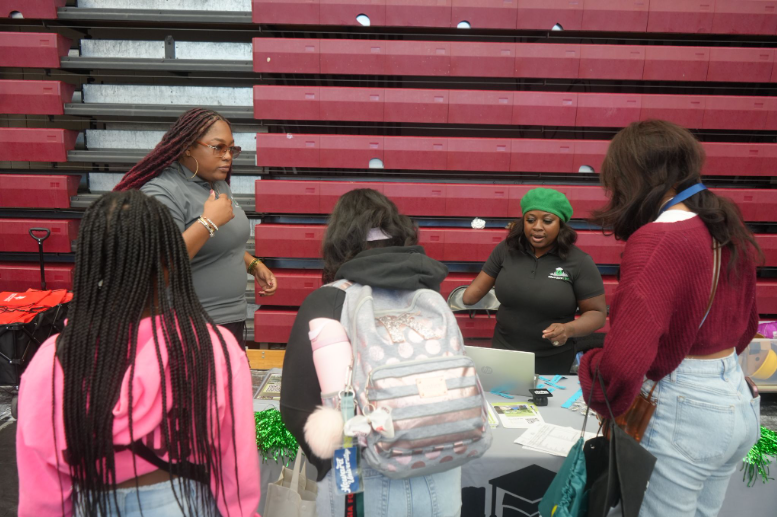
Kendra Agee, program Director, and LaTonia Gee, program manager for Graduate 313, assist students with college access support during Detroit Onsite Admissions Day. Photo by Lance Knight.
A new partnership in Detroit will provide middle schoolers through adult learners with access to resources designed to help residents enter and complete college, with hubs expected to open on the city’s east and west sides this fall.
Graduate 313, a partnership between the Jamie and Denise Jacob Family Foundation and Detroit College Access Network, aims to expand educational opportunities for Detroiters in what organizers describe as a first-of-its-kind, neighborhood-based college and career success initiative backed by a $3.5 million investment.
After exhausting the model of supporting what most organizations refer to as a “college coach” that walks program participants through the college experience, the Jacob Family Foundation is supporting DCAN, which has worked to ensure equitable access to postsecondary education for Detroiters since 2012, as it launches Graduate 313.
The new model will deliver college and career resources directly within Detroit neighborhoods, Jacob Family Foundation Executive Director Megan Fenkell said, funding an initial three-year investment with additional help from partners including the General Motors Foundation and Rocket Community Fund.
“We wondered what would happen if there was a place in Detroit that students all the way from middle school to adult learners could go where they could get the support to get to and through college (or) return to college,” Fenkell said. “DCAN is the intermediary, and quite frankly, the leader in Detroit when it comes to all things college-going. So, it just seemed like the natural fit for us.”
Graduate 313 will launch this fall with a flagship office for Graduate 313 and DCAN programming on the city’s west side in a building located near the intersection of Plymouth and Evergreen roads.
On the east side of the city, Graduate 313 will occupy space in the former Winans Academy of Performing Arts building as an “impact partner” within Anchor Detroit, a community hub developed by Life Remodeled.
After a year of advising, the initiative is now fully-staffed and will begin offering services inside physical buildings. Services will include one-on-one-advising, emergency grants, wraparound services and college field trips that will either allow Graduate 313 to connect with a school, nonprofit or out-of-school time partner to take students to college campuses in the area or bring colleges to their physical locations.
Along with resources, DCAN Senior Director of Community Hubs Jasmine Brooks said Graduate 313 is modeled to provide locations that are accessible by walking, car or city bus routes based on “asset mapping” that determined locations that would be most beneficial to Detroiters.
“As a native Detroiter, you don’t necessarily operate in silos, but residents that live on the west side, that’s where they kind of stay put,” she said. “Those that live on the east side or southwest Detroit usually stick to the neighborhood in the area where you’re most comfortable in.
“We want to change that trajectory by having these neighborhood hubs across the city, so that no matter where you live, you have somewhere in your neighborhood — in your backyard — where you’re able to go and access college access resources and an opportunity to then also persist and actually complete those credentials.”
Graduate 313 was launched with the intention of improving the City of Detroit’s access to and completion of college degrees. According to the U.S. Census Bureau, 18% of Detroit residents age 25 and older hold a bachelor’s degree. The initiative is aligned with helping boost that number toward Gov. Gretchen Whitmer’s “Sixty by 30” goal of having 60% of working-age adults earn a postsecondary college degree or skill certificate by 2030.
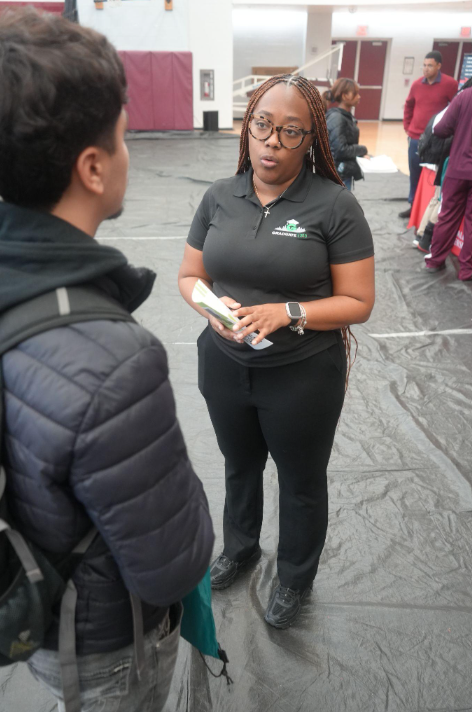
Graduate 313 will help address the challenges city residents young and old face by bringing resources closer to the communities that need them most, creating clearer pathways to college, career training and economic mobility, Brooks said.
Graduate 313 plans to measure success by tracking who’s coming through its doors, setting a goal of reaching 5,000 Detroit residents in its first year, Brooks said, with the intention of increasing that number year-over-year. This will be done by collecting data on who takes advantage of its services while assigning participants in the program to one of six advisors for high school, college and adult learners.
“We’re not only trying to connect them to credentialing and postsecondary planning, but we’re also trying to connect them to the resources that are preventing the barriers that they have right now,” Brooks said. “We want to help eliminate that.
“So I think it’s a unique position to be in, where we’re not just concerned necessarily just with our numbers — like we’ve got to hit a certain amount of people — but we really want to make sure that we’re touching people so that they spread the word that, ‘Here’s genuinely a staff of people that are going to connect me across the city of Detroit to people in places that I may not have had access to if I had not been connected through Graduate 313 and the Detroit College Access Network.’”
While the Jacob Family Foundation is on board for a three-year funding commitment, Fenkell said the foundation and DCAN also are actively fundraising to continue the effort past the three-year grant.
The foundation believes giving residents access to support that will help them get to “day one” of college in a setting that isn’t intimidating with help from people who are embedded in the community will help remove the barriers that could be the deciding factor in whether they decide to continue toward the completion of a degree, she said.
“We know that the student counselor ratio at the high schools is extremely off balance,” she said. “It’s just challenging to get the support easily. (Graduate 313 provides) a wide range of support that you’re not necessarily able to easily seek out on all college campuses.”
Lansing, MI