Morrisey: WV public school funding formula needs work, spending may not be the answer
Aug 09, 2026 | 6:56 pm ET
Description
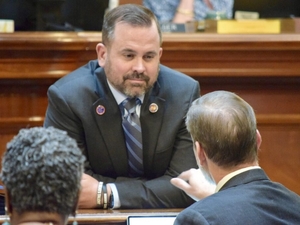
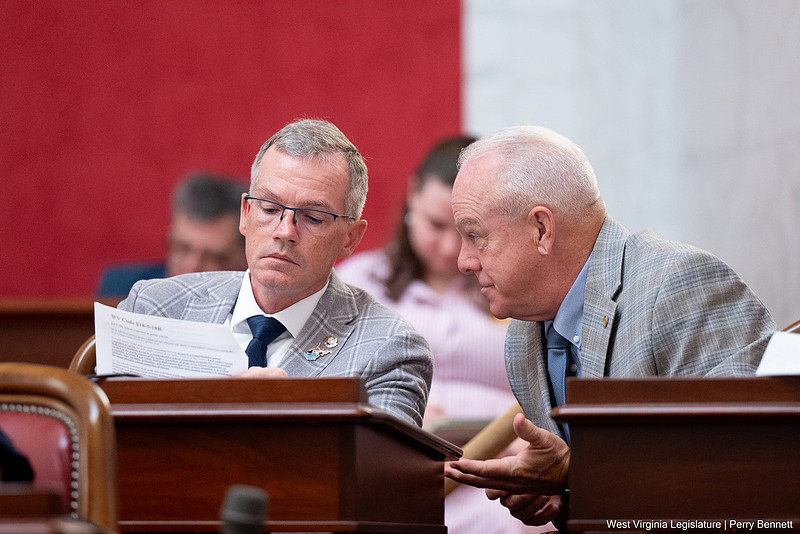
Sen. Eric Tarr, R-Putnam, and Del. Joe Parsons, R-Jackson, look over a presentation in the Joint Committee on Education on Aug. 9, 2026. (Photo by Perry Bennett/West Virginia Legislative Photography)
Gov. Patrick Morrisey’s team laid out his office’s ideas for revamping West Virginia’s school funding formula, a decades-old equation that has been linked to public schools’ dire financial situation.
Debate over the funding formula is expected to be a leading topic in the 2027 legislative session.
Morrisey’s office wants to see the formula simplified and more money directed to classrooms, but that doesn’t necessarily mean a hefty financial investment into public schools.
“The governor has a deep desire to strengthen public education. Everyone should share that desire,” said Curtis Capehart, who represented the governor’s office during a presentation to lawmakers on Sunday at the state Capitol.
West Virginia uses a seven-step formula to determine how much state funding goes to county school systems based on factors including the number of students enrolled.
State population decline coupled with students leaving public schools for the Hope Scholarship have put many counties in urgent money trouble. The growing number of special education students, which can require costly services, has also impacted schools’ budgets.
Since lawmakers adjourned in March, school officials have sounded alarm bells on worsening school finances, warning multiple counties are headed to insolvency. An additional 5,000 students have left the school system since October, and more school closures are expected.
“The current funding formula is, in a word, complex, relying on multiple steps of intricate calculations that very few people can understand at all,” Capehart told lawmakers. “This inadvertently obscures accountability, prevents everyone, including laborers and taxpayers alike, from readily understanding how funding is out. Any future reform should need to remove complexity in order to increase transparency.”
Morrisey wants to simplify the formula and keep money tied to the student, Capehart said, and the governor’s team believes that the funding formula’s focus on enrollment is one of its better features.
Any reform to the funding formula should be carried out in “a fiscally disciplined manner,” Capehart said.
“West Virginia ranks near the national average in terms of per pupil spending, but our education results do not. Many states spend substantially less per pupil than West Virginia does, but nonetheless, have significantly better outcomes,” Capehart said. “This demonstrates that injecting more money into the system, simply spending more, is not the answer.”
Financial resources should be focused directly into the classroom, according to Capehart.
The legislative session concluded in March without lawmakers making any changes to the school funding formula after debate on multiple bills to deal with the issue. Roadblocks often centered on funding concerns; a House bill updating the funding formula would have cost $214 million.
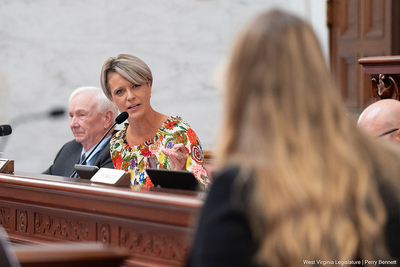
Capehart’s presentation was the first time lawmakers had heard this list of Morrisey’s education priorities, according to Senate Education Chair Amy Grady, R-Mason.
“Whenever we’re looking at education reform, and we’re looking at how we’re going to change that funding formula, the governor’s office is also a part of that,” Grady said. “We want to make sure that we are all connecting, that we’re all working towards the same goal, instead of you know the two of us working one direction and another one fighting against us.”
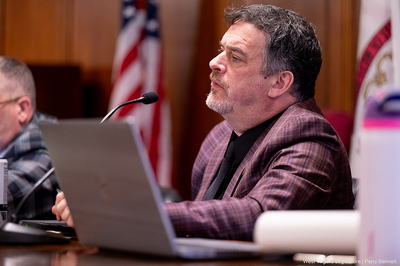
Del. Mike Pushkin, D-Kanawha, raised concerns about the Hope Scholarship, the state’s education voucher program, and its effect on public school finances.
More than 26,000 students have applied for full funding of the Hope Scholarship for the upcoming school year — the first year the program opens up to all West Virginia students. The program has cost the state of West Virginia an estimated $155 million so far after lawmakers allocated $277 million for the Hope Scholarship to account for any student who uses the program in the 2026-27 school year.
A $114,000 study paid for by the House recommended that the state put some guardrails on the Hope Scholarship spending — it has a broad list of allowable expenses, including out-of-state schools — in an effort to improve overall school finances.
“There’s no guardrails there, there’s no regulation there … that, by definition, would take money out of public education,” Pushkin said.
Capehart responded that he “was not here to speak about Hope Scholarship today.” Morrisey has been a staunch supporter of the education voucher program.
Capehart floated other ideas from Morrisey’s office to boost education outcomes in the state, including addressing teacher and staff pay. The National Education Association ranks West Virginia as 47th in the nation for average teacher salary.
“It would be in the long-term interests of the state to create a broad, competitive salary structure that draws more people to these educational professions and rewards,” Capehart said.
Charleston, WV