Democratic gubernatorial candidates split on education; advocates see next year as pivotal
Aug 10, 2026 | 4:45 am ET
Description
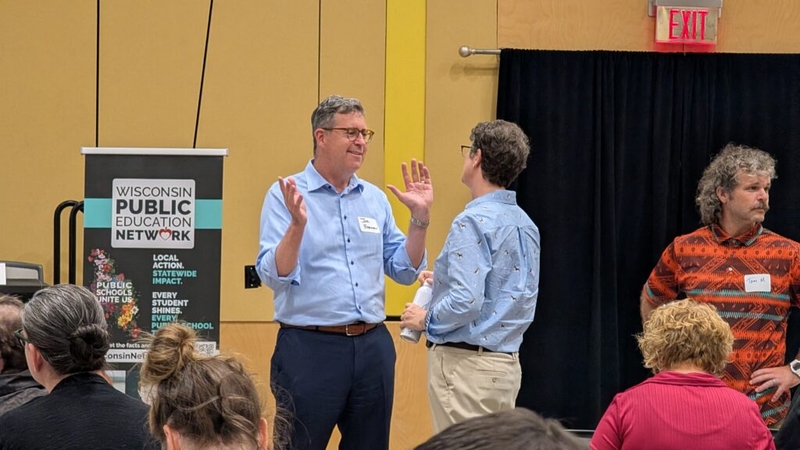
Former DOA Secretary Joel Brennan, who is running in the Democratic primary for governor, speaks with State Superintendent Jill Underly at the Wisconsin Public Education Network summit in Superior. Underly told the Wisconsin Examiner that school voucher programs are a “drain on our public education system,” but cannot be shut down overnight. (Photo by Baylor Spears/Wisconsin Examiner)
Amy Starzecki, administrator of the Superior school district in northern Wisconsin, detailed the financial difficulties her district has faced in recent years to a roomful of public education advocates gathered in the auditorium of Superior High School at the end of July.
Starzecki’s district had to transfer $6 million from its general fund to cover special education expenses that aren’t reimbursed by the state, she said, while at the same time coping with a 40% increase in healthcare costs. She said she was grateful that the community passed a referendum two years ago to help with costs, but it expires in 2029.
“I’m very nervous about whether we continue to push forward another referendum or whether it will pass, recognizing there’s fatigue in all of our communities and our families are experiencing the same inflation,” Starzecki said, adding that the school has taken steps to cut costs by closing a middle school and reducing administrative overhead.
“We feel very strongly that we need to be looking at the funding formula and making sure that we are addressing the increased inflationary costs and increasing the revenue tied to that so that we don’t have to go to referendum and close that gap,” Starzecki said. “We need to have a significant change in our special education reimbursement to stop from pulling from our operating budget in order to cover the cost of those expenses that those students need.”
Public education advocates have for years called on the Republican-led Legislature to significantly boost state aid to public schools.
The calls have gone unanswered by lawmakers, including this year when schools received no increase in their general aid from the state. But advocates see an opening for change with voters choosing both a new governor and electing candidates who will determine which party controls the state Senate and Assembly next year, along with a lawsuit challenging the constitutionality of the state’s school funding formula. A favorable decision for the plaintiffs in the lawsuit could require an overhaul of the formula by the Legislature and the new governor.
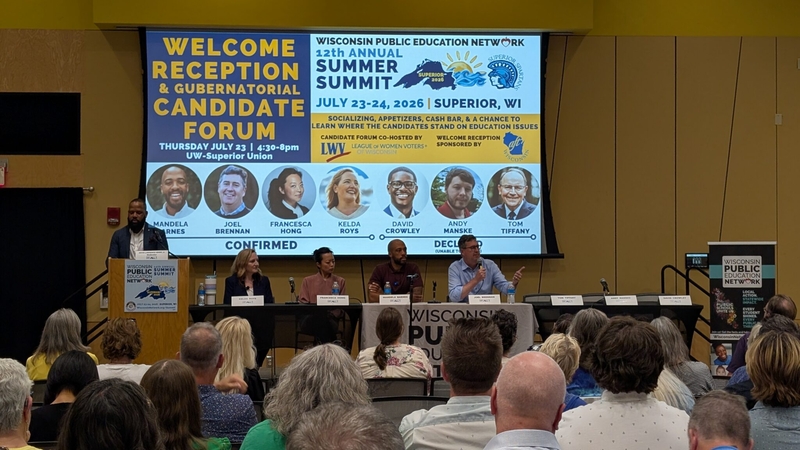
Democrats competing in the primary for governor, including Department of Administration Secretary Joel Brennan, state Sen. Kelda Roys and state Rep. Francesca Hong, participated in a forum in Superior during the annual Wisconsin Public Education Network summer summit at the end of July. Milwaukee County Executive David Crowley, who is also running, did not take part, nor did Republican candidates U.S. Rep. Tom Tiffany and Andy Manske.
All the Democratic candidates for governor have said they support increasing funding for the state’s public schools, raising the amount the state pays for special education and restoring the state’s guarantee to cover two-thirds of school costs. (Crowley, Hong and Roys have promised to work toward a 90% special education reimbursement rate from the state, while Brennan has said that 60% is the “the most reasonable” rate for the state to adopt immediately.)
Tiffany has also said he would increase school funding, including for special education, while cutting property taxes, including by overturning Evers’ 400-year veto of a measure capping school districts’ ability to raise revenue from local property taxpayers. He has not laid out a specific plan for both increasing funding for schools and cutting taxes. Tiffany has also supported school choice programs, including the Trump administration’s federal tax credit program rewarding people who donate money to school choice programs.
Manske recently said on social media that he supports universal school choice because he doesn’t “like parents/kids being robbed of choices for education” but that he is also interested in reforms to ensure all schools follow the same rules.
The Democrats diverge on how they say they will handle Wisconsin’s school choice programs, which allow students to attend private schools and independent charter schools using taxpayer funds.
Brennan and Crowley want focus on public growth, not cutting vouchers
Brennan and Crowley have said they want additional transparency and accountability measures put in place for voucher schools, but have not proposed any plans to sunset the programs
Crowley has argued that the state first needs to strengthen public schools before considering whether the voucher system should change. He has said he would not expand or shrink the programs, including the Milwaukee and statewide choice programs.
Instead, his campaign says, he will focus on investing in and improving the state’s public schools. His campaign told the Wisconsin Examiner that “his priority is ensuring public schools are fully funded and prepared to serve every student, including if and when the state’s voucher programs eventually sunset.”
Crowley has explained this stance by saying that the state’s public schools would not be prepared for the influx of students that would arrive if voucher schools shut down immediately. He recently said on an episode of Pod Save America that candidates who say they will end the programs are not “being honest or realistic about the situation.”
“This is going to upend, not just these children’s learning, their families, but what will this actually do to the public school system?” Crowley said. “We just did a $250 million referendum to make sure we have enough resources for [Milwaukee public schools] students. How are we going to send 30,000 [additional] students to the public schools?”
According to the Department of Public Instruction, the state’s school voucher system, which includes the Milwaukee, Racine, statewide and special needs programs, cost over $700 million in taxpayer dollars this year, with more than 60,000 students participating.
About 30,000 students use vouchers through the Milwaukee Parental Choice Program to attend private schools or independent charter schools. The cost of the Milwaukee program, which is paid for through state general purpose revenue, has grown to over $300 million. When the Milwaukee program launched as a small pilot program in 1990, it cost $700,000.
Crowley’s campaign told the Examiner that he would make increasing funding for public education his top priority “by directing available state resources toward K-12 education before pursuing additional tax cuts or other spending priorities.”
“David does not see this as a choice between maintaining the current voucher system and strengthening public schools,” a campaign spokesperson said. “Rather than expanding voucher programs, he would prioritize new education investments in public schools, including increased general school aid and higher special education reimbursement, while maintaining the current voucher programs without expansion.”
Brennan has also made the argument that it’s not feasible to suddenly end Wisconsin’s school voucher programs, especially in Milwaukee. During the only televised debate in the primary he said he supports capping enrollment in the programs and disclosing the cost of private voucher schools on taxpayers’ property tax bills.
“There are representatives in Milwaukee… for whom more than half the people who live there are sending their kids to private schools. We have to live in the real world. This is dividing Democrats,” Brennan said at the debate. “I wouldn’t put legislators in a position where they’re going to have to tell parents that they can’t send their kids to their schools of their choice.”
Colleston Morgan, the executive director of the City Forward Collective, a Milwaukee-based education advocacy group that supports school choice, has called for Democrats to embrace school vouchers and private-school choice.
Morgan noted that, especially in Milwaukee many Black and Latino families rely on school vouchers, saying it’s too late to backtrack.
The Milwaukee program, Morgan said in an interview with the Examiner, has been championed by Black public officials, including former Milwaukee Superintendent Howard Fuller and Polly Williams, a Democratic state lawmaker, and was designed to serve Black and Hispanic families seeking an alternative to the Milwaukee Public Schools. Fuller has expressed reservations about the program’s expansion, however, saying he does not support universal school choice.
“I think we have forgotten that history in the current political moment, but I also think we have forgotten the reality that when you say we’re going to end vouchers or we’re going to put forward budget amendments that exclude the voucher program from these increases — what you’re saying is you’re defunding or underfunding one-fourth of the students in the state’s largest city,” Morgan said. “That it is a position — it’s incompatible to me with our values as Democrats.”
Morgan’s organization has not endorsed a candidate, but was complimentary of Evers, who has overseen the largest boost in funding for school choice programs in Wisconsin state history while negotiating budgets with Republicans.
“I would like to see leadership in the governor’s office that continues that legacy,” Morgan said.
Hong and Roys propose sunsetting vouchers
Hong and Roys both support sunsetting the state’s voucher programs, but have proposed different timelines for phasing them out.
Advocates have acknowledged that the phase-out would likely not be quick, including Department of Public Instruction Superintendent Jill Underly. She said the voucher programs are a “drain on our public education system,” but cannot be shut down overnight.
“We don’t want to disrupt kids’ lives, so you come up with a responsible plan,” Underly said. She noted that the state has ended programs before, including Chapter 220 in Milwaukee, a program that allowed Black students in the city to attend suburban schools as part of an integration an effort. The program was phased out in 2015.
Underly, a Democrat who hasn’t endorsed a candidate in the gubernatorial primary and noted that her office is nominally nonpartisan, has said she will be prepared to knock on doors for pro-public school candidates after the primary.
Underly also said she plans to “swing for the fences” with her agency’s request in the next state budget. In its 2024 request, DPI requested at least $3 billion in additional spending for Wisconsin schools. Underly said she saw each candidate explaining “how they would re-prioritize public education within the revenue that they have.”
“We do have a limited amount of money or revenue, but it’s about priorities,” Underly said.
Roys and Hong, who are both Madison-area state lawmakers, have campaigned on the pledge that they will direct public money to public schools.
Roys, who calls herself the “public education candidate” and has said if elected, she would dedicate the state’s entire projected budget surplus to public schools and seek to sunset the state’s voucher program.
Roys has laid out a three-step approach to sunsetting the private school voucher system. Those steps include putting in place additional transparency and accountability measures, ending the statewide program in the next state budget and slowly phasing out the Milwaukee and Racine programs by allowing current students and their siblings to continue their education through the program. No other students would be allowed to enroll after that.
“We know that having a stable school environment is important for them,” Roys said. “Over time, as these kids… graduate, you are gradually reducing the number of kids who are enrolling in voucher programs. At the same time, you’re increasing the capacity and the quality of the public schools, so that more and more Milwaukee parents will feel excited about their kids attending the public schools in their district.”
Roys was endorsed early on by Wisconsin Education Association Council (WEAC), the state’s largest teacher’s union.
Hong has not laid out a detailed plan for sunsetting the programs, but recently said on Pod Save America that the Milwaukee program would be the last program phased out.
“Sunsetting that program for Milwaukee, we’re looking at at least the second or third session, so that would be around 2030,” Hong said. “But again, we want to make sure that [Milwaukee Public Schools] is a partner with us and that the families who are in the program, that the education is not disrupted.”
Morgan questioned whether gradual plans could be nondisruptive.
“I wonder how you practically pull it off, like for all the same reasons that school consolidations in the public school context are really tricky,” Morgan said. “Those schools are not going to stay open. They’re going to hit a tipping point and not be able to operate anymore… It doesn’t work.”
Public schools advocates expressed concern about the amount of money being funneled out of the public schools by private school choice.
State Rep. Christian Phelps (D-Eau Claire), who is seeking his second term in office this year, told the Examiner that he is running for reelection this year on a “pro-public education platform.”
“If you drive around Eau Claire, the signs that remain year-round say ‘we love Roosevelt School,’” Phelps said, referring to a school that has faced possible closure. “I don’t know how much longer people can get away with, like sprinkling some crumbs on special ed and doing nothing else in a budget and saying that was a historic increase.”
Phelps said voters should pay more attention to legislative races because of the Legislature’s role in determining how much the state invests in public schools. Evers has proposed that the state spend more than $7 billion on education, but those calls were rejected by the Republican-led Legislature.
“We have seen that if the Legislature doesn’t deliver that kind of budget, the governor’s only option is to sign or veto,” Phelps said.
Holly Sweeney, an Elk Mound School Board member, told the Examiner that her small rural district is doing OK in part because of open enrollment, which allows students who live in neighboring districts including Eau Claire to attend schools in a different district. Sweeney said she is concerned about the amount of money that goes to vouchers in her area — about $120,000 — which, she said, “doesn’t sound like a lot, but for our little school district, that’s a lot.”
“Our neighboring school district, Chippewa Falls… they have over $3 million going from their schools to voucher schools,” Sweeney said. “That’s something that we’re really concerned about.”
Madison, WI