Pa. rape crisis centers: We are not a budget line item
Jun 08, 2026 | 6:10 pm ET
Description
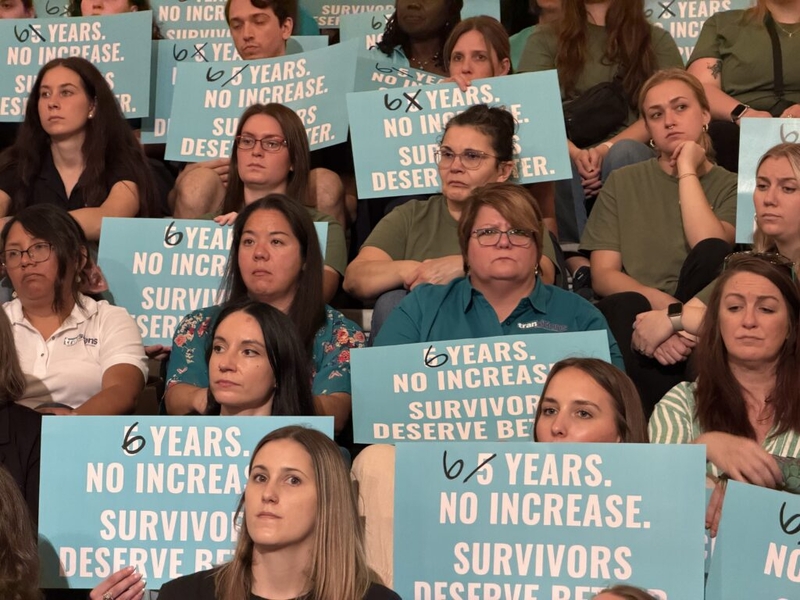
Advocates for rape crisis centers call for more dollars after six years of relatively stagnant funding. The crowd holds signs from last year's rally, with handwritten sign changes. (Photo by Whitney Downard/Pennsylvania Capital-Star)
After six years of relatively stagnant funding, members from Pennsylvania’s 47 rape crisis centers came together in Harrisburg to call for double the state dollars they receive after years of stagnation.
“Do your damn job,” said Katie Blume, the chair of the board of directors for Centre County’s Centre Safe. “We should not be here watching (other) bills… easily pass both chambers of this legislature while people whose lives are literally at risk have to come here and beg.”
For several years, funding for rape crisis centers remained stuck at $11.9 million, finally crossing the $12 million threshold last year following a 2% increase.
Now, advocates hope to more than double it with an additional $12.5 million.
One of the things I tell my clients is, ‘You’re angry because you’re worth it … my job is to let them feel that anger and know that they are worth it. I’m here today because we’re angry, advocates are angry, survivors are angry — we’re angry because we’re worth it.
“The funding being debated today is not just the line item in the state budget, it’s a survivor’s first call for help. It’s the counseling after trauma. It’s the advocate standing beside someone in their darkest moment,” said LaQuisha Anthony, the acting executive director of Philadelphia’s Center Against Sexual Violence, known as WOAR.
“We are a lifeline, and survivors across Pennsylvania are counting on us to keep that lifeline strong,” Anthony continued.
Her center laid off nearly three-fourths of its staff in October during last year’s state budget impasse. WOAR got $90,000 in temporary funding from the Philadelphia District Attorney’s office, but has struggled to recover.
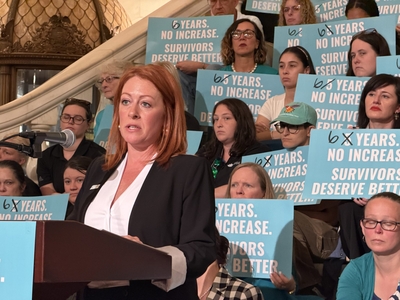
The 135-day budget delay stalled nearly $530 million in payments for safety net programs like rape crisis centers, child support and behavioral health. Some relied on savings, while two crisis centers took out interest-free bridge loans from the state Treasury.
Through several speeches, a current of frustration was evident. Sadie Restivo, the executive director of Pittsburgh Action Against Rape (PAAR), shared that one lawmaker urged her to bring survivors of sexual violence to the Capitol to share their stories, which she said would reopen old wounds “simply to justify funding that should already exist.”
“With all due respect … How many stories do you need to hear before you act? How many times must survivors relieve the worst moments of their lives before their pain is considered sufficient testimony?” Restivo asked the crowd. “The reality is this: survivors do not owe you their story. They do not owe you their trauma. They do not owe you proof that rape crisis centers save lives.”
Where that funding goes
Services vary by center, but frequently include hotlines, counseling and therapy, and someone to support a survivor during a forensic examination or in the courtroom — usually at no cost.
Centers rely heavily on government funding to stay afloat, even as budget requests outnumber available funds. Blume said the facilities were left fighting for scarce local dollars with animal welfare organizations, hospitals and food banks.
“I need legislators in this building to understand the only reason I am standing here today is because more than 28 years ago, Centre Safe and loving parents saved my life. I am standing here, because 25 years ago I had access to mental health services at my college campus,” continued Blume. “There are far, far too many people who have not had that opportunity.”
View this post on Instagram
Prevention programming includes PASSAGES, Inc.’s year-old Teen Advocate Group, geared toward high school students, who learn about healthy relationships, consent and preventing sexual violence. Young people then share those lessons at local events or through a monthly podcast.
PASSAGES serves Clarion, Clearfield and Jefferson counties.
“They care and they have the same passion as grown-ups,” said Joy Horner, who coordinates the group as PASSAGES’ education supervisor. “We know (teens) go to each other first, not a grown-up, so we thought, ‘What if we equip these teens to help each other?’”
The young advocates act as a bridge, and Horner said peers have approached the teens first before getting professional help.
Budding singer-songwriter Rylee Lindeneitz, a 16-year-old from Jefferson County, poured her frustration with double standards for teenage girls and boys into a song, performing during the rally in Harrisburg.
“It’s so easy to put feelings into music, and it’s so much easier to listen to it that way … and you get the message so much better,” said Lindeneitz. “We grow up and are told not to do certain things, not to wear certain outfits, not to act certain ways because we don’t want to be a ‘distraction’ or we don’t want to give off the wrong impression.”
“We get put under pressure to be a certain person … and we get blamed for things that happen to us or how people see us. When, in reality, it’s the people who do that,” continued Lindeneitz, who is a teen advocate with PASSAGES. “It’s never the victim’s fault.”
Feeling the pinch
Teen advocates like Lindeneitz are just one source of referrals. By law, emergency room must have on-call advocates and law enforcement must direct people to their local rape crisis centers. University campuses must also have advocates and prevention education reviewed by local organizations.
“None of it is funded,” said Ali Perrotto, the CEO of the Sexual Assault Resource and Counseling Center, which covers Lebanon and Schuylkill counties. “We just keep getting more and more things driven into our system and more and more survivors demanding services. … because it’s not available through mental health systems and it’s not available through education services.”
That $250,000 increase for all the facilities last year didn’t go far, she noted, saying that her own center alone could have absorbed that funding bump and avoided cutting therapy positions.
“When we talk about (a) $12.5 million (increase), we’re talking about what it will take to actually increase advocate salaries from $16 per hour — which they could make at a gas station — to a livable wage of $21.50,” added Perrotto, who co-chairs the public policy committee for the Pennsylvania Coalition to Advance Respect.
“Our current funding of $12.2 (million) … you split that among 47 centers covering 67 counties and 25,000-plus survivors, it really doesn’t cover very much,” she continued.
State House lawmakers passed Gov. Josh Shapiro’s budget without any changes last April. It keeps rape crisis centers flat funded. The Senate hasn’t yet taken any action on the spending plan.
The deadline for the next fiscal year’s budget is June 30.

Harrisburg, PA