NC voting rights groups say they’ll increase efforts to help voters overcome obstacles
Jul 27, 2026 | 4:38 pm ET
Description
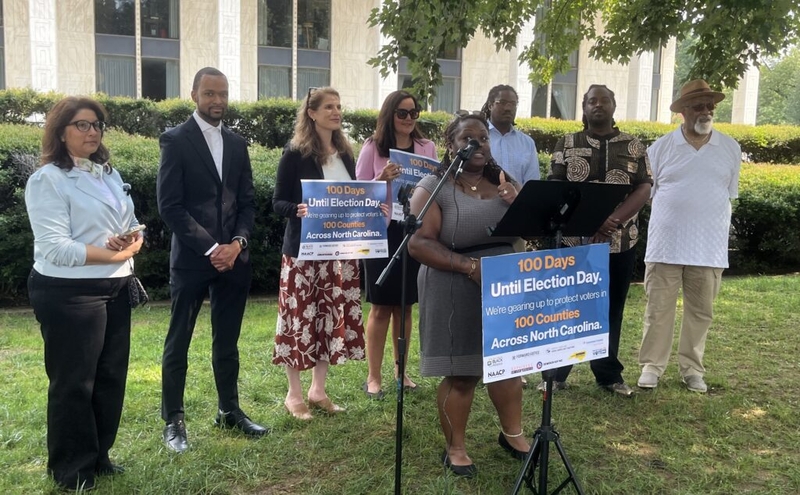
Brittany Cheatham of Forward Justice speaks at a news conference at which voting rights groups said they would intensify outreach efforts to counter voting obstacles, July 27, 2026. (Photo: Lynn Bonner/NC Newsline)
Voting rights advocates said Monday they are stepping up voter protection efforts for this year’s midterm elections in the face of efforts they say will hinder legitimate voters.
Senate Republicans are scheduled Tuesday to begin consideration of House Bill 958, which passed the House with only Republican votes.
After the House passed the elections bill last month, House Speaker Destin Hall, R-Caldwell, said the measure is needed to ensure election accuracy.
“At the end of the day, I don’t think anybody really believes it’s difficult to vote in this state, because it’s simply not,” Hall told reporters.
But critics said the bill would make it harder for legitimate voters to have their ballots count.
Irving Joyner of the NC NAACP said recent laws “are intended for the purpose of disenfranchising lawful citizens in this state who have the right to vote, but people in power don’t want them to vote.”
The state NAACP and other organizations are stepping up efforts this year to register new voters, help those already registered to update their information, make sure people get to the polls, and make sure those votes are counted, Joyner said.
Shruti Parikh, director of education and political engagement for North Carolina Asian Americans Together, emphasized the importance of voter hotlines.
A Korean-speaking voter who had trouble requesting an absentee ballot in the last election called the hotline for help, she said.
“Because we had a Korean-speaking staff member on our team, we were able to connect them with someone they could communicate with in their native language,” Parikh said. “No voter should wonder whether they understand the rules well enough to participate.”
Voters will also face the implications of decisions made beyond the Legislative Building.
NC elections board moves to make it easier to toss voters’ ballots
The state Board of Elections recently endorsed a new rule that would make it easier to toss ballots along party lines. It would allow a majority of members of a county board of elections to decide that a voter lied about the reason they don’t have photo ID. Current rules require a unanimous, bipartisan board vote to make that determination.
After that decision, state Elections Director Sam Hayes sent out a statement saying he did not think the change would result in the rejection of more ballots.
County elections boards are also approving early voting plans that move sites away from college campuses and other popular locations.
Granville County adopted a controversial early voting plan that closes one of its most-used sites and moves another away from downtown Oxford.
Last week, the Guilford County elections board refused to open early voting sites at NC A&T State University and UNC-Greensboro for the fall election, which the campuses had in 2024.
Guilford’s elections board, in a 4-1 vote, approved a plan with a compromise location that is a 38-minute walk from A&T and 31-minute walk from UNC-G, said A&T student and community organizer Kema Leonard.
Students and their supporters are working on providing shuttle service and organizing a walk to the polls, he said.
“We’re going to make sure that we still show up and have our voices heard, because this is what democracy looks like,” Leonard said.
The state Board of Elections will have the final decision on Granville and Guilford’s early voting plans because their county boards did not come to unanimous decisions.
Raleigh, NC