Republican lawmakers face off for party nomination to lead Oklahoma labor department
Jul 27, 2026 | 4:29 pm ET
Description
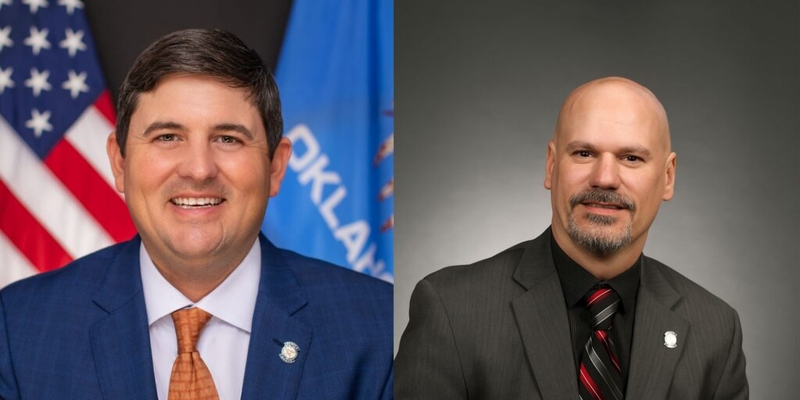
John Pfeiffer, left, and Kevin West, who are vying for the Republican nomination for Labor Commissioner, are pictured. (Provided photos)
OKLAHOMA CITY — Two state lawmakers seeking the Republican nomination to be elected Oklahoma’s next labor commissioner hope to modernize the Department of Labor and dig into artificial intelligence’s impact on businesses.
Reps. John Pfeiffer, R-Mulhall, and Kevin West, R-Moore, both advanced from the June 16 primary and will be on the Aug. 25 primary runoff ballot to secure their party’s nomination for the position to lead the state Department of Labor.
Only registered Republicans are eligible to vote in this race.
The winner will face Democrat Kevin Dawson and Libertarian Mike Hall in the Nov. 3 general election.
Pfeiffer said he is running because he wanted to continue serving Oklahoma after terming out of the Legislature. He has helped to run his family’s cattle farm and also led House committees that helped to oversee the state Department of Labor and its budget.
If elected, Pfeiffer would like to work to retain the state’s inspectors, improve interagency coordination, maintain Second Amendment rights for businesses and fold the Oklahoma Workforce Commission into the Department of Labor.
West said he’s running because of his experiences in the Legislature and his 40 years working in commercial cabinet-making, eight of which he owned his own business.
He would like to work to update safety trainings and to outline clearer expectations and schedules for inspections.
Modernizing the Department of Labor
Both candidates said they want to review the administrative rules under the purview of the Department of Labor and eliminate outdated or irrelevant rules that could be encumbering Oklahoma businesses.
Both men also said they’d like to cut down on “red tape” or burdensome mandates and look into updating the Department of Labor’s website.
Pfeiffer said he wants to work with employees and industry representatives to review the Labor Department’s rules.
“I know we did this 10 years ago, but is this still a problem,” he said. “And hear from both sides, not just industry, but the workers in these industries. Is this something that still needs to be in place to make sure we maintain proper health and safety, or because the world’s changed is this something that’s just kind of become a check-the-box, needless little piece of state bureaucracy.”
West said he is already in the process of reviewing the administrative rules. Sometimes the rules expand beyond the intended purpose, he said.
“And if there is something that we need to be doing that we don’t have the statutory authority for, then that’s when I, as commissioner, would go to the Legislature and say, ‘Hey, industry needs this, this would be good for these reasons.’ And get them to pass legislation giving that authority,” West said.
Working with artificial intelligence
With artificial intelligence increasingly playing a role in conversations about labor and the workforce, both Pfeiffer and West said they don’t know exactly how they’d like to handle the technology but would like to study its use and development more.
Pfeiffer said he thinks the Department of Labor should be involved in any regulation of AI the Legislature pursues, but he doesn’t want overregulation.
“I think we need to be cautious to make sure that any laws or regulations we pass on this are for the right reasons and not just because we’re scared,” he said. “… And I think that can be a little worrisome and a little nerve-wracking because we don’t want to stifle what this could be and the real positive changes it could bring.”
West has proposed creating a bipartisan taskforce to study AI’s integration with the workforce, something that would likely require legislative approval.
“What I would like to see done with AI is to provide resources to these companies, help them navigate this, so that we can ensure that as much as possible AI is being used as a tool, which is what it’s intended to be, as opposed to a replacement,” he said.
Wage enforcement
A report from the Workplace Justice Lab found that Oklahoma only employs three people to oversee wage enforcement.
Each investigator individually oversees enforcement for 32,000 businesses and 430,000 workers, the report found, and over 28,000 Oklahomans are already paid below the current minimum wage of $7.25 an hour every year.
Pfeiffer said he wants to see if there’s a backlog of wage disputes or a lack of knowledge on Oklahomans knowing where they file complaints about wage enforcement before saying whether or not more investigators need to be hired.
“I think the first step would definitely kind of be a general overall outreach … and then if we need to adjust and add (employees), then that’s something we can look at,” he said.
West similarly said he’s not sure how many wage complaints are being reported to the department, but he’d want to review the situation before making changes.
“Three people can, in some cases, take care of a lot of things, but it is absolutely one of those front-facing duties of the department and needs to take priority,” he said. “… Maybe we have three full-time people doing it and we have some people on backup so if we do get additional issues coming through, we’re able to handle that.”
Oklahoma City, OK