Louisiana House committee advances congressional map favoring Republicans
May 21, 2026 | 10:24 pm ET
Description
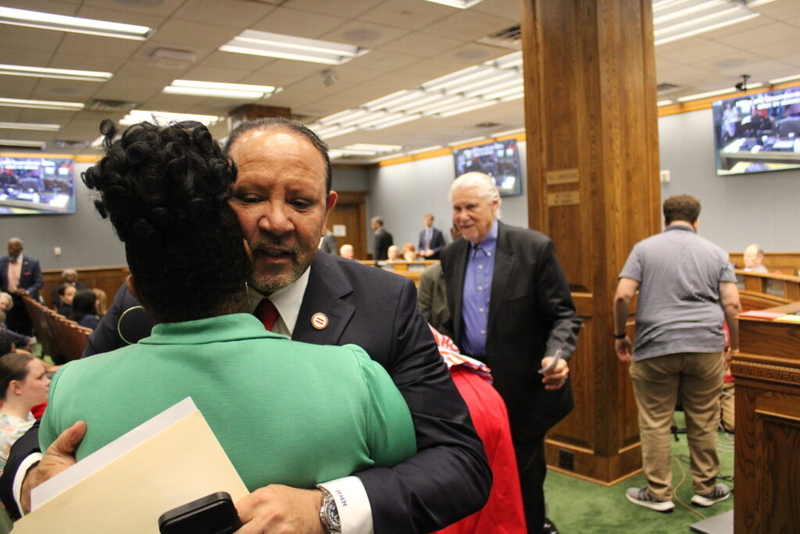
Marc Morial, National Urban League president/CEO and former New Orleans mayor, hugs Judy Reese Morse, leader of the Greater New Orleans Urban League, after he spoke to the Louisiana House and Governmental Affairs Committee against a bill to eliminate one of the state's majority-Black congressional district Thursday, May 21, 2026, at the State Capitol. Morial was joined in testimony by former New Orleans Mayor Sidney Barthelemy, background, and former Orleans Parish Clerk of Criminal Court Arthur Morrell. (Photo by Greg LaRose/Louisiana Illuminator)
After hours of testimony in opposition, a Louisiana legislative committee advanced a congressional redistricting plan Thursday evening that adds an additional Republican seat ahead of this year’s midterm elections.
On a party-lines 10-7 vote, the House and Governmental Affairs Committee approved Senate Bill 121 by Sen. Jay Morris, R-West Monroe, which keeps only a single majority-Black district among Louisiana’s six U.S. House seats. By eliminating the second Black district the legislature created two years ago, Republicans would gain another probable win in their bid to maintain control of Congress.
The majority-Black district in Morris’ proposal is essentially the same one U.S. Rep. Troy Carter, D-New Orleans, won in 2022. Morris said the district was designed to protect Carter’s incumbency, though its inclusion of the capital area means it would pit Carter against current 6th District Congressman Cleo Fields, D-Baton Rouge.
Morris said his goal in drawing the map was to disregard race and instead focus on party. While racial gerrymandering remains prohibited, partisan redistricting is legal. Morris said his map is designed to “maximize Republican advantage for the incumbent Republicans that we have in Congress.”
The vote to advance Morris’ bill came after more than five hours of passionate public testimony, all in opposition to his proposal.
Among those who spoke against the bill were former New Orleans Mayors Marc Morial, now president of the National Urban League, and Sidney Barthelemy, whose son, state Sen. Sidney Barthelemy Jr., D-New Orleans, also opposes the bill.
Morial recalled to lawmakers when he came to the State Capitol for the first time as a child with his father. In 1967, Ernest Morial was the first Black person elected to the Louisiana Legislature since Reconstruction. Every other Black person in the building was either holding a mop, shining shoes or carrying a tray of water, Marc Morial said.
Ernest Morial was New Orleans’ first Black mayor, serving from 1978-86.
When Marc Morial won election to the legislature and took his seat in 1992, he said other Black men and women held roles such as lawmakers, lawyers, lobbyists and more.
Morris’ map, he said, would undo that racial progress.
“This state was on an arc of change. What this moment feels like to me right now is a reversal of progress,” Morial said. “I’m not going to sit here and allow my intelligence and integrity to be insulted because someone can sit here and say ‘I never considered race.’”
Morris’ bill was amended in the House committee at the request of Rep. Dixon McMakin, R-Baton Rouge, to move parishes in the Capitol and Acadiana region.
Sen. Caleb Kleinpeter, R-Port Allen, said that if McMakin’s changes aren’t undone on the House floor, the Senate would reject their changes. Kleinpeter, who leads the Senate committee in charge of redistricting, specifically objected to the splitting of St. Martin Parish.
If McMakin’s amendments make it through the House and the Senate rejects them, the bill would be sent to a conference committee where three legislators from each chamber would meet behind closed doors to reach a compromise. Some of these late-compromise amendments are made public only minutes before lawmakers vote on them.
Thursday’s latest step to overhaul the state’s congressional makeup comes three weeks after the U.S. Supreme Court declared Louisiana’s existing U.S. House districts an unconstitutional racial gerrymander. The 6-3 decision from conservative justices in the case Louisiana v. Callais has prompted Republican leaders in Southern states to adjust their congressional maps as well.
The day after the Callais ruling, Republican Gov. Jeff Landry suspended the U.S. House party primaries, which would have taken place Saturday, to give lawmakers enough time to adopt new maps for the 2026 midterm elections.
Last week, lawmakers rescheduled the primaries for Nov. 3. Instead of holding semi-closed party primaries as originally planned, Louisiana will instead revert to a jungle primary in which candidates of all parties appear on the same ballot. Any runoffs needed would take place Dec. 12.
The qualifying period for the November U.S. House elections is Aug. 5-7, meaning candidates who signed up in February for the May 16 elections will have to qualify again.
The bill moving the election date to November also voids any ballots already cast in the U.S. House primaries. More than 42,000 people returned absentee ballots before Landry suspended the races. Secretary of State Nancy Landry was unable to remove House races from the ballots for the May 16 election, so tens of thousands of others were able to vote in those elections during the early voting period.
A provision in the bill will hide the number of voided ballots cast in the House races from public disclosure. Those details were added to the legislation in a closed-door meeting and adopted by both chambers over the course of an hour without an opportunity for public comment.
Baton Rouge, LA