‘Friday we either print packets or we go to court,’ say organizers of Stratos project referendum
May 27, 2026 | 7:02 am ET
Description
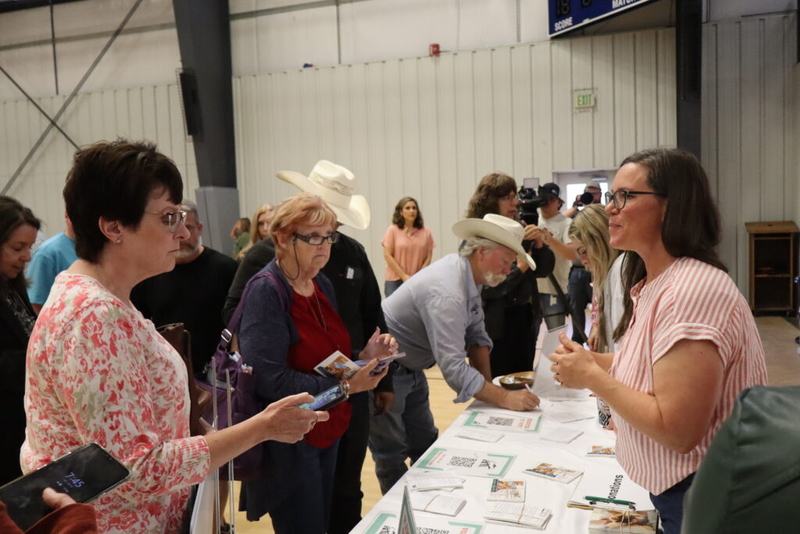
People sign up for information on the Box Elder Accountability Referendum Group during a public forum about the Stratos Project in Box Elder County (Alixel Cabrera/Utah News Dispatch)
Weeks after Box Elder County commissioners voted to greenlight the Stratos Project, a massive data center planned for 40,000 acres of unincorporated land, many questions lingered in the same room where that decision was made. This time, with less fireworks, with different voices featured — and even more questions.
For Brenna Williams, a Brigham City resident, a more immediate question will be answered on Thursday. That day, she said Tuesday evening, she’ll know whether she’ll start to gather signatures for a referendum initiated by her Box Elder County neighbors, or if she’ll have to take steps to challenge the data center in court.
“This Thursday, we’ll find out from the county attorney what they have to say, whether we can do this or not,” Williams said. “So I guess Friday we either print packets or we go to court.”
A group of volunteers of what’s now known as the Box Elder Accountability Referendum Group, or BEAR, set up a table alongside Grow The Flow, a group advocating for the Great Salt Lake, ahead of a second public forum about the proposed data center the Military Installation Development Authority (MIDA) is working on alongside reality show “Shark Tank” celebrity investor Kevin O’Leary.
If the referendum is successful, it would essentially undo the unanimous approval from Box Elder County commissioners for a resolution supporting the data center project, Williams said. However, whether a citizen initiative could negate the vote is still unclear.
“We would just go back and hopefully we can renegotiate some of the taxing stuff, if we can’t get rid of Stratos altogether, which would be my hope,” Williams said during the panel.
A Box Elder County group wants voters there to decide proposed data center’s fate
According to KSL, Utah House Speaker Mike Schultz, R-Hooper, believes residents should be able to vote on whether to allow the data center.
Over 100 people gathered at a Box Elder County Fairgrounds event space on Tuesday evening to discuss all things related to the project, which has unleashed a wave of protests across Utah because of magnitude, uncommonly quick approval process and the potential environmental impacts a project of this nature could carry.
While developers have released initial renderings with their vision for the campus, volunteers have done the math with the details that officials have released so far, trying to forecast what the center could mean for the state’s air, water and overall temperature.
When presenting the project to commissioners in the past, MIDA representatives highlighted that a perk of building the campus on the Box Elder County site was its proximity to the Ruby natural gas pipeline. The original plan was expected to host a 9 gigawatt natural gas plant to feed the campus without interfering with the state’s grid.
Utah Gov. Spencer Cox has recently denied that a 9 gigawatt operation would ever be approved in the state. But, if the plans had moved forward as initially presented, atmospheric sciences experts estimated that the power plant itself would have increased the state’s carbon dioxide emissions by over 50%.
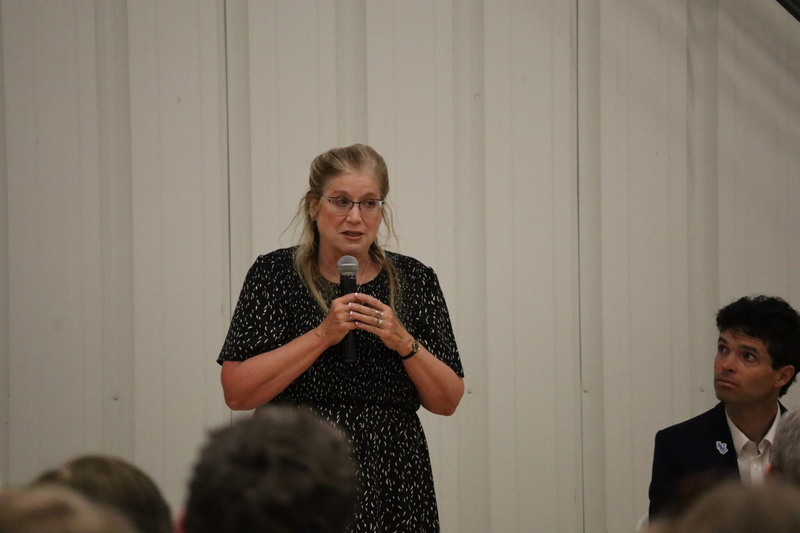
That was one big concern for Williams, whose granddaughters have to stay indoors on bad air quality days because of their asthma.
“The problems I see with this are the water and the air, the lack of transparency and process, the changing to our lifestyles, the tax capture, and then the environmental issues,” Williams said.
After seeing the renderings O’Leary digital posted this month, Williams described them as “tone deaf” because they include floor-to-ceiling windows and solar panels in a bird migratory pathway.
“I mean, they don’t understand this area at all. So it’s just really sad,” she said.
The referendum effort has made waves even outside Utah. Uproar over the project has made international headlines, and Vermont Independent Sen. Bernie Sanders has called, Williams said.
Salt Lake City, UT