US Senate stopgap fails to renew more than $38B a year in state transportation funding
Aug 04, 2026 | 5:41 pm ET
Description
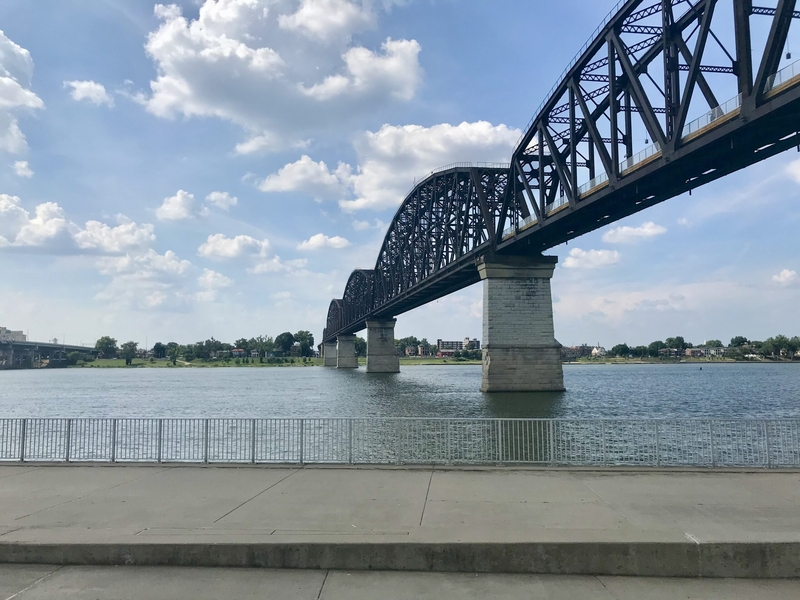
The Big Four Bridge over the Ohio River, connecting Louisville, Kentucky, and Jeffersonville, Indiana. (Photo by Sarah Ladd/Kentucky Lantern)
WASHINGTON — The stopgap spending bill supported by an overwhelming majority of U.S. senators does not address tens of billions in expiring transportation funding, leaving states facing a massive effective budget cut starting Oct. 1.
The 2021 bipartisan infrastructure law, which authorized highway and transit programs for five years, expires Sept. 30. Roughly $38.6 billion per year in extra federal transportation funding is set to expire with it, even if the continuing resolution the Senate advanced 89-4 Monday becomes law.
The stopgap measure, a version of which has also passed the House, would keep the government funded mostly at current levels, and reauthorize highway and transit programs through Dec. 11.
But it would not renew the advance appropriations that provided $184 billion over five years for a host of transportation programs under the infrastructure law President Joe Biden signed in his first year in office.
Ben Gilsdorf, an associate legislative director for transportation at the National Association of Counties, said in a Tuesday interview that the advance appropriations funded many of the group’s top transportation priorities.
“It's not all of the programs under (the infrastructure law) that would stop without an extension,” he said. “But for us, it's several of the most impactful ones.”
The National Association of Counties was part of a broad range of advocacy groups representing business, labor, cities, state departments of transportation and every mode of transportation that signed a letter last month asking Congress to extend the supplemental funding.
Funding for Transportation Department programs makes up a bit more than half of the total advance appropriations in the infrastructure law, which also includes major funding for the U.S. Environmental Protection Agency, the Federal Emergency Management Agency, Energy Department and telecommunications program.
The total advance appropriations for fiscal 2026 were about $66.2 billion, according to the nonpartisan Congressional Budget Office.
Bridges, airports, transit and more
The DOT funding largely flows to state departments of transportation.
Returning to pre-2021 baseline infrastructure spending would leave every state with less federal funding to cover varied transportation needs.
About 30%, $10.8 billion per year, of the extra transportation funding is determined by formula, meaning the amounts sent to each state vary based on population, highway miles and other factors.
California is the only state that would lose 10 figures worth of funding, at nearly $1.1 billion.
But even Vermont, the state with the lowest total funding lost, would see $55.6 million less in formula funds if the funding is not extended, according to data Senate Appropriations Committee Vice Chair Patty Murray of Washington sent to her fellow Democratic senators last month.
A total of 10 formula programs representing different modes of transportation would be affected, according to the fact sheet from Murray’s office.
More than half of the formula funding, $5.5 billion, is slated for the Federal Highway Administration’s bridge repair program.
Airport construction funds represent the next-greatest funding at $3 billion per year. The Federal Transit Administration’s grant program to maintain transit system infrastructure would lose $950 million and state transportation departments would lose another $900 million in federal funding for electric vehicle charging stations.
Other affected programs are for highways in Appalachian states, truck safety inspections, ferry boats and terminals, FTA grants for senior passengers and those with disabilities and the National Highway Traffic Safety Administration programs.
In addition to formula funds, the remaining 70% of advance appropriations is distributed via 25 competitive grant programs, according to the Murray document.
Grant programs to fund ports, large highway and rail projects, transit station upgrades, roadway safety and other projects would be among those losing funding.
Complicating spending negotiations
While the law that initiated the additional funding was bipartisan, there are indications an extension could be a more partisan issue.
Murray said ahead of the Senate floor vote Monday that Republicans did not “agree to our efforts to extend critical advance appropriations for infrastructure” and vowed to continue pursuing the additional funds.
Appropriations Chair Susan Collins, a Maine Republican, did not reference advance appropriations in a press release announcing a deal on the stopgap bill.
Republicans, who hold majorities in both chambers of Congress, may prefer to settle the future of the funding through a long-term surface transportation bill or full-year appropriations measure, Gilsdorf said.
Even if the Senate bill is enacted, there will be an opportunity when it expires to revisit the issue, he said.
“There'd be another bite at the apple,” he said.
A person familiar with negotiations who was not authorized to speak on the record said Tuesday that the advance appropriations in the 2021 law were meant to be one-time funding, and that extending them in a stopgap measure meant to preserve the status quo would be inappropriate.
The funding is part of a larger policy debate than is usually considered in a continuing resolution, the person said.
The issue could hang over negotiations for full-year spending bills, likely to begin in earnest after November’s elections.
Senate appropriators have not reached a deal for top-line spending levels for fiscal 2027.
Republicans, at President Donald Trump’s urging, are seeking a massive boost to defense programs.
Democrats historically seek parity between non-defense and defense spending, but have relaxed that stance while the extra infrastructure funds have been flowing. Without that additional funding, Democrats might be less amenable to compromise.
All States Newsroom content is free to republish. Read our republishing policy for more information.