Critics of county line celebrate end of yearslong legal fight
Aug 04, 2026 | 4:49 pm ET
Description
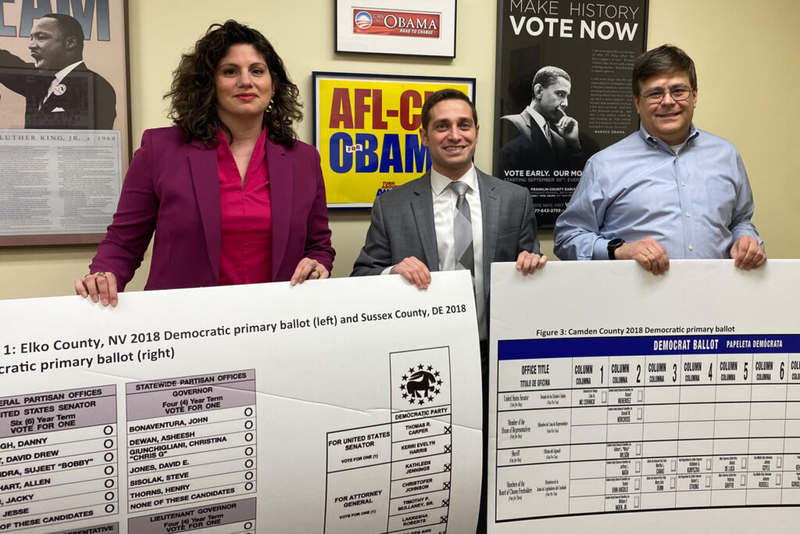
Yael Bromberg, Brett Pugach, and Flavio Komuves posing in their offices with, on the left, an office block-style ballot and, on the right, a county-line ballot that federal judges say is likely unconstitutional. (Photo by New Jersey Monitor)
A federal judge on Tuesday approved the final settlement ending litigation over a bespoke New Jersey ballot design the judge found was likely unconstitutional, capping a yearslong fight that has swelled primary candidacies in the Garden State.
The settlement between Sen. Andy Kim (D) and Bergen County Clerk John Hogan, the last constitutional officer to remain involved in the litigation, bars the county from using primary ballots that group candidates by party endorsement. The deal also ends a separate lawsuit filed by congressional candidate Christine Conforti that also targeted the ballot design, known as the county line.
“It’s definitely good cause for celebration,” said Brett Pugach, one of the attorneys who represented the candidates. “It’s over.”
The settlement comes more than a year after former Gov. Phil Murphy signed a law requiring primary ballots to group candidates by the office they are seeking instead of by party endorsement.
Activists had long complained about the county line, which allowed primary ballots in most of New Jersey’s counties to group candidates for various offices together if they all received the backing of county political parties, giving them preferential ballot placement over their challengers.
The lawsuits stemmed from Conforti’s 2018 Democratic primary loss against party-backed candidate Stephanie Schmid and party organizations’ early backing of then-first lady Tammy Murphy over Kim in the primary for the U.S. Senate seat Kim now holds (Murphy dropped out of the race before voting began).
As part of its agreement with Kim and Conforti, Bergen County agreed to use ballots that group candidates by office sought, conduct individual draws for each candidate’s ballot position, and pay $29,280 in legal fees to the plaintiffs.
Hogan’s office also agreed it would not bracket candidates seeking separate offices together or incongruously separate candidates seeking the same office by placing some in the far-flung reaches of a ballot away from their competitors, a ballot spot known derisively as “Ballot Siberia.”
“The ‘county line’ ballot design system operated as a form of unconstitutional viewpoint discrimination. It manipulated election outcomes and undermined voters’ power at the polls,” said Liza Weisberg, supervising attorney for the American Civil Liberties Union of New Jersey. “The end of this litigation is a momentous milestone. We will always fight to ensure that elections are free, fair, and truly reflective of the will of voters, not party insiders.”
The latest settlement over ballots comes more than two years after District Court Judge Zahid Quraishi ruled New Jersey’s prior county-line design likely violated the constitutional rights of candidates who did not win county political organizations’ blessings.
In ruling the design was likely unconstitutional, the judge said clerks had exceeded their authority by printing ballots whose design was likely to affect the results of an election in violation of the elections clause of the U.S. Constitution.
He also said it likely violated free association protections in the First Amendment by effectively requiring candidates to bracket with others seeking higher office to even have a shot of obtaining preferential ballot position.
“You saw this in a couple of instances: Folks who were interested in running simply at the local level would have to go out and recruit candidates further up the ballot to have a shot at running,” said Flavio Komuves, another of the attorneys who represented Kim and Conforti.
Voting advocates, progressives, and others celebrated Quraishi’s ruling as a step toward a more open democracy and celebrated again on Tuesday with news of the case’s end.
It’s definitely good cause for celebration.
Though the end of the county line has caused no tectonic shifts in the Legislature, its death has spurred a new wave of office-seekers and emboldened intra-party challenges across the state.
Some of those challengers, like Assemblywoman Katie Brennan (D-Hudson) and Assemblyman Ravi Bhalla (D-Hudson), have even seen success in their campaigns against party-backed opponents, but the biggest shift has been their number.
Last year, 209 New Jerseyans filed to run for seats in the General Assembly, the greatest number in nearly half a century. House candidacies rose too, jumping to 58 this year from 50 in 2024, when Kim’s Senate bid and two in-office deaths created a rare swell of opportunity for would-be congresspeople.
Those candidates wouldn’t have run under the old system, let alone won, said Yael Bromberg, another attorney who represented Kim and Conforti.
“I think it’s very clear that we’ve seen that abolishing the line has been transformative for New Jersey politics, welcoming new voices and perspectives that were previously completely excluded from the process and at least giving them a fair shot in the primary election,” she said. “We’ve already seen two primary cycles where that’s borne out.”
Despite the progress, county line opponents see more room for reform. They said New Jersey’s procedures for draws that determine candidates’ positions on the ballot are antiquated and leave a thumb on the scale for some candidates.
Though exact procedures vary by county and clerk, ballot positions across a voting jurisdiction are typically determined by a single hand draw. Voting advocates have pushed for electronic draws and procedures that would rotate candidates’ names to ensure none won an advantage as a result of their position on the ballot.
“The ballot design law left unchanged all of the existing laws about the clerks sort of grabbing at cards and capsules and failed to modernize that aspect of the balloting system, so that’s certainly one thing that is on our radar,” Komuves said.
Trenton, NJ