Dems continue to hammer Trump Education Department transfers
Aug 04, 2026 | 5:49 pm ET
Description
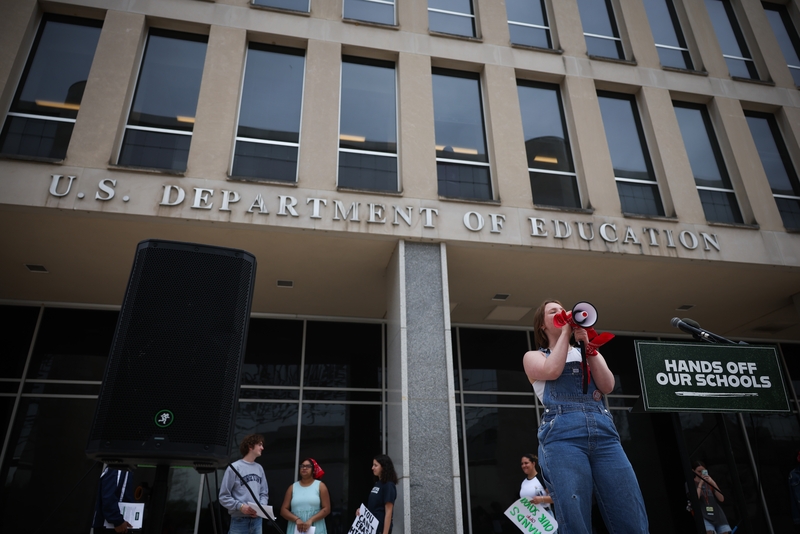
Students rally in front of the U.S. Department of Education building in Washington, D.C., in April to protest President Donald Trump’s efforts to dismantle the U.S. Department of Education. (Photo by Kayla Bartkowski/Getty Images)
WASHINGTON — U.S. Senate Democrats on Tuesday rebuked the Department of Education’s efforts to transfer its special education programs and civil rights enforcement to other agencies.
Sen. Mazie Hirono of Hawaii convened a panel of advocates and former department officials in Republican and Democratic administrations to blast the department’s moves, which represent a key step in President Donald Trump’s efforts to dismantle the Education Department.
Education announced in June that the Department of Health and Human Services would administer programs under Education’s Office of Special Education and Rehabilitative Services, or OSERS, while civil rights enforcement under its Office for Civil Rights would be transferred to the Justice Department.
Democrats have been highly critical of the moves since they were announced.
Families of students with disabilities “deserve an educational system that is going to provide their kids with the education services that (are) required under IDEA,” Hirono said Tuesday.
The Individuals with Disabilities Education Act, or IDEA, guarantees a free public education for students with disabilities. OSERS is responsible for managing and supporting IDEA. The umbrella unit includes the Office of the Assistant Secretary, Office of Special Education Programs and the Rehabilitation Services Administration.
Meanwhile, Education’s Office for Civil Rights is tasked with investigating discrimination complaints from students and families.
Lacking expertise
Democratic critics of the interagency agreements say the Education Department is best equipped to deal with special education programs and civil rights enforcement.
“In my view, neither of these other agencies or departments have the expertise to really be able to handle their piece of this,” Sen. Chris Van Hollen said.
The Maryland Democrat noted that he’d “much rather be in a position where we’re trying to make good things happen than trying to prevent harm to the Department of Education and the effort to make sure that we address the civil rights of students and make sure that people have the special education opportunity that the law requires, but here we are.”
The Education Department announced 10 earlier interagency agreements with HHS, Labor, Interior, State and Treasury in an effort to shift several of its major functions to those agencies.
‘One consistent answer’
Valerie C. Williams, who served as director of the Office of Special Education Programs, or OSEP, under the Biden administration, said the deteriorating quality of special education may not be immediately noticed, but would have significant consequences for the students.
“Here’s what worries me most, as someone who ran this office: The damage does not announce itself,” she said. “The erosion of enforcement and support does not show up the week it happens. It shows up months later, as a state that quietly stops getting monitored, a complaint that just sits, or a phone call that never gets answered.”
Laurie VanderPloeg, associate executive director for professional affairs at the Council for Exceptional Children, called on members of Congress across the aisle to “stand up for infants, toddlers, children and youth with disabilities by preserving the Department of Education and protecting special education programs from being transferred to another agency.”
VanderPloeg served as director of OSEP during the first Trump administration.
“We must resist the urge to make the fate of children with disabilities political, and urgently remain focused on supporting outcomes for all children,” she said.
Seth Galanter, a senior fellow at the Edley Center on Law and Democracy at the University of California, Berkeley, School of Law said “there’s a reason that Congress kept OCR and OSERS in the same building.”
Galanter, who served as the principal deputy assistant secretary for civil rights during the Obama and Biden administrations, said “school districts need one consistent answer on disability rights, not two agencies pulling in different directions.”
Administration defends transfer
Tuesday’s forum came just days after a Senate education panel advanced a bipartisan bill to rein in Trump’s efforts to dismantle the Education Department and would block interagency agreements that transfer programs regarding special education, elementary and secondary education, postsecondary education and Native American education.
That legislation notably would not apply to the administration’s efforts to shift civil rights enforcement under OCR to the Justice Department.
Savannah Newhouse, a spokesperson for the Education Department, doubled down on the administration’s efforts, in a statement shared with States Newsroom on Tuesday.
Newhouse said Hirono and her Democratic colleagues “are either completely ignorant to the collapse of American education, or they are actively rooting for the bureaucracy over our children,” adding that “their desperate fearmongering, claiming students will lose guaranteed federal support, is flatly false.”
Newhouse added that under Education’s partnership with Justice, “families retain the exact same direct line to staff for civil rights complaints.”
Regarding Education’s agreement with HHS surrounding special education programs, Newhouse said “OSERS staff remain fully committed to protecting the Individuals with Disabilities Education Act (IDEA) with bolstered support from HHS — an agency that already successfully manages grants and programs that serve individuals with disabilities.”
All States Newsroom content is free to republish. Read our republishing policy for more information.