Federal court rules Alabama Power can impose extra charge on customers with solar panels
Mar 27, 2026 | 3:41 pm ET
Description
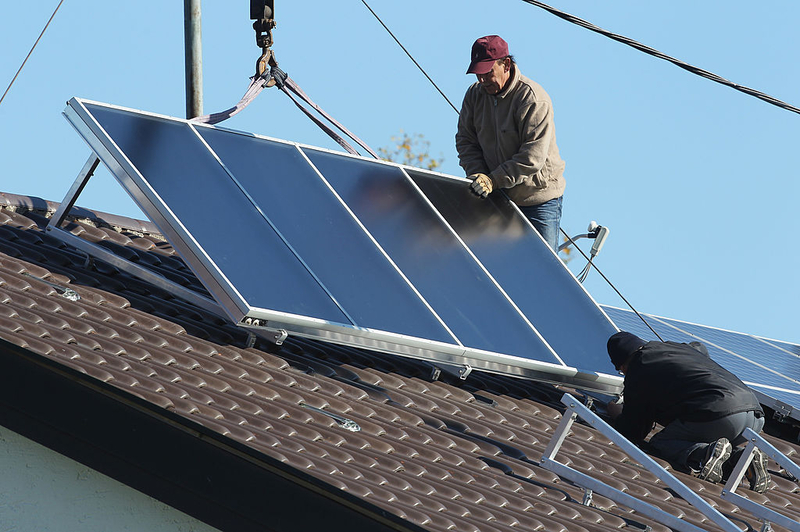
Workers install solar power modules for producing electricity on the roof of a house on October 15, 2011 in Wessling, Germany. A federal court Wednesday ruled that Alabama Power can continue to impose an additional charge on customers with solar panels. (Alexandra Beier/Getty Images)
A federal district court on Wednesday ruled that Alabama Power may continue to charge an additional fee to households with rooftop solar panels.
U.S. District Court Judge Annemarie Carney Axon granted a motion filed by both Alabama Public Service Commission and Alabama Power that sought a summary judgement dismissing a lawsuit filed by plaintiffs to rescind the fee, known as a capacity charge, from their bills. Axon did not provide an opinion with the order.
Plaintiffs said in a statement Friday that they were disappointed with the ruling.
“I am frustrated that Alabama Power solar customers like me have to pay an extra monthly fee in order to reduce our power bills,” said Mark Johnston, an Episcopal priest and retired executive director of Camp McDowell.
He added that “I want lower electricity bills and a better environment for my children and grandchildren.”
Christina Tidwell, a senior attorney with the Southern Environmental Law Center, which represented the plaintiffs in the lawsuit, said in the statement that it was “a disappointing day for Alabama Power customers who want to use solar energy to get relief from some of the highest electricity bills in the nation.”
“Not only are we missing out on the bill savings that could be realized through installing rooftop solar, but we’re also missing out on opportunities for job creation and economic development,” the statement said.
Alabama Power said in a statement Friday that “customers who rely on the grid must help pay for the grid.”
“We are pleased the court agreed with the Public Service Commission’s determination that customers who choose to use Alabama Power for backup service should pay their share of costs to maintain the grid,” the statement said.
The company said it supports customers who want to install rooftop solar, but said those who want to connect with Alabama Power “must pay their share of grid costs so other customers are not unfairly burdened.”
The Alabama Public Service Commission in 2012 authorized Alabama Power to charge $5 for kilowatts of power that customers generate from their solar panels. The charge increased to $5.41 in September 2020. For a site with a 5kW solar array, that would cost an additional $25 per month or $300 annually. That amounts to about $9,000 in costs over the 30-year lifespan of a solar system.
That additional cost reduces the return for households and businesses that make installing solar panels to make the investment worthwhile.
Critics argue the additional fee reduces the incentives for people to install solar panels on their properties.
According to the Solar Energies Industry Association, Alabama at the end of last year had 966 mW of solar power installed in the state, accounting for less than 1% of total energy production. By comparison, South Carolina, demographically similar to Alabama, had 3,061 mW of solar power, generating about 3.8% of energy in that state. Mississippi, with about 57% of Alabama’s population, had 2,052 mW installed, about 3.7% of generation there.
The plaintiffs filed the lawsuit in July 2021. The defendants sought to have the case dismissed because they said that the federal court does not have jurisdiction and that a state court is a proper venue. A federal court denied the motion in October 2024 and allowed the case to proceed because it has jurisdiction over the 1978 Public Utilities Regulatory Policies Act of 1978 (PURPA), a federal law that gives the Federal Energy Regulation Commission (FERC) the power to enforce rules.
Montgomery