WV lawmakers give Flock until Friday to answer questions
Oct 07, 2026 | 4:05 pm ET
Description
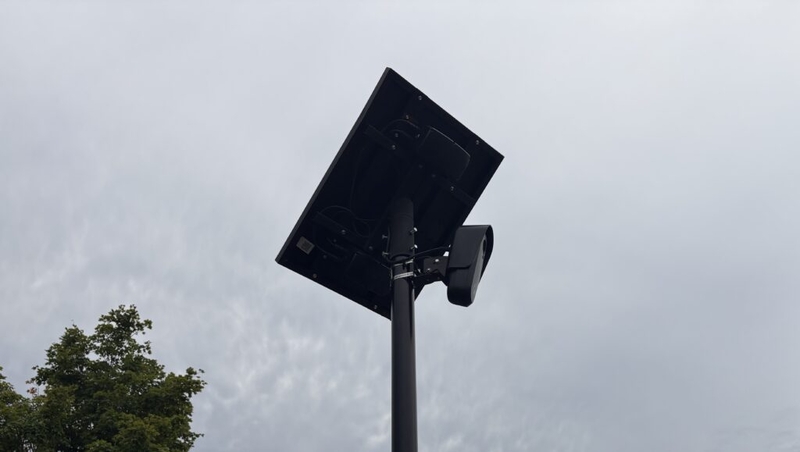
A Flock camera is seen in a parking lot in Morgantown, West Virginia on Sept. 4, 2026. (Photo by Leann Ray/West Virginia Watch)
As West Virginia lawmakers consider how to rein in artificial intelligence-driven police surveillance technology with legislation during their upcoming session, they’ve given Flock Safety a deadline of this week to answer a series of questions to their satisfaction — or else they may use subpoenas or compel witnesses to answer them.
In a letter Monday, members of the House Committee on Government Organization gave Flock Safety until Friday to provide written answers to questions they sent in a letter dated Aug. 14.
Del. Tristan Leavitt, R-Kanawha, and a member of the committee, said Tuesday lawmakers will introduce legislation regarding the technology in 2027, but the committee is trying to gather as much information as it can before crafting “responsible safeguards.”
“The reality is that the technology continues to evolve, and so it creates all sorts of questions ranging from the technological, to, again, just what protocols they have in place to, again just the efficacy of the product altogether,” Leavitt said.
Lawmakers’ original request included 19 questions from five categories: security incidents and unauthorized access, surveillance scope and data sharing, accuracy and false positive rates, internal oversight and employee access controls, and data governance and infrastructure.
Delegates asked Flock, for instance, to provide the number of times when raw video footage has been accessed by unauthorized users for each year the company has existed, and what caused the security breach in each instance.
In a 10-page response from Flock Safety on Sept. 1, Dan Haley, chief legal officer for Flock, wrote a broad response to each of the five categories of questions, but did not include specific answers to many of the questions lawmakers posed.
“Flock Safety takes the security of customer data, including video and license plate data, extremely seriously,” Haley wrote, in part, under the heading regarding security incidents. “Because Flock operates technology used by thousands of public safety agencies and handles information associated with active criminal investigations, our security program is designed around continuous prevention, detection, testing, investigation and remediation rather than the unrealistic assumption that a system will never experience a security event.
State lawmakers wrote in a response that many of the answers were not sufficient.
“A general description of your security program is not a substitute for the information we requested about raw video footage from Flock devices being accessed,” lawmakers wrote in a response Sept. 3.
Flock said that they would “welcome the chance to provide a briefing to the committee,” but Lawmakers said in a response that a briefing is not acceptable.
“Meeting behind closed doors is no substitute for providing written responses to questions of such clear public concern — questions all the more relevant since new Flock camera hacking incidents have come to light,” the letter from Monday reads. “Six weeks after our initial August 14, 2026 request, you have failed to produce these answers. As our last letter clearly stated, we do not intend to sit for a briefing with you until Flock Safety has responded in full to our requests. “
The Oct. 5 letter is signed by Leavitt, Ryan Browning, R-Wayne; Patrick Lucas, R-Cabell; and Committee Chair Chris Phillips, R-Barbour.
Several West Virginia municipalities across West Virginia have either considered or contracted with Flock Safety to install surveillance systems, including automatic license plate readers and gunshot detection equipment. The American Civil Liberties Union says the technology is “tracking, logging and sharing your movements without a warrant.”
Flock Safety has been the subject of privacy and constitutional concerns nationally. The Institute for Justice has reportedly identified more than 100 incidents of Flock abuse, including law enforcement stalking romantic partners, wrongfully pulling people over and other misconduct.
The ACLU of West Virginia is suing the city of Huntington over its five-year contract with the company to provide the surveillance equipment for more than $2.1 million. A Huntington organization opposed to Flock is pursuing a ballot initiative that would require the city to void its contract with the company.
Leavitt declined to mention what specific safeguards lawmakers are considering, but said he expects a “very robust discussion” during the 2027 legislative session, which begins in January.
“What has kind of united everybody from all different perspectives on these questions is that Flock needs to answer the requests that we’ve made so that we are best informed to make those decisions,” Leavitt said.
The request comes about two months after Kevin Kane, director of government affairs for Flock, gave a presentation to the Joint Standing Committee on Government Organization during the August legislative interim meetings.
“You had, really, two different categories of challenges there,” Leavitt said of Kane’s testimony. “One is that a number of detailed questions they simply said ‘we’ll get back to you on that,’ and they clearly intimated they’d like to have a private meeting instead.”
Leavitt said lawmakers believe the information should be provided publicly because the issue has so much public interest, and public interest plays a role in how lawmakers legislate.
“The second real challenge is that there were several different areas where Flock’s representative provided certain information that then, on later questioning, really broke down, and rather gave the impression that he was trying to mislead the Legislature.”
Leavitt said many West Virginians have questions about Flock. Some people are adamantly opposed to the technology, while others are learning about it for the first time, he said. It’s important that lawmakers understand it before regulating it, he said.
“We want to make sure that we don’t craft the law in such a way that it doesn’t really actually get at what all of the vulnerabilities and issues are,” he said. “So that requires us really honing the depths of this as much as we can, so that we make sure that we do as good a job as possible in the legislation that we pass.”
Charleston, WV