Marsh-building river diversions have local support at the Bird’s Foot Delta, but money still needed
Oct 07, 2026 | 6:23 pm ET
Description
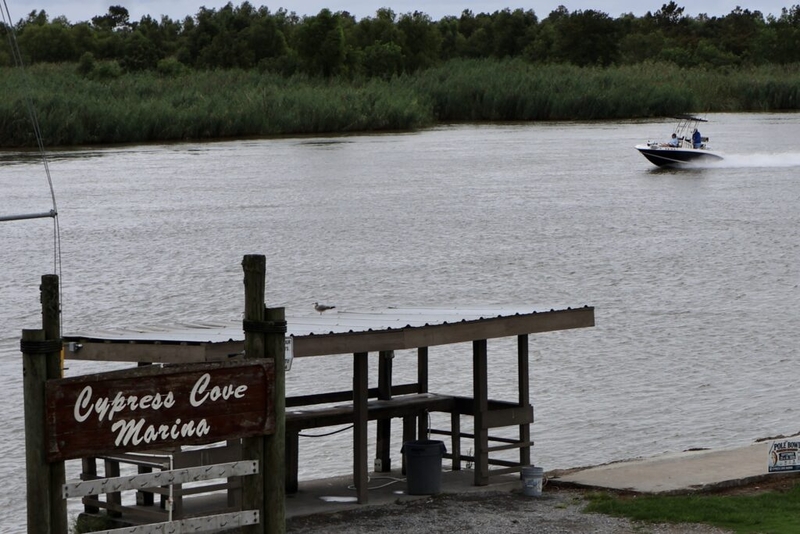
A boat travels near the Cypress Cove Marina in Venice, Louisiana. A coastal restoration project in lower Plaquemines Parish looks to revitalize wetlands that were damaged by the Deepwater Horizon oil spill. (Photo by Elise Plunk/Louisiana Illuminator)
VENICE — Fishermen and property owners in lower Plaquemines Parish are optimistic about a plan for how to rebuild lost wetlands at the Mississippi Delta, though state officials still need to line up more than $150 million to pay for the project.
Members of the Louisiana Coastal Restoration and Protection Authority sought input from locals and fisherman who live and work around the southernmost tip of Southeast Louisiana. They were given the floor Tuesday night at a community meeting held at the New Orleans Big Game Fishing Club in Venice on the Bird’s Foot Delta Hydrologic Restoration Project.
The project would open and close some of the both natural and human-made channels of water in the delta to use river water and sediment to revitalize the adjacent marsh.
Fishermen and longtime residents of Plaquemines Parish voiced general support for the project at the meeting.
Earl Armstrong Jr., a cattle rancher and lifetime resident of Pilottown, spoke about the power of restoring the river’s flow to under-nourished wetlands.
“I know all these areas like the back of my hand, “ Armstrong said. “If we can get all this water that’s being lost … you’ll have a lot better chance trying to build up places downriver.”
Brent Roy, a charter captain and fisherman who operates out of Venice, agreed that the marsh west of South Pass, where the river and sediment flow are higher, looks healthier than the east side. He called the Bird’s Foot Delta plan “a great project” and suggested the CPRA also consider building a barrier island to contain the fresh sediment.
Baker said the CPRA “would love to” pursue a barrier island project, but that the cost is prohibitive.
“If I had all the money in the world, I would do it, but then that still doesn’t fix why I’m losing all this [sediment],” he said.
Everett Marks, a landowner in Plaquemines Parish, shared concerns with the CPRA’s tentative plan to place dredged sand from the channel clearing near his private duck hunting property, bringing up the issue of whether the state would try to claim ownership. Despite this, he indicated he would be willing to work with CPRA to find a place to put sediment that would not disrupt duck hunting on his private land.
“Great project, I’m for the project,” Marks said. “I’m just not for the sand being dumped on private property. There’s got to be some other place to dump the dirt.”
Over the past 40 years, more than 26,000 acres of wetlands have been lost on the southeastern end of the delta’s tip from sea level rise, sediment deprivation and impacts from the Deepwater Horizon oil spill in 2010.
“This is the closest land mass to the oil spill, the Bird’s Foot Delta,” said Todd Baker, the CPRA’s project manager. “Because it’s not Grand Isle or a Florida beach, there weren’t a lot of people out there with cameras filming everything that was going on. So it was able to sit in this (oil-damaged) environment for a very long time.”
To revitalize the area, the plan proposes the removal of sand shoals from the Pass a Loutre navigation channel that have “plugged up” water flow downriver, Baker said. The plan also calls for closing several small channels along the western side of the larger South Pass and opening others on the eastern side to deliver more river water and the valuable sediment it carries to deteriorated marsh areas.
“It really is an opportunity to do whole ecosystem restoration,” Baker said, adding that project models expect to build at least another 1,000 acres of wetlands.
By opening up avenues for flow to the east, Baker said the project aims to use the Mississippi River’s natural power to build land more efficiently than humans could alone.
For example, sediment flow to wetlands east of South Pass will increase by a substantial 40%, according to projections.
“We have a problem out here, and we’re not gonna attack the symptom,” Baker said.” We’re gonna attack the problem.”
Engineers have been designing the Bird’s Foot Delta project since 2020, spending $2.7 million of the $6 million from the BP Deepwater Horizon settlement dollars allocated for [insert description]But it will take a lot more money to see the plan through to completion. Officials said at the meeting they expect total costs to run anywhere from $144 million to $176 million.
Baker said the price tag has such a large range because the rising cost of diesel fuel makes dredging costs hard to predict.
“But also, this is the Mississippi. We don’t know how much sand we’re gonna have over the next few years, where it’s gonna deposit,” he added.
Baker said the CPRA plans to ask for more BP settlement dollars to fund the project by the end of 2027 to hopefully begin construction on the project by early 2028. The CPRA is part of a panel of federal trustees that has to approve how settlement dollars from the Deepwater Horizon oil spill are spent to restore damaged areas of the coast.
Baton Rouge, LA