‘Wanton abuse of power’: Kelly, union leader criticize southwest Kansas ICE raids, seek reform
Oct 07, 2026 | 5:36 pm ET
Description
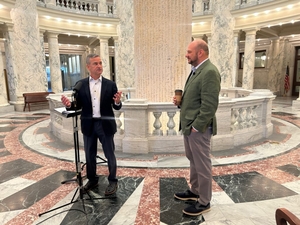
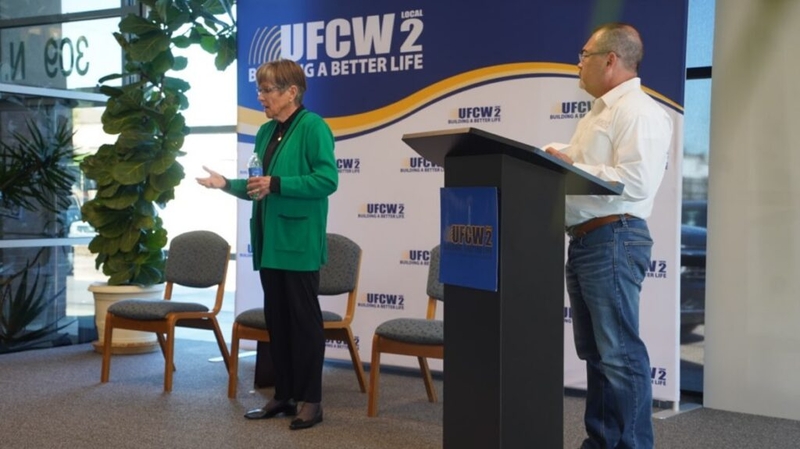
Gov. Laura Kelly spoke to members of the United Food and Commercial Workers Union in Dodge City Oct. 5, 2026, about federal immigration raids in the area. Martin Rosas, right, president of the union's Local 2, also spoke at the event. (Photo from Kansas Governor's office.)
TOPEKA — Federal immigration officials subjected southwest Kansas to a “wanton abuse of power,” Gov. Laura Kelly said, and she pledged to union members that she would work to restore immigrants’ sense of belonging and security.
Kelly spoke at a United Food and Commercial Workers member meeting Monday in Dodge City, highlighting the importance of immigrants in Kansas. The union’s local chapter is based in Bel Aire and represents 14,852 members in meatpacking, grocery, food processing, healthcare, retail, and other industries.
On Sept. 22, U.S. Immigration and Customs Enforcement agents arrived in Garden City, Liberal and Dodge City, as well as smaller surrounding towns, to detain immigrants who didn’t have proper documentation, ultimately arresting about 110 people. No comprehensive list of those arrested has been released.
“Under no circumstances should you have been subjected to the wanton abuse of power you experienced two weeks ago,” Kelly said. “I wanted to come that week to assure you that your governor and your state law enforcement officials were with you. I didn’t come then because after several calls with Martin (Rosas) and others, I believe my presence would have put all of you in more jeopardy.
“But I’m here now to listen and to do whatever I can, whatever my administration can, to restore your sense of belonging, your sense of security, and your pride in being a candidate,” she added.
Martin Rosas, president of the union’s Local 2, encouraged union members to make their voices heard by voting.
After the meeting, Rosas said the majority of industries in the area rely on an immigrant workforce, and often workers come from “mixed status” families, meaning one person will have legal papers to work but the rest of the family won’t.
The meatpacking industry uses E-Verify, the government system that confirms work status, he said. But the people who didn’t go to work in southwest Kansas were afraid to leave their families because they may not be here legally.
“They don’t show up for work, not because they can’t attend to work. It’s because they’re afraid to leave their house when we got these goons knocking on people’s doors, kicking doors open, shooting people, killing people. We have seen that,” Rosas said.
Immigrants have seen delays since 2016 in government action to provide a legal pathway to residency or citizenship, and then the “aggressive position that this administration has taken against immigrants as a whole or people of color” has generated fear, he said.
Politicians can no longer delay or “kick the can down the road,” Rosas said.
“The demand for labor workforce is growing in the United States,” he said. “However, the current immigration system doesn’t recognize that need. While we evolve with more and more need for workers in America, the politician has not done anything, other than like this current administration attacking the immigrants.”
Immigrant labor is crucial for the U.S. workforce, he said. Positive responses to ICE and deporting immigrants online make Rosas realize how people think about the immigrant workforce.
“When you see those reactions, everything is a result of years of dehumanizing the immigrant workforce that is very significant to the production and the economy of the United States,” Rosas said.
Rosas, who is an immigrant and became a U.S. citizen in 1996, said that when he sits down and talks with people one-on-one, they have a different view of the immigration system and understand the need for reform.
He pointed to recent news that Oklahoma’s Republican Gov. Kevin Stitt recognized that if undocumented people left the state, it would put a “huge dent” in the economy, Rosas said.
He referred to comments Stitt made to NewsNation offering full support to Trump for closing borders but saying that people who aren’t criminals shouldn’t be deported because beef prices will go up. Stitt gave an example of an Oklahoma immigrant who had a marijuana violation 20 years ago. Although the man’s employer was willing to vouch for him, ICE deported him.
“People have to analyze, really, what is the cost of us not doing anything with immigration?” Rosas said. “No one, including myself, no one is loving to have open borders. If you’ve been in the country for a period of time, you’ve been doing everything according with the law, good civic human being, good human person, you should be allowed to regularize your status. The system itself has created this problem, and by not taking action, it’s aggravating the problem to the point where it is today.”
Kelly called for immigration overhaul in her remarks, asking the nation to “return to being a beacon of civility, humanity and opportunity.”
She noted how the makeup of southwest Kansas has shifted since she first moved to the state in 1986. As executive director of the Kansas Recreation and Park Association, she visited recreation centers, parks, ball fields and other areas, which offered opportunities for area families.
“But I was also struck by how segregated programs were,” she said. “The children of the white families played in the city-sanctioned leagues. The children of the Hispanic families played in their own separate leagues. Fast forward over those 40 years, the entire culture in Southwest Kansas has radically changed.
“Hispanic and Latino citizens and immigrants from other parts of the world now make up the majority of many of our communities,” she said. “The schools, the businesses, the arts, the very economy of Southwest Kansas thrive because of the influx, the integration, and the influence of the multinational makeup of this region.”

Topeka, KS