U.S. Supreme Court justices appear skeptical of allowing Boulder climate lawsuit to proceed
Oct 05, 2026 | 4:49 pm ET
Description
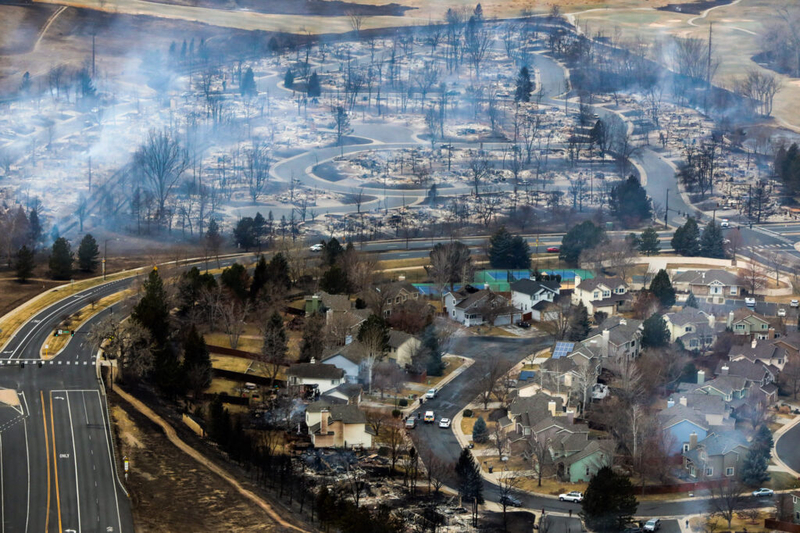
An aerial view of a Boulder County neighborhood that burned in the Marshall Fire, on Dec. 31, 2021. (Hart Van Denburg/CPR, pool)
The U.S. Supreme Court’s conservative majority Monday appeared broadly sympathetic to fossil fuel companies’ argument that allowing two Colorado local governments to sue them over climate change in state court would be a “recipe for chaos.”
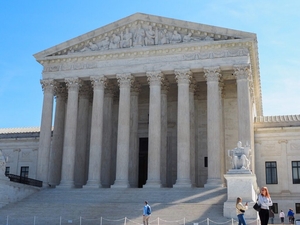
Attorneys for both sides in Suncor v. Boulder, along with the Trump administration, presented oral arguments in a two-hour hearing, the first of the Supreme Court’s 2026-27 term. The case originated in Colorado in 2018, when Boulder’s city and county governments sued Exxon Mobil and Suncor Energy, seeking monetary damages under state tort law for their role in contributing to climate change.
Despite being filed eight years ago, the case has yet to proceed to trial, as the fossil fuel companies have repeatedly tried to have it dismissed or moved to federal court by arguing that the Constitution and federal clean-air laws preempt such state-level proceedings.
As justices waded into a thicket of jurisdictional issues raised by Suncor and Exxon when they petitioned the nation’s highest court to weigh in last year, Chief Justice John Roberts noted the “practical matter” of what could happen nationwide if Boulder’s case is allowed to proceed.
“Presumably if you prevail, the next day, a municipality in every single state will file a lawsuit, probably copy your pleadings, and then there’ll be at least 50 … causes of action filed,” he told the attorney representing Boulder. “How would you think that will work out on the ground?”
Boulder, fossil fuel companies face off at the Supreme Court in high-stakes climate case
With more than 30 similar lawsuits already filed by state and local governments across the country, environmental advocates say the outcome in Suncor v. Boulder could be a turning point in efforts to hold the fossil fuel industry accountable for climate change.
Justice Elena Kagan, the most senior of the court’s three liberal justices, compared the wave of climate litigation to state-level efforts against tobacco companies in the 1990s and against opioid manufacturers in the 2010s. She asked the attorney for Suncor and Exxon if those lawsuits should have been preempted, too.
Kannon Shanmugam, representing the companies, said the tobacco litigation involved “a more traditional misrepresentation claim” and consumers “suffering injury quite directly.”
“I’m waiting to see the distinction,” Kagan replied. “Because this complaint talks a lot about misrepresentations that are made by the defendants.”
Climate change in Colorado
In a statement Monday, Boulder County said that its case seeks to hold the companies “responsible for knowingly contributing to climate alteration while concealing the dangers of their products.”
The Suncor v. Boulder proceedings come after another unprecedented summer of record heat, extreme drought conditions and destructive wildfire activity impacting Boulder and other Colorado communities, as human-caused climate change, mostly the result of fossil fuel combustion, pushes average global temperatures to dangerous new highs. In December 2021, Boulder County was the location of the Marshall Fire — the most destructive fire in Colorado history, and one in which scientists say climate change was a factor.
“Faced with these rising costs, we ask, is it fair for communities to shoulder these costs alone? We believe it is not,” Boulder County’s statement said. “For decades, the companies producing and selling fossil fuels knew that their products contribute to a changing climate. These companies are asking the Court to help them evade responsibility.”
Alito absent
Absent from Monday’s oral arguments was Justice Samuel Alito, one of the Supreme Court’s most conservative members. Alito recused himself from further proceedings in the case last week, after environmental advocates had called for him to step aside because he owns stock in at least two oil companies.
Alongside the two parties to the case, Sarah Harris, U.S. deputy solicitor general, appeared before the court on the Trump administration’s behalf, asking the justices to side with the fossil fuel companies. In an unusual move, the administration filed an unsolicited brief in support of Suncor and Exxon’s initial petition to the court shortly after it was filed in August 2025.
“We agree with petitioners: interstate air pollution is an inherently federal area, and Congress hasn’t authorized this suit in the Clean Air Act,” Harris told the justices.
Though he posed multiple questions to Shanmugam about the companies’ legal arguments, conservative Justice Brett Kavanaugh appeared to agree, saying that the court had multiple precedents making it “crystal clear” that issues involving interstate air and water pollution are subject to federal preemption.
“We don’t have to reinvent the wheel,” Kavanaugh said. “Because we’ve said this multiple times — and Congress, presumably, when doing the Clean Air Act and doing the Clean Air Act amendments, has relied on this court’s precedents, establishing that this kind of pollution is a federal law matter.”
Attorney Kevin Russell, representing Boulder, reiterated that the plaintiffs’ case against Suncor and Exxon goes beyond an attempt to merely regulate greenhouse gas emissions.
“The deception claims, I think, are far outside anything the Clean Air Act is designed to deal with,” Russell said. “The Clean Air Act doesn’t give the EPA authority to figure out what is the ideal amount of emissions … or the right mix of fuels, or the right level of economic activity. It is a much more precise mandate that is limited to putting a cap on the amount of emissions from particular point sources.”
But both Kagan and Roberts sounded skeptical of Boulder’s position that its litigation isn’t seeking to regulate emissions.
“Everything depends on this idea that the defendants are responsible for excessive emissions,” Kagan said.
“Isn’t your suit an attempt to evade those (Clean Air Act precedents)?” asked Roberts. “It’s an effort to reduce emissions. The fuel production itself doesn’t have the sort of universal harm that we’re talking about.”
As Monday’s hearing began in Washington, climate activists gathered at a rally in Boulder, where Mayor Aaron Brockett, survivors of the Marshall Fire and other speakers urged the Supreme Court not to issue a ruling that lets the fossil fuel industry off the hook.
“Our community and many others have suffered terribly from worsening wildfires, floods and drought because of the deception of big oil companies, who knew that burning fossil fuels would overheat our planet, but chose to obfuscate the truth to prioritize their profits,” Micah Parkin, an advocate with climate group 350 Colorado, said in a statement. “Boulder deserves to have our day in court to hold these corporations accountable for the costs our community is having to bear.”
Denver, CO