South Dakota National Guard helps with more than 1,000 deportations since July 2025, governor says
Oct 05, 2026 | 5:52 pm ET
Description
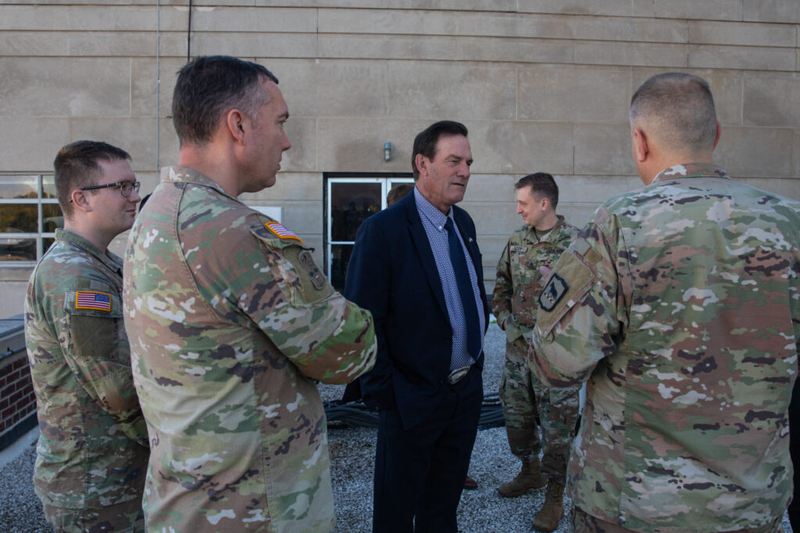
Gov. Larry Rhoden, of South Dakota, meets with soldiers with the South Dakota National Guard, Georgia National Guard and Alabama National Guard in support of Joint Task Force-District of Columbia in Washington, D.C., on Oct. 9, 2025. About 2,300 National Guard members were supporting the D.C. Safe and Beautiful mission providing support to the D.C. Metropolitan Police Department. (U.S. Army National Guard photo by Sgt. Tyler O’Connell)
The South Dakota National Guard has helped process 1,013 deportations for U.S. Immigration and Customs Enforcement since July 2025.
Gov. Larry Rhoden’s office included the figure on Monday in a news release announcing his decision to extend his order for cooperation with ICE in paperwork processing, a task assigned to seven National Guard members. The extension will run through September 2027.
It’s unclear how many of the 1,013 people were residing in South Dakota, because some of them could have been passing through the state. The U.S. Department of Homeland Security, the federal agency that oversees ICE, did not provide the number to South Dakota Searchlight when asked.
Highway Patrol reimbursement
Rhoden’s release also said the Trump administration will pay the South Dakota Highway Patrol $480,000 for its continued work under a cooperative agreement with ICE. Under the terms of that agreement, signed in 2025, 38 state troopers have been trained and are enabled to question people about their immigration status and detain people on ICE’s behalf.
Earlier this summer, Rhoden said the state got $150,418 from ICE to compensate the Highway Patrol for its work.
Rhoden’s Monday news release said the combined $630,418 goes toward “personnel payroll, specialized field equipment, and information technology stipends to support the agency’s coordinated enforcement efforts.”
Troopers have been involved in “261 immigration-related arrests involving individuals unlawfully present in the United States who were encountered during routine patrols across South Dakota,” according to the press release.
Prison, parole cooperation
The state Department of Corrections has also helped ICE deport people since Rhoden’s pledge of state aid for immigration enforcement efforts began last year.
The prison agency has an agreement under which its officers can question inmates about their immigration status.
The state has also paroled inmates who are in the U.S. without legal status into ICE custody. Since July 2025, the state has done that to 38 people.
Some of those inmates were released on presumptive parole. That means they were in line for an automatic early exit from prison because they had followed the rules there and completed the in-custody programming assigned to them upon arrival.
Broader cooperation
In total, there are 11 state or local agencies in South Dakota that have 287(g) program agreements with ICE, under which the agencies are trained and empowered to conduct certain tasks related to immigration enforcement.
The Department of Corrections has two agreements.
The power to question inmates comes through a “Jail Enforcement Model” agreement. The second agreement is a “Warrant Service Officer” model, which lets corrections staff serve immigration warrants to inmates in state prison custody.
South Dakota Attorney General clarifies scope of immigration enforcement agreement
The Highway Patrol has a “Task Force Model” agreement, acting on ICE’s behalf to ask questions and detain people encountered in the normal course of state trooper business.
The Minnehaha and Pennington county sheriff’s offices, both of which operate jails, have warrant service officer agreements. The Grant County Sheriff’s Office has two agreements: one for jail enforcement, and another that lets its deputies question and detain as state troopers do.
Centerville and Viborg are the only cities in South Dakota that have 287(g) agreements with ICE.
The other agencies that have agreements with ICE are the sheriff’s offices in Corson, Edmunds and Hughes counties, and the South Dakota Division of Criminal Investigation.
Tony Mangan, spokesperson for the division, said there hasn’t been remuneration for its work with ICE, which is more limited in scope than the work of the Highway Patrol. Mangan also provided a statement from Marty Jackley, who oversees the division as South Dakota’s attorney general and entered into its agreement with ICE.
“I limited the Division of Criminal Investigation’s agreement with ICE to only violent criminals and drug dealers,” Jackley said. “That mission has not changed.”
Local chief hopes assistance helps bring new funding
Centerville Police Chief Lon Hatcher said he signed a task force agreement with ICE in the interest of making sure he and his fellow officer in the department of two are “evaluating who we’re dealing with to make sure that we’re safe, and the community remains safe.”
“We don’t have a huge amount of demand because our community is smaller,” Hatcher said. “We’re sitting between 900 and 950 people, roughly.”
Centerville is about 40 miles southwest of Sioux Falls. Hatcher’s task force agreement also involves welfare checks for unaccompanied minors.
Under that part of the agreement, Hatcher is empowered to help ICE visit children who entered the U.S. without a parent or guardian and are placed with adult “sponsors” by the Department of Homeland Security. Last November, the department announced its plans to leverage local agencies with 287(g) agreements to help locate and vet sponsors for 450,000 such children.
Hatcher said he’s been called out to assist in one such welfare check, in Sioux Falls.
Centerville is reimbursed for its time and equipment use, but Hatcher said he also hopes the agreement will help the department receive favorable treatment when applying for federal grants.

Pierre, SD