Schiltz: ‘I did not violate any ethics rules’
Oct 02, 2026 | 4:50 pm ET
Description
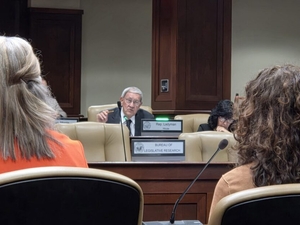
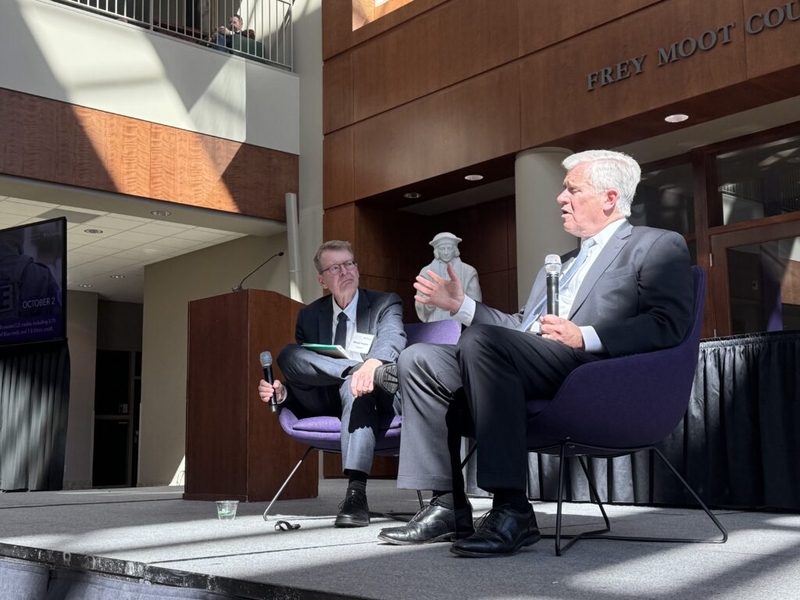
U.S. District Judge Patrick Schiltz speaks at a symposium at the University of St. Thomas School of Law on Friday, Oct. 2, 2026. (Photo by Madison McVan/Minnesota Reformer)
U.S. District Judge Patrick Schiltz on Friday publicly recounted the challenges of administering justice during Operation Metro Surge, just two days after the Justice Department filed an ethics complaint against him and other judges for criticizing the federal government’s actions during the immigration crackdown.
University of St. Thomas law professor Michael Paulsen interviewed Schiltz at a symposium on state law remedies for federal lawlessness at the St. Thomas School of Law. Schiltz was until recently the chief judge for the federal bench in Minnesota.
On Wednesday, the U.S. Department of Justice filed a judicial misconduct complaint to the 8th Circuit Court of Appeals, accusing “all but one” of Minnesota’s federal district judges of unethical conduct, citing a New York Times article featuring interviews with Schiltz and other Minnesota judges.
In the article, Schiltz, who twice clerked for the late conservative icon Supreme Court Justice Antonin Scalia and was appointed by George W. Bush, said what happened in Minnesota federal court during Operation Metro Surge “created a grave threat to the rule of law.”
The DOJ in its complaint accused Schiltz of making “overtly political” comments and discussing cases pending before him. (The New York Times wrote that Schiltz didn’t comment on specific cases.)
At the St. Thomas law school, Schiltz discussed the federal government’s failure to follow court orders in nearly 200 instances; threats against himself and other judges; unprecedented legal maneuvering by federal prosecutors to secure arrest warrants for journalists; and the filing of more than 1,000 wrongful detention lawsuits, called habeas corpus petitions, and the pressure to rule on them before detainees were shipped out of state.
“I spoke (to the New York Times) repeatedly and explicitly about the threat to the rule of law and the threat to judicial independence, and I have not only the right, but I have the duty to do so,” Schiltz said, citing a judicial code of conduct opinion that affirmed judges’ right to defend the rule of law and their own independence.
“If I’m going to defend judicial independence, I can only defend against the person who is threatened by judicial independence,” he said.
Schiltz chose his words carefully, ribbing Paulsen — an old friend — for being a “provocateur” by asking about the federal government’s conduct.
Paulsen said he once tried to get Schiltz a job at the University of Minnesota, where he was working. “They just couldn’t stomach two conservatives on the same faculty,” Paulsen said.
Schiltz instead got a job at the law school at the University of Notre Dame, where he taught future Associate Supreme Court Justice Amy Coney Barrett. He joined the federal bench in Minnesota in 2006.
The attorneys in attendance gave Schiltz a standing ovation at the conclusion of his remarks.

Saint Paul, MN