At AG debate, Republican Ron Schutz commits to putting stocks in blind trust
Oct 02, 2026 | 6:00 pm ET
Description
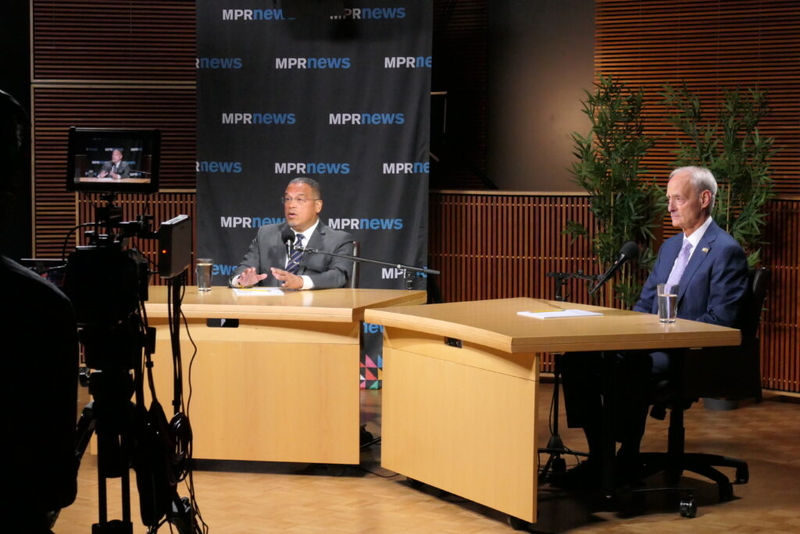
Democratic Attorney General Keith Ellison and Republican challenger Ron Schutz debate at MPR News in St. Paul on Oct. 2, 2026. (Photo by Max Nesterak/Minnesota Reformer)
Republican Ron Schutz said if he’s elected Minnesota attorney general, he will give up control of his vast stock portfolio and divest from any companies that are currently in litigation with the state.
Schutz made the commitment on Friday during an MPR News debate with Democratic Attorney General Keith Ellison, days after the Reformer reported on the potential conflicts of interest presented by his 174 individual stock holdings.
“I will divest from any stocks that I currently own from companies that are in litigation with the state. I will put the rest of it in a vehicle that I won’t have any insight into,” Schutz said, noting that his portfolio is already professionally managed by RBC Wealth Management.
During Friday’s debate, the first in what’s one of the most competitive statewide races, Ellison and Schutz also answered questions from MPR’s Brian Bakst on fraud, the Trump administration, pardons and prediction markets.
Schutz said he would approach the job as a trial attorney — not a politician — leaning on his experience as a partner at a large national law firm. Schutz is not new to politics, though, having spent years as a Republican Party donor and conservative activist. He’s a member of the Federalist Society and serves as a board member of the think tank Center of the American Experiment.
He criticized Ellison for not doing more to stop the fraud scandal that has enveloped Minnesota government and politics since 2022 and accused Ellison of following the lead of California and other Democratic attorneys general.
“I’ve got three grandchildren that live in this state, and I prefer that they grow up in a state that looks a lot more like the one I grew up in and was known as the ‘Land of 10,000 Lakes’ and not the state, as it’s currently known, as the land of 10,000 frauds,” Schutz said.
Ellison, who is seeking a third term, focused his message on affordability, pointing to his track record of going after Big Pharma for price gouging insulin users, employers for wage theft and predatory lenders for deceptive business practices. He also defended his record going after fraudsters, boasting he’s convicted more than 350 people for Medicaid fraud.
“Vote for the person who’s going to fight for your family and help you afford your life,” said Ellison, who’s been using the phrase “afford your life” since his time in Congress.
Trump and Operation Metro Surge
The Attorney General’s Office can serve as a powerful check on the presidential administration and a bulwark against executive actions that affect the state.
Ellison’s office has acted aggressively to push back against President Trump with 75 lawsuits challenging his administration’s use of tariffs, Operation Metro Surge, cuts to safety-net programs and more.
Schutz has mostly avoided criticizing the Trump administration, but he also would not say if he opposes any of the lawsuits Ellison’s office has filed.
“I’m one guy running for attorney general,” Schutz said. “I haven’t had a chance to look at all these cases.”
He did say he issued a press release following the January killing of Alex Pretti by Border Patrol agents in Minneapolis, calling for transparency and a joint investigation by federal and state authorities. Federal agents blocked state investigators from the scene, and Ellison has sued for access to evidence in Pretti’s killing, as well as that of Renee Good.
Schutz said he would “absolutely” continue pursuing possible prosecutions of the federal officers involved in Good’s and Pretti’s killings.
Pardons
Ellison defended his vote to pardon Tou Lue Vang, a Hmong immigrant convicted in 2006 of sexually abusing a 10-year-old girl, because the victim supported it. The decision garnered national attention after the Trump administration highlighted the case and deported the man to Laos.
The case underscored the significant power the attorney general has in granting mercy to people with convictions as a member of the Board of Pardons with the governor and state Supreme Court chief justice, both of whom also voted to pardon Vang.
“I thought it’s important to listen to victims,” Ellison said, noting he has voted against pardoning many others who didn’t have victim support.
Schutz said he wouldn’t have voted to pardon Vang. He said he thinks pardons should only be granted to people who were wrongfully convicted, though it’s unclear how he would determine who was wrongfully convicted.
(Trump, meanwhile, has been particularly profligate with his pardon power, granting clemency to fraudsters, major drug traffickers and the people who stormed the Capitol and beat police officers during the Jan. 6 insurrection attempt.)
Schutz also noted the pardon of Vang was opposed by the local prosecutor’s office and that Democratic gubernatorial candidate Sen. Amy Klobuchar said she wouldn’t have supported it.
Stocks
Schutz previously declined to answer questions from the Reformer about how he would manage the potential conflicts of interest from his large stock portfolio.
Ethics experts say continuing to hold individual stocks while serving as attorney general would be untenable because the public wouldn’t know whose interests he was representing.
Minnesota AG candidate’s stock portfolio presents 174 potential conflicts of interest
If elected, Schutz would have to sell his stock in at least six corporations to uphold his commitment to divest from companies in litigation with the state: Alphabet, Amazon, Apple, Exxon Mobil, Pfizer and Uber.
Ellison says he doesn’t own any individual stocks.
Schutz said he’s gone up against big corporations such as Apple and General Electric during his career as a patent attorney, winning tens of millions of dollars for his clients.
“I will take that track record, that aggressiveness, and I will use it to make sure that nobody — and I mean nobody — takes advantage of Minnesotans,” Schutz said.
It’s unclear how much his portfolio is worth or how much divesting could cost him because state law only requires candidates to list companies in which they own more than $10,000 of stock. Schutz did not make himself available for questions from reporters after the debate.
Agreements
The two appeared to be broadly in agreement on abortion, prediction markets and banning mining near the Boundary Waters Canoe Area Wilderness — but would likely diverge in practice.
Schutz said he views the right to abortion as “settled law” in Minnesota, noting the state Legislature codified that right in 2023. Ellison said he will continue to fight “tooth and nail” to protect patients’ access to abortion and doctors who provide it.
Both described prediction markets as a scourge. Minnesota passed a first-of-its-kind ban on prediction markets, which a federal judge blocked from taking effect pending litigation.
Asked about defending Gov. Tim Walz’s executive order banning mining near the Boundary Waters, Schutz said it’s the job of the attorney general to defend executive orders unless they are unconstitutional.

Saint Paul, MN