Fact-checking misleading, false claims from first Oregon 2026 gubernatorial debate
Oct 02, 2026 | 6:27 pm ET
Description
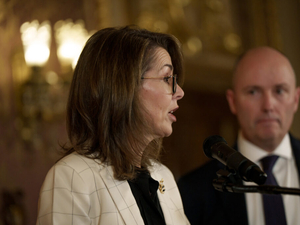
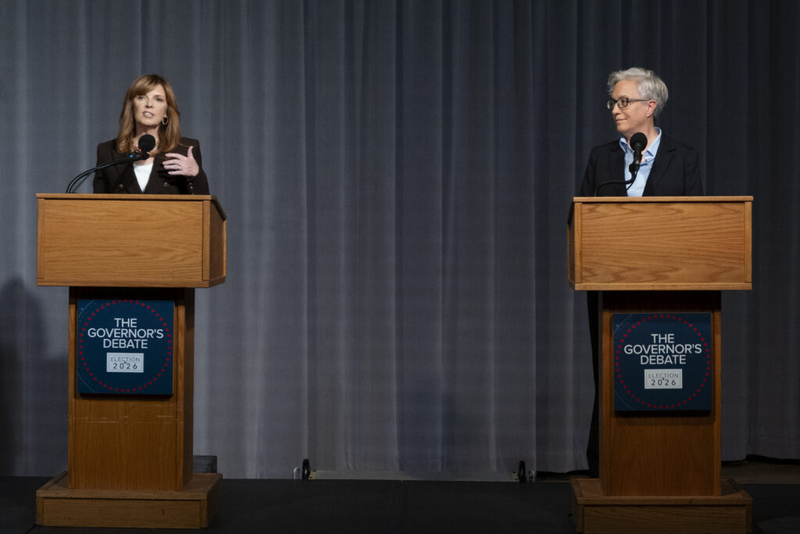
State Sen. Christine Drazan, R-Canby, and Democratic incumbent Gov. Tina Kotek participate in a gubernatorial debate on Thursday, Oct. 1, 2026. Some of their comments included misleading or false claims. (Photo by Will Yurman/ Lookout Eugene-Springfield/Pool)
Both leading candidates for Oregon governor were feeling the heat of the race as they attacked each other’s trustworthiness at Thursday night’s first televised debate in Eugene.
At times, Democratic incumbent Gov. Tina Kotek and state Sen. Christine Drazan, R-Canby, talked past each other about issues such as the National Guard and Portland U.S. Immigration and Customs Enforcement facility. In other instances, they were more blatant in mischaracterizing each other’s positions and statements.
The result of the quick back-and-forth and rebuttals during the hour-long debate left multiple misleading or untrue claims unchallenged on live television.
Kotek, for instance, accused Drazan of misrepresenting Kotek’s work as a governor, hiding her voting record as a Republican legislator and inaccurately describing protests outside the Portland U.S. Immigration and Customs Enforcement facility last year that led President Donald Trump to attempt to federalize the Oregon National Guard to what he called a “war zone.”
Although there was some violence by protesters leading the Portland Police Bureau to declare a riot in June 2025, the site has seen thousands of largely peaceful crowds since, including children, people with disabilities and seniors.
Drazan, who opened her debate speech with a warning that Kotek would try to mislead voters and made some false claims of her own about state legislation, issued a statement condemning “violent mobs and domestic terrorists” and said “we need order, we need to restore safety, and Oregon’s local leaders have failed to provide it” following Trump’s attempted deployment of the National Guard to Portland last September.
Although some political observers interpreted the timing of her statement as tacit support for his actions, Drazan on Thursday denied that.
“Technically, I didn’t support his decision,” Drazan said. “Let me be clear, I don’t want National Guard troops in Oregon. Here’s what I did. I said Oregon should enforce our own laws.”
Kotek took credit for Oregon’s successful lawsuit keeping the administration from deploying troops to the state’s largest city.
“I fought in the courts to make sure unlawful actions could not happen.100 days later, the troops went home — not only Oregon troops, but California troops-and we averted a disaster,” Kotek said. “My opponent said nothing, and she’s recreating the facts.”
“That. Is. False,” Drazan said in a three-word rebuttal to Kotek.
Here’s a look at some of the other misleading or false claims made by the candidates during last night’s debate:
1. Mail-in voting: Drazan faced a question for introducing a 2025 bill, House Bill 3872, that would have overturned the state’s vote-by-mail system in favor of in-person voting. She maintains that the bill would have preserved access to absentee ballots for Oregonians seeking that option.
But the bill would have undone Oregon law requiring it to pay for ballot postage and instituted identification requirements similar to those backed by Republicans nationwide. Drazan said that her sponsorship came from concern that “Oregon is only one of eight states across the nation that doesn’t provide an alternative at all to absentee voting.” In fact, however, Oregon allows voters to mark their ballots in-person at their county clerk’s office, where they can access a privacy booth.
2. Data centers: Kotek repeated a talking point on Thursday that her opponent voted against the POWER Act, a 2025 state law that makes it easier for the state to raise costs on data centers that strain the state’s energy grids. Drazan voted for an earlier iteration of the law but voted against it during its final time on the House floor in 2025.
The senator said Thursday that lawmakers passed the law in “an election year gimmick,” though there was not a routine statewide or legislative race in Oregon that year. She claimed that the law “also targeted small towns and small communities where they’re trying to have data centers for their school districts and their fire stations.” The law says it only applies to large-energy use data centers who consume more than 20 megawatts of energy.
3. Lower taxes: Kotek said she found it “ironic that Senator Drazan wants to talk about affordability when she voted against a low-income tax break in the session this year.” That’s a nod to Senate Bill 1507, which disconnected Oregon from some of the business-friendly tax breaks passed under the 2025 federal GOP tax and spending law.
While the law expanded Oregon’s earned-income tax credit, the law also canceled out auto loan and business-friendly tax breaks for Oregonians that saved the state approximately $300 million in revenue. A Republican-backed attempt to put that law on the ballot for voters to repeal failed in June after not gathering enough signatures.
4. Climate change: Drazan has long been an opponent of progressive climate policies on the grounds that they are burdensome regulations that lead to higher costs for Oregonians, though she hasn’t made controversial comments denying the human-made phenomenon, unlike some other Oregon Republicans.
Kotek, speaking about wildfire relief and the importance of resiliency against climate change, said that Drazan “does not believe” in the scientific phenomenon. The senator quickly rebutted that she “absolutely” believes that “man-made climate change has an impact on us, and it is absurd for her to assert otherwise.”
5. Labor and agriculture: Asked by a debate panelist about whether Oregon would switch to a higher overtime threshold such as Colorado’s for agricultural workers, Drazan noted that “there was intended to be a takeover of our family farms through labor boards in the state of Oregon that that farmers and ag interests across our state opposed in the course of this last session, which Tina Kotek advanced.”
In fact, Kotek signed into law House Bill 2548, which was a 2025 state law that was watered down to instead support a study into the labor standards and working conditions of farmworkers in the state. An earlier version of the bill created a governor-appointed labor board for agricultural workers under the Oregon Bureau of Labor and Industries.
“I hope sometime in the course of the evening, we’ll have some facts coming from Christine Drazan,” Kotek replied afterward.
Federico Araujo, a spokesperson for Kotek’s campaign, declined to offer on-the-record responses to each statement but pointed to a statement released after the debate on Thursday in which he said voters “saw that Christine Drazan is blatantly out of touch with Oregonians.”
“Unlike Drazan, Governor Kotek clearly communicated how she would keep making Oregon more affordable, setting Oregon’s students up for success, and defending abortion access,” he wrote. “For working Oregonians, the right choice for governor couldn’t be clearer.”
Ashley Quinton, a spokesperson for Drazan’s campaign, stressed that the agriculture study law started out as what she called “a takeover of family farms through (a) costly and draconian labor board.” She said that the 2025 POWER Act was “a total election year gimmick” and that “it’s awfully generous yet absurd to presume that Kotek wasn’t going to run for re-election.”
She also pointed out that Drazan’s vote-by-mail bill would have asked voters to weigh in on the change to the state’s election system only after it received approval by a Democratic majority in the Legislature and a governor’s signature.
“Only then would it be referred to the ballot for Oregonians to approve a measure establishing in-person voting on Election Day with Picture ID as the main form of voting and while protecting vote-by-mail through the absentee ballot,” Quinton wrote in an email. “Drazan never pushed for the bill: she never asked for a public hearing, sent out a press release, campaigned on it, or wrote about it on social media — that matters.”
Salem, OR