Voting rights advocates regroup as Callais decision threatens Black representation
Sep 17, 2026 | 5:00 am ET
Description
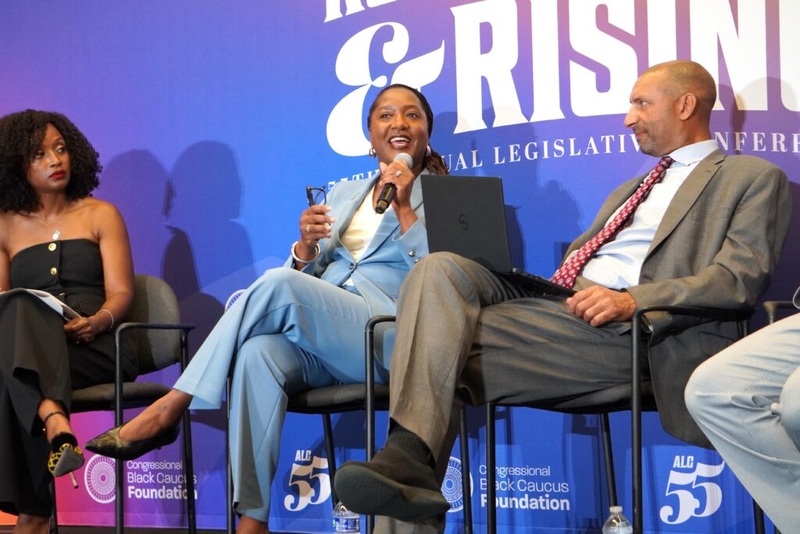
Janai Nelson, center, speaks on a panel about the effects of the Louisiana v. Callais decision at the Congressional Black Caucus Foundation’s 55th annual legislative conference Wednesday. On stage with Nelson is Lakeisha Steele, left, and Spencer Overton. (Photo by William J. Ford/Maryland Matters
With “the crown jewel” of civil rights legislation gutted by the U.S. Supreme Court, and possibly the seats of 20 Black members of Congress at stake in November, voting rights advocates on Wednesday called for a makeover of the nation’s highest court.
The court’s decision in Louisiana v. Callais was “a calamity” that erased equal representation for Black voters, said Janai Nelson, president and director-counsel of the NAACP Legal Defense Fund.
In April, conservative justices ruled 6-3 that protections in the Voting Rights Act of 1965 allowing states to consider race in redistricting amounted to an “unconstitutional racial gerrymander.”
At issue were Louisiana maps that created a second majority-Black congressional seat currently held by Democratic U.S. Rep. Cleo Fields, who is not seeking re-election. Following the court decision, the GOP-controlled legislature quickly redrew Fields’ district to favor a Republican, leaving Louisiana with one Black-majority district out of six. The state’s Black population is around 30%.
Callais marked the second consequential decision on voting rights by the Supreme Court. In 2013, justices struck down preclearance of voting laws and maps in states with a history of voter disenfranchisement.
“It’s awful,” Nelson said Wednesday on the first day of the Congressional Black Caucus Foundation’s annual legislative conference in Washington, D.C.
“But it’s also an invitation to do something much bolder and broader than what we had before,” Nelson said. “I’m a Voting Rights Act cheerleader through and through. As powerful a tool as it was, the Supreme Court, in a different iteration, called it the crown jewel of civil rights legislation. It was always held up as the emblematic, most muscular legislation that came out of the Civil Rights Movement. And even with all that, it wasn’t quite enough.”
The Callais decision triggered Republican majorities in several Southern states to reshape congressional districts less favorable to minority voters in time for the midterm elections. Analysts have said possibly 20 of the Congressional Black Caucus’s 62 members could lose their seats this fall.
“I think a lot of electeds are very much affected and nervous about themselves and their community having a lot less power after Callais,’’ said Spencer Overton, a law professor at George Washington University.
Panelists discussed several options that lawmakers could consider to help reestablish and reinforce voting rights – a system of proportional representation, expanding the court or setting term limits. They stressed that people must be willing to sacrifice to make changes in the current political climate.
Overton said proportional representation allows people to elect multiple representatives in each district in proportion to the number of people who vote for them.
“It’s an opportunity to kind of reset and kind of reimagine,’’ Overton said. “So, I think we have some opportunities in this moment.”
But the idea isn’t new, he said.
Lani Guinier, a civil rights attorney whom former Democratic President Bill Clinton nominated in 1993 to become the first Black woman to head the Department of Justice’s Civil Rights Division, endorsed the idea.
But Clinton abruptly withdrew Guinier’s nomination over criticism from Republicans about her views on voting rights, as she had suggested that “one person, one vote” was not sufficient to advance minorities’ concerns.
Cliff Albright, co-founder and co-executive director of Black Voters Matter, said Guinier’s nomination was not only caught in controversy over race “but also this: Proportional representation is fundamentally a challenge to the two-party system. That’s where the bigger threat was.”
Albright offered three possible changes to improve the work of the Supreme Court: expand it from the current nine members; creating ethics reform; or setting term limits.
“Try. Be willing to do and make mistakes,” he said. “In trying, we may fall short, but guess what? In falling short, we will still move one step closer to liberation.”
Getting out the vote
The panel on Callais was among more than 100 sessions during the 55th annual conference at the Washington E. Convention Center where thousands of elected officials, legal experts, community leaders and others are expected. Topics will cover health, education, artificial intelligence and space exploration industry.
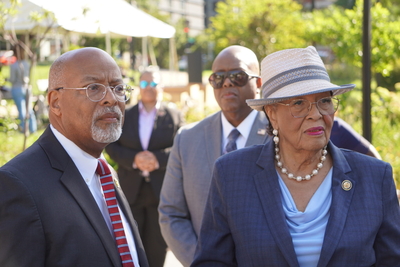
During a press conference Wednesday morning, Reps. Glenn Ivey, D-Maryland, and Alma Adams D-North Carolina, said that although the Trump administration, helped by Republican-controlled statehouses that passed redistricting laws to give the GOP an advantage, they remain confident many of their members will succeed in the November general elections.
“We are working to get those seats. We’re going to try and turn this vote out. That’s really important,” Adams said before the press conference. “We know we’re going to take the House. We’re confident about that in terms of the numbers and how the members are faring out here in the community.”
Annapolis, MD