Rhode Island’s payroll transparency portal hasn’t been updated in nearly a year
Sep 17, 2026 | 5:00 am ET
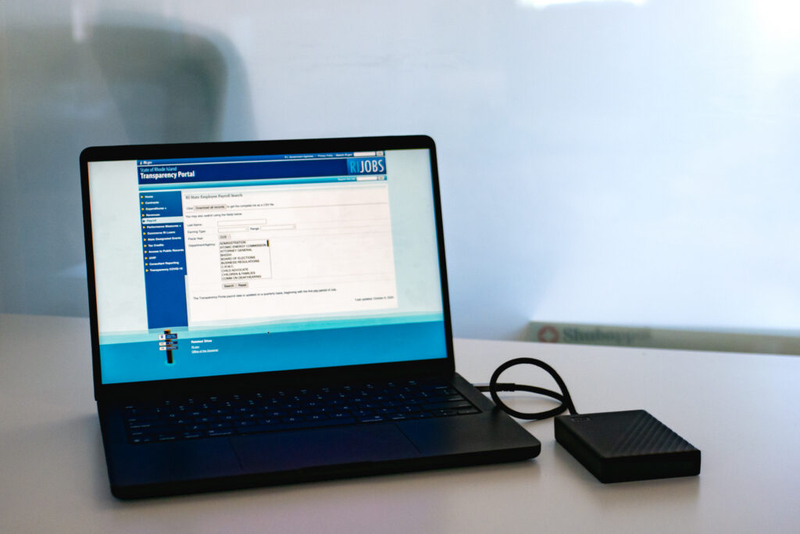
Description
Rhode Island’s state employee payroll transparency portal is displayed on a laptop on Wednesday, Sept. 16, 2026. The database has not been updated with new payroll information since Oct. 9, 2025, amid the state’s transition to a new payroll system. (Photo by Alexander Castro/Rhode Island Current)
Members of the press, government watchdogs and the merely curious all use Rhode Island’s payroll transparency portal for easy lookup of any state employee’s salary, overtime and other essential wage data.
Anyone visiting the payroll portal to find out how much a certain state employee makes, however, will be looking at not-quite-fresh numbers. The online payroll directory, which is supposed to be updated quarterly, notes on its own website that it has not been fed new data since Oct. 9, 2025.
The lack of updates is because of the state’s transition to its new financing, human resources and payroll system, also known as the Enterprise Resource Planning (ERP) system — a multiyear effort spanning two gubernatorial administrations that was finally completed last year in a $99 million effort.
“The payroll transparency portal updates have been paused while the State goes through the ERP transition,” Department of Administration spokesperson Karen Greco said in an email Wednesday. “Because ERP holds more robust data than the legacy system, consolidating them is taking time.”
Greco confirmed that, in simple terms, the new ERP system outputs data that differs from what the existing transparency portal was built to ingest.
Work on the portal remains ongoing, Greco said, but added that “essential business operations currently take priority.” She could not immediately provide a timeline for when new updates would resume.
The payroll portal’s most recent update from last October derives from early in fiscal year 2026; fiscal year 2027 began July 1.
Other data for fiscal year 2026 appears absent from the transparency portal. The expenditures database — which lists and breaks down state government payments to vendors, municipalities and other entities — also did not appear to contain any data for fiscal year 2026 as of Wednesday afternoon.
Other sections of the portal, like its database of state government contracts and purchasing agreements, have been updated recently.
In the meantime, Greco said interested parties can still request and receive updated payroll information about state employees.
That’s not the best compromise for open government advocates like Steven Brown, executive director of the ACLU of Rhode Island, who said in an email Wednesday that he hadn’t been aware of the portal’s stagnant data.
“While we recognize that transitions to new database systems can be challenging, this is, after all, a transparency portal,” Brown wrote. “Getting it up and running should be a much greater priority for the state than it appears to be.”
“A year is way too long to leave easy access to this important public information languishing,” Brown added, and urged the state to give the issue “much more serious attention” as well as a more concrete timeline.
John Marion, executive director of Common Cause Rhode Island, was similarly disappointed by the lapsed upkeep of what he described as an important reservoir of public knowledge.
“For over a decade, it has been an invaluable tool for the press and public to track government salaries,” Marion said in an email Wednesday.
The payroll database contains data going back to 2011, with annualized salaries available from fiscal year 2016 onward. The Department of Administration said the transparency portal itself launched in 2013, during former-Gov. Lincoln Chafee’s administration.
Marion said he’s “old enough to remember” its creation.
In a statement still available on the portal website, Chafee touted his new initiative upon its release as “a significant step in my Administration’s efforts to provide the public with an increased level of information regarding the operation and management of government, as well as ensuring the most efficient use of taxpayers’ money.”
Chafee created the portal voluntarily and did not go through the General Assembly to enact laws which would require the portal’s maintenance, Marion noted.
“This shows the limits of government transparency that relies on voluntary compliance,” Marion said.
A year is way too long to leave easy access to this important public information languishing.
Government salaries are among the records most commonly sought by the public, Marion said, and he noted Providence’s own municipal transparency portal, where salary information is the most-viewed public record among more than 16,000 records available on the site.
Marion said he hopes the Department of Administration “prioritizes getting the portal back up and running” and that it will respond “to individual requests for the data as expeditiously as possible.”
The compensation of government employees is categorized as public under Rhode Island’s Access to Public Records Act (APRA). To this end, the payroll search lets users look up state workers by last name, fiscal year and department or agency. Users can also sort the database to see, for example, who received the biggest salary in a particular agency or who made the most in overtime in a particular fiscal year across state government.
Greco said the Department of Administration cannot verify if the portal has deviated before from its regularly scheduled updates.
“We have no way to verify any changes to the cadence of updates to the portal since its inception,” she wrote.
Other woes related to the Workday rollout
The state payroll portal’s dearth of updates is another shockwave from the ERP rollout, which began under former Gov. Gina Raimondo’s administration and was completed in two phases last year under Gov. Dan McKee.
The state’s ERP system replaced aging infrastructure on both the back- and front ends of Rhode Island’s payroll, human resources and financing systems. The new system is a cloud-based implementation of Workday configured by another state vendor, Accenture.
State employee unions demand accountability for paycheck errors amid new software rollout
A 2024 solicitation for a vendor to implement the new Workday-based system described the Division of Human Resources’ clerical operations as mostly analog, with timesheets submitted on paper or as PDFs, and hiring forms completed as hard copies. The old system additionally used “a couple standalone information technology systems” along with a payroll system rooted in the 67-year-old programming language COBOL — an enduring and still-updated favorite of governments, banks and big businesses, but also a language with increasingly few practitioners.
The ERP’s finance portion went live in July 2025, followed by human resources and payroll in November — shortly after the payroll portal received its most recent update on Oct. 9, 2025. The 2024 vendor solicitation mentions a first run of the payroll planned for a day later on Oct. 10, 2025, although it’s not clear if the state maintained this timeline.
Nevertheless, problems began soon after the payroll transition and stretched on for months, eventually providing an awkward conclusion for then-Department of Administration Director Jonathan Womer’s time at the department when McKee compelled him to resign in March.
Informing McKee’s decision to let go of Womer was a string of payroll-related debacles following the ERP transition, including paychecks with the wrong wages, incorrect overtime or holiday pay, problems with benefits and deductions, incorrect employer labeling and W-2s, and excess contributions made to employee retirement plans.
The outcome is not at all uncommon for larger ERP efforts, which tend to be expensive and prone to errors and problems, often due to the sheer complexity of large-scale IT overhauls which replace hodgepodge systems that gradually fused over the years. A 2020 report from 18F, a digital services team working under the U.S. General Services Administration, cited research showing just 13% of government software projects costing more than $6 million were completed on time, within budget and to satisfactory results.
Providence, RI