Ohio report cards show 38 school districts need help to meet state standards
Sep 17, 2026 | 3:55 am ET
Description
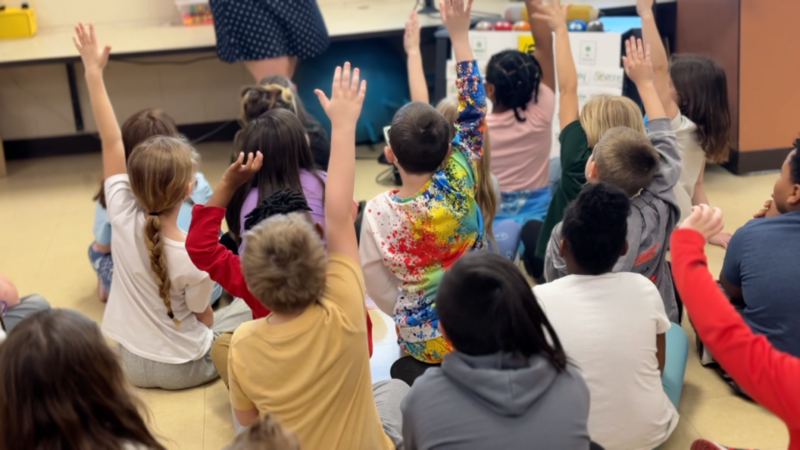
Ohio school children in a classroom. (Photo by Morgan Trau.)
About 6% of Ohio school districts need support to meet state standards, according to the new state report cards the Ohio Department of Education and Workforce released Tuesday.
The department uses 1 to 5 star ratings in half increments based on six categories: achievement (25% weight toward overall rating), progress (25%), early literacy (12.5%), gap closing (12.5%), graduation (12.5%), and college, career, workforce, and military readiness (12.5%).
The state switched away from using the A-F letter grade system to star ratings back in 2021.
- 61 districts earned 5 stars — meaning these districts significantly exceed state standards
- 92 districts earned 4.5 stars — exceeds state standards
- 160 districts earned 4 stars — exceeds state standards
- 145 districts earned 3.5 stars — meets state standards
- 111 districts earned 3 stars — meets state standards
- 32 districts earned 2.5 stars — needs support to meet state standards
- 6 districts earned 2 stars — needs support to meet state standards
No district earned below 2 stars.
Canton City Schools, Dayton Public Schools, Lima City Schools, Middletown City Schools, Toledo Public Schools, and Trimble Local Schools each earned 2 stars.
Click here to find out how your local school district performed on the state report cards for the 2025-26 school year.
Columbus City Schools — the state’s largest district with about 45,000 students — earned 2.5 stars overall, an improvement from last year’s 2 stars.
Cincinnati Public Schools earned 3 stars overall and Cleveland Metropolitan School District received 2.5 stars overall.
“While we know there is more work to do to improve achievement, our proficiency gains and continued student growth show we are moving in the right direction,” Cleveland Metropolitan School District CEO Warren G. Morgan II said in a statement.
Statewide data
English language arts proficiency reached a statewide five-year high of 62.2%, up from 60.4% during the 2024-25 school year.
Ohio school districts are required to teach the science of reading, which incorporates phonemic awareness, phonics, fluency, vocabulary, and comprehension.
“We know the science of reading is the best method we have for teaching children of all abilities how to read,” Ohio Gov. Mike DeWine said in a statement.
“A change of this scale takes time and persistence from teachers and students, but when you look at this year’s state report cards and see what has been done in a relatively short amount of time, it is a tremendous accomplishment.”
ODEW Director Stephen Dackin also praised Ohio’s literacy results.
“Raising literacy achievement is foundational to everything we want for Ohio students,” Dackin said in a statement.
“The ability to read proficiently opens doors to success in mathematics, postsecondary education, careers, and life beyond the classroom.”
Math proficiency also reached a five-year statewide high with 56.4%, up from 55.3% during the 2024-25 school year.
Ohio’s four-year graduation had a minor increase to 88.8%, compared to last year’s 88.3%, according to the report card.
The statewide chronic absenteeism rate — missing 10% or more of school hours for any reason — dropped to 23.9%, according to the report card. The chronic absenteeism rate was 25.1% last year and 30.2% during the 2021-22 school year.
“Widespread absenteeism continues to undermine academic improvement, particularly in Ohio’s highest-need communities,” Aaron Churchill, Ohio Research Director at the Thomas B. Fordham Institute, said in a statement.
“At its current rate of improvement, Ohio will return to pre-pandemic chronic absenteeism rates sometime during the 2030s. That is unacceptable. State policymakers must take more aggressive steps, including a stronger report-card mechanism, to ensure daily attendance.”
Ohio saw a slight dip in the number of students experiencing homelessness — going from 26,292 students during the 2024-25 school year to 24,609 students in the 2025-26 school year.
Southern Local Schools in Meigs County had the highest percentage of students experiencing homelessness with 15.8%, followed by Nordonia Hills City Schools in Summit County with 10.5%.
The state report card also lists the number of students in each district that used one of five private school scholarships for the 2025-26 school year— the Autism Scholarship Program, the Jon Peterson Special Needs Scholarship Program, the Cleveland Scholarship, the Education Choice Scholarship, and the Educational Choice Expansion Scholarship Program.
Ohio lawmakers expanded the Education Choice-Expansion eligibility to 450% of the poverty line through the 2023 state budget — creating near-universal school vouchers. K-8 students can receive a $6,166 scholarship and high schoolers can receive a $8,408 scholarship in state funding under the expansion.
Cleveland Schools had 7,893 EdChoice and Cleveland Scholarship students, and 24 EdChoice Expansion students in 2025-26.
Columbus City Schools had 7,298 EdChoice students and 1,781 EdChoice Expansion students in 2025-26.
Cincinnati Public Schools had 6,796 EdChoice students and 1,635 EdChoice Expansion students in 2025-26.
Northwest Local Schools in Hamilton County had the most EdChoice Expansion students during the 2025-26 school year with 2,629 students, followed by Oak Hills Local Schools in Hamilton County with 2,615 students and Parma City Schools in Cuyahoga County with 2,613 students.
Follow Ohio Capital Journal Reporter Megan Henry on X or on Bluesky.
Columbus, OH