How low should it go? Maryland regulators weigh energy efficiency program cuts
Sep 03, 2026 | 5:00 am ET
Description
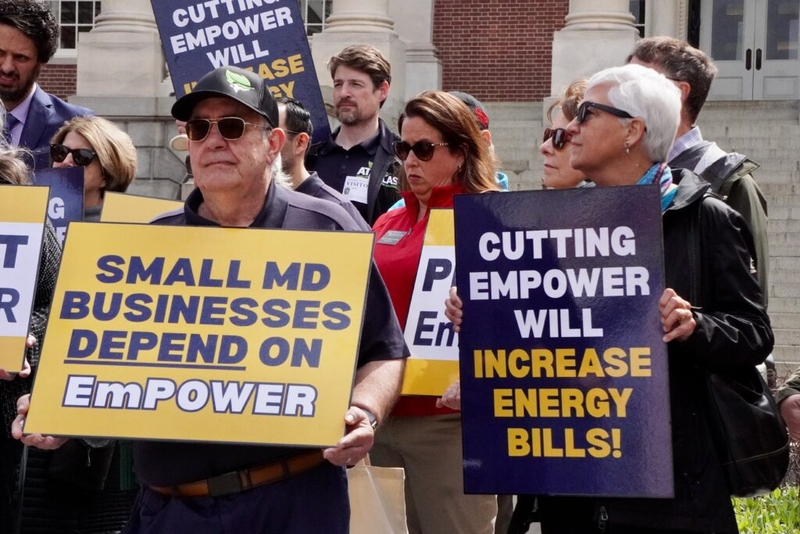
Protesters gathered outside the State House on March 30 to defend the EmPOWER Maryland program against temporary cuts proposed in the Maryland General Assembly. (Photo by Christine Condon/Maryland Matters)
Maryland’s electric utilities submitted proposals Tuesday to reduce the size of EmPOWER Maryland, the state’s signature energy efficiency program, changes that could save residential customers up to $9 a month on their electric bills starting in January.
The proposals follow a temporary reduction of the program by lawmakers earlier this year to offset high electric bills, amid pressure on the grid from data centers, retiring power plants and more.
Now, regulators at the Maryland Public Service Commission are deciding how dramatically to cut the EmPOWER program. The commission in July asked asked each utility that offers EmPOWER to submit two options: a more aggressive cut to the program and a less aggressive one.
At Exelon, which owns Baltimore Gas & Electric, Pepco and Delmarva Power, officials said they’re hoping to see the commission approve the deeper set of cuts.
“Given where our customers are in terms of their bills, I think the most important thing that we can do is offer some relief — and we think that’s in line with the legislative intent,” said Lindsay North, director of strategy at Pepco and Delmarva Power.
But those cuts would come as Maryland’s Exelon utilities are proposing rate increases that may make any EmPOWER savings less noticeable.
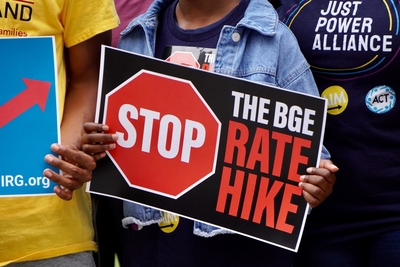
Baltimore Gas & Electric in July put forward what it called a “bare bones” rate increase request that would raise the average residential customers’ monthly bill by $8, if approved by the PSC. Regulators recently cut a Pepco rate increase request in half, but Pepco customers will see, on average, a $3.94 increase in their monthly bills, the commission ssid.
And consumer advocates and environmental groups have warned that short-term cuts to the EmPOWER program would increase bills in the long run, as homes and businesses that are less energy efficient place greater strain on the electric grid. That would add costs to consumers and ultimately require new infrastructure such as substations and power plants.
“It’s really just shifting those costs into the future,” said Mike Specian, a senior research manager at the American Council for an Energy-Efficient Economy. “Because if you’re not going to pay for energy efficiency now, you’re going to have to pay for additional generation later.”
Utility proposals differ
Under the plans submitted Tuesday, Potomac Edison’s residential customers in Western Maryland could see the biggest EmPOWER Maryland surcharge drop on their monthly bills. Its two proposals would cut either $8.79 or $8.06 per month compared to this year. (Some of that decline is because the company over-collected EmPOWER funds in 2026, said spokesman Will Boye.)
Delmarva Power’s residential customers could see a similar decline — either $7.86 or $8.39 a month — according to its plan. At BGE and Pepco, the monthly decrease would be more like $6 to $7.50.
Southern Maryland Electric Cooperative customers, meanwhile, would see a monthly decrease of 22 cents or $1.53. In total, the EmPOWER program would cost those customers $14 to $16 each month in 2027.
North, of Pepco and Delmarva Power, said she’s hoping customers don’t feel the effects of a shrunken program. She said the goal was to trim programs that customers are using less, and keep the most popular programs, offering similar-sized rebates as in years’ past — but fewer in number.
“I don’t know that our customers are going to notice that much of a difference,” North said. “It’ll be the same impactful EmPOWER where they [can] participate in the majority of programs that they know, or their neighbors have done.”

EmPOWER, which began in 2009, offers consumers free and reduced price energy efficiency services, including home energy audits, insulation and weatherization, HVAC upgrades, smart thermostats and more.
Under their plans for 2027, the Exelon companies plan to continue offering free “quick home energy checks,” which are considered a “gateway” to EmPOWER programs, wherein an energy efficiency professional visits a customer’s home and identifies possible improvements, installing LED light bulbs and weather stripping along the way.
But fewer rebates will be available. Homeowners seeking rebates for new HVAC equipment and other upgrades could encounter exhausted budgets if they apply too late, North said.
“The contractor who is running or helping to support that program would know when those budgets are getting close to being spent, and so they’d probably encourage the customer to get those applications in and sign up sooner so that they get those rebates and those incentive dollars before the budgets run out,” North said.
Some EmPOWER programs could end entirely. BGE’s lower-budget scenario would end a few EmPOWER initiatives, including an appliance recycling program and a budget for experimental energy efficiency pilot programs, said Jessica Yu, a senior manager of BGE’s energy efficiency portfolio.
The company believes the temporary cuts won’t be “too detrimental” to the state’s long-term energy demand.
“Like the appliance recycling program — that’s not really impacting peak demand,” Yu said. “We are taking the resources and budget that were used towards that program and actually shifting it towards the programs that provide the biggest reduction in peak demand.”
BGE has also proposed adding new resources for customers, including a dedicated staff member to help people who in multifamily dwellings, such as apartments and condos, access EmPOWER programming where eligible. The company also plans to better target marketing dollars for EmPOWER, Yu said, sending information to customers most likely to use it.
“In the past, because of how ambitious the goals were and because they were climbing at the degree that they were climbing at, it required us to basically have to throw everything at the wall to get as much GHG [greenhouse gas] savings as possible. Now that there’s a little bit more breathing room, we’re really able to focus and optimize our portfolio,” Yu said.
Maryland geothermal energy program faces delays amid cost concerns
Disputes over emissions goals
When the General Assembly decided to cut EmPOWER in this year’s Utility RELIEF Act, they did so by trimming the greenhouse gas emissions reduction goals associated with the program. The goals will decline in 2027, and then begin increasing again in 2029, reaching today’s goals by 2033.
But the legislature also allowed utilities to count solar energy in their territories toward their goals, effectively reducing the size of the EmPOWER program further — and adding some complexity to the calculations.
The utilities proposed a formula that would cut EmPOWER more drastically, said Specian, of ACEEE.
“The utilities took advantage of the RELIEF Act,” Specian said. “In my opinion, they used it as an excuse to try to lower the size of the program even further. But in doing so, it violates the law.”
ACEEE proposed its own formula, as did the PSC staff. Amid the disagreement, the commission asked the utilities to produce two plans for their EmPOWER budgets — one following the utility model and the other from the commission.
But a coalition of advocates, the Maryland Energy Efficiency Advocates, have appealed that decision, arguing that the two models approved by the commission wouldn’t meet the legislature’s goal. The advocates argue that the utility model would result in nearly $40 million less net benefit to utility customers, and the model from the commission’s staff would result in $13 million less net benefit.
The commission is accepting comment on the rehearing request, and has not made a decision.

Annapolis, MD