Ahead of Labor Day, unions back Crowley
Sep 03, 2026 | 4:45 am ET
Description
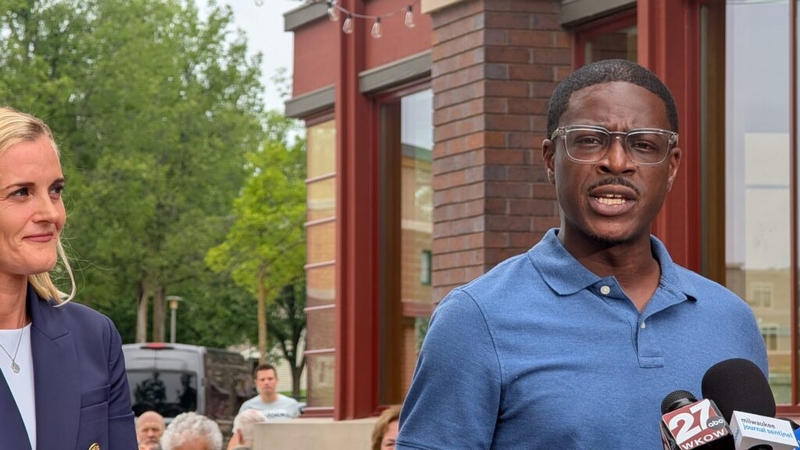
Democratic gubernatorial candidate David Crowley was endorsed by four labor unions on Wednesday. (Photo by Baylor Spears/Wisconsin Examiner)
Days before Labor Day, and with just over two months before the November election, a coalition of labor unions announced Wednesday they were backing Milwaukee County Executive David Crowley’s campaign for governor.
Leaders from American Federation of Teachers-Wisconsin, the Service Employees International Union Wisconsin, the United Food and Commercial Workers Local 1473 and the Wisconsin Education Association Council announced their organizations’ endorsements of Crowley — acknowledging that even if they don’t agree with the Democratic nominee on every issue, he’s preferable to Republican U.S. Rep. Tom Tiffany — who as a member of the Legislature voted for Act 10, the controversial law that stripped collective bargaining rights from most public employees.
“For the future of labor, this election is incredibly important,” Jon Shelton, president of AFT-Wisconsin and a professor at UW-Green Bay, said. “We know that we just came out of a primary that was contentious, but we are showing the solidarity to work with your campaign to make sure that we don’t just win this election, but we win a trifecta, and we move the state of Wisconsin in the direction that every working person, every kid in our schools, every citizen in this state deserves.”
At a virtual news conference to announce the endorsements, Crowley touted his family’s union membership and the work he’s done in the past to support Wisconsin labor.
“Working people, we aren’t asking for a handout,” he said. “We’re asking for a seat at the table. We’re asking for a fair deal. That’s pro- worker, that’s pro-family, and that’s the Wisconsin that I absolutely believe in.”
Leadership from some of the unions touted the support Crowley has provided to them in previous fights. Pat Raes, president of SEIU Wisconsin Healthcare and a nurse at Madison’s Meriter Hospital, noted that Crowley joined her union’s fight when Meriter’s nurses went on strike last year and when Milwaukee commercial office workers were bargaining for a new contract in 2024.
Raes also pointed to Crowley’s support for raising Wisconsin’s minimum wage, overturning Act 10 and expanding access to child care and healthcare.
But other unions throwing support behind Crowley are making some policy concessions. WEAC had endorsed state Sen. Kelda Roys (D-Madison) in the Democratic primary for governor — partially because of her plan for winding down the state’s private school voucher program.
Private school vouchers
As Milwaukee County executive, Crowley represents the part of the state with the largest number of voucher school students and has said he doesn’t support ending the controversial program, though he has said he wants to increase oversight and transparency.
On Wednesday, WEAC president Peggy Wirtz-Olsen said she’s “talked” with Crowley about the “damage caused by vouchers” and added “Wisconsin educators are convinced that David Crowley will be the best choice for governor.”
“WEAC has met with David Crowley and engaged in extensive conversations about the issues that are affecting public school educators, my colleagues and I, students and families we serve, and public education in Wisconsin,” Wirtz-Olsen, who also teaches high school English and art in Marshfield, said. “We’ve talked honestly about the inadequate and unstable funding, the growing class sizes, educator shortages, mental health, special education, and all the damage caused by the vouchers. We’ve talked about affordability and about high costs and how that’s squeezing families, students, and our educators.”
Tiffany has supported voucher schools and cuts to public education funding as a member of the state Legislature and in Congress. If elected, he and his Republican allies are likely to further expand the state’s voucher programs, which draw from the same pool of resources as public schools. Wirtz-Olsen said that WEAC was supporting a candidate who won’t send more state money to private voucher schools.
“When lawmakers send more taxpayer dollars into unaccountable private school voucher programs instead of fully funding public schools that serve every student, the direct result is fewer resources for students who need the support, larger class sizes, and continued delayed services,” she said. “It’s no wonder that about half of first-time teachers will leave the profession. These demands are unsustainable. That’s been a failure of state priorities. Wisconsin needs a governor who understands that public schools are not a chip for high-stake deals. Public schools are an investment in our children, our workforce, our communities, and our democracy.”
Data centers and trade unions
The early weeks of the general election campaign were dominated by the two candidates wrangling over the issue of data centers, which has become a hot button in elections across the country this year.
Tiffany, who in ads has called Crowley “data center David,” has said he opposes data centers, along with wind and solar farms, on the grounds that they’re taking too much of Wisconsin’s prime farmland. Crowley has said he wants to enact additional regulations governing data center development, including requirements that they be powered by renewable energy and built with union labor.
Wisconsin’s building trade unions have been more supportive of data center developments than the public at large.
But once hyperscale data centers such as those currently under construction in Beaver Dam, Mount Pleasant and Port Washington are built, the artificial intelligence technology they support could potentially disrupt the jobs of thousands of Wisconsin workers, including the teachers, professor and nurses endorsing Crowley.
At the Wednesday event, Crowley said he wanted to make sure Wisconsin is “being aggressive when it comes down to protecting our workforce, protecting our environment, making sure that not one single dime is being pushed off to ratepayers and taxpayers here.” He added that he believes AI should increase productivity rather than replacing it and noted that Tiffany was a deciding vote when the House of Representatives voted to ban states from regulating AI for a decade as part of the One Big Beautiful Bill Act. The provision was not in the version of the bill that President Donald Trump signed into law last year.
“Artificial intelligence will never ever be able to compete with authentic intelligence, and that’s what people bring to the table,” Crowley said. “And so it is unfortunate that my opponent, Congressman Tom Tiffany, he actually was the deciding vote to actually put up a state ban on us being able to regulate artificial intelligence. But we have to do everything that we can to make sure that we’re protecting workers moving forward and make sure that workers have a seat at the table as it relates to how we use artificial intelligence in the field, no matter the industry.”
Madison, WI