Lacking cash, Jackson is leaning into his ground game
Sep 03, 2026 | 5:17 am ET
Description
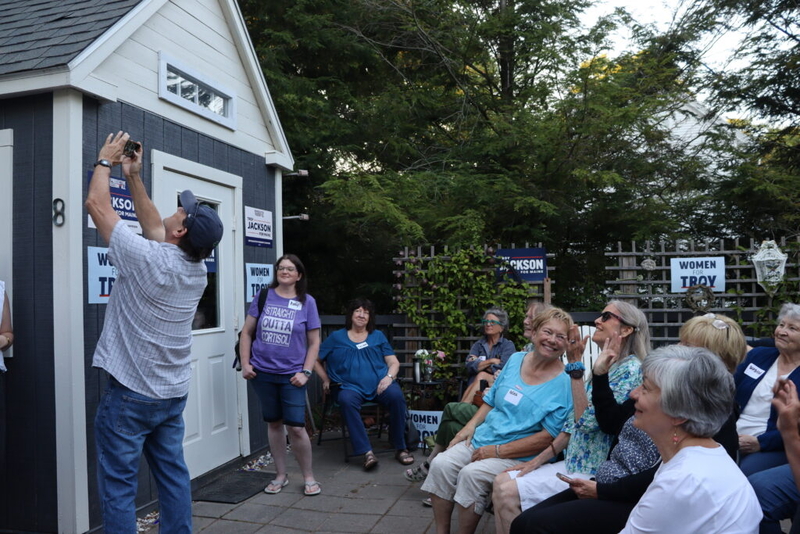
Democratic U.S. Senate nominee Troy Jackson takes a selfie with supporters at a campaign event in Brunswick on Aug. 26, 2026. (Photo by Emma Davis/ Maine Morning Star)
Troy Jackson is focused on the ground game.
Wearing a Red Sox hat and jeans in a supporter’s backyard in Brunswick, the Democratic U.S. Senate nominee did not mince his words. “They’re gonna outspend us,” he told Maine Morning Star of incumbent Republican U.S. Sen. Susan Collins’ campaign and the dark money groups blanketing the airwaves with favorable ads.
“There’s just no way around it. But, you’re seeing all across this country people are getting outspent and still winning because they have the right message. People know that they’re honest and sincere — what they’re fighting for.”
That trend has largely been seen in primaries with progressive candidates challenging establishment Democrats. Jackson is banking on progressives like himself being able to replicate that success against Republicans in the fall.
With a glaring financial disadvantage to Collins, Jackson is aiming to scale up the type of support that secured him the nomination in July, after Graham Platner’s late exit from the race following an accusation of sexual assault.
Coming off of a recent loss in the Democratic gubernatorial primary, Jackson quickly consolidated support for his Senate bid, becoming the presumptive replacement before official votes were even cast at a nominating convention that the state Democratic Party pulled together in a matter of weeks.
“We’re gonna do just like what we did for the convention,” Jackson said. “We’re gonna go out and organize people. I mean, we’ve got a ground game.”
By the numbers
Jackson isn’t required to report his campaign’s full stockpile until October, but he raised $5.3 million through his party’s national fundraising platform, ActBlue, in July alone — largely on July 25, the day he was selected.
He started essentially from scratch during a condensed campaign period, unable to transfer any money from his gubernatorial bid. But Collins had already been outfundraising Platner when he was still in the running.
The Republican incumbent had $11 million cash on hand as of last quarter, which covered April 1 through June 30. Still, much of her financial might comes from outside groups.
For example, the Senate Leadership Fund, a Republican super PAC, committed to investing over $42 million against Jackson the day Maine Democrats officially selected him as their nominee. While such super PACs must disclose their donors, they are beneficiaries of large contributions from nonprofits that aren’t.
According to a New York Times analysis of advertising funded by dark money, Republican groups have spent $47.4 million in Maine’s Senate race so far, including on TV ads and mailers.
In comparison, Democratic groups have spent $27.1 million, according to that analysis. Some of the liberal dark money being funneled to Jackson comes from the Government That Works PAC, which is spending $1.3 million on supportive ads, according to recent filings.
Voters of various persuasions have told Maine Morning Star throughout the past year that negative ads focused on mudslinging do not resonate with them.
“I can’t even watch baseball in peace,” said Judy Parker, a Democrat from Portland.
Parker and other voters said they want ads to focus on policy. Ads of both types have been misleading this election cycle. Unable to escape them, Sophie Creamer of Portland said they try to fact-check claims in real time.
“It still doesn’t influence ultimately how I’m going to vote in the race,” Creamer said of ads, “because I think the best place for me to get my information about a candidate is going to be from their campaign website in terms of policies.”
Studies have found that political ads don’t often change voters’ minds but can help boost voter turnout.

The ground game
While both money and a ground game matter, money doesn’t buy outcomes, said Mark Brewer, chair of the political science department of the University of Maine. Collins won reelection the last time even though her Democratic challenger, Sara Gideon, had outspent her.
“I think money gives Collins an advantage, but I don’t think it debilitates Jackson in any way, shape, or form,” Brewer said. “Despite the modernization of campaigns and the professionalization of campaigns and all that other stuff, we know that boots on the ground still matter.”
Money can matter in that, too, because it can be used to buy a ground game. Several Mainers have reported out-of-state canvassers knocking their doors to campaign for Collins.
“We know that a ground game based on enthusiastic volunteers and party workers is better than a hired-gun ground game, just because those people are more invested,” Brewer said.
More than 1,000 Mainers joined Jackson for the Maine Democratic Party’s volunteer kickoff last month. But that’s far less than the approximately 15,000 volunteers Platner’s campaign said it had before he withdrew from the race.
“There are more of us out there that are looking for a different government than the people that are holding us back,” Jackson told the crowd during his first town hall in Lewiston Tuesday night.
Similar to Platner’s campaign events, attendees were encouraged to sign up to volunteer their time.
“One conversation with any of you all, and those ads are toast,” said organizer Eva Kappas. “The billionaires are terrified because they don’t have what we have in this room and that is all of you.”
One of the Mainers knocking doors and phone banking for Jackson is Diane Morin of Augusta, who first met him when she was helping a friend campaign for the state Legislature in 2012. With family in the logging industry, Morin recalled liking Jackson’s background and dedication to helping average workers, having formerly been a hairdresser with few benefits and no vacation.
Given his late entry into the race, Jackson is tasked with constructing the plane while he’s flying it, as Brewer put it, “and Susan Collins is anything but. She’s got decades of construction experience. It’s almost turnkey-ready.”
That said, nationally this cycle Democrats have a massive enthusiasm advantage over Republicans, Brewer added.
“Can Jackson take advantage of that?” he asked. “Can Collins somehow cut into that?”

Augusta, ME