Missouri labor unions, abortion rights groups turn unlikely alliance into ballot power
Aug 28, 2026 | 6:55 am ET
Description
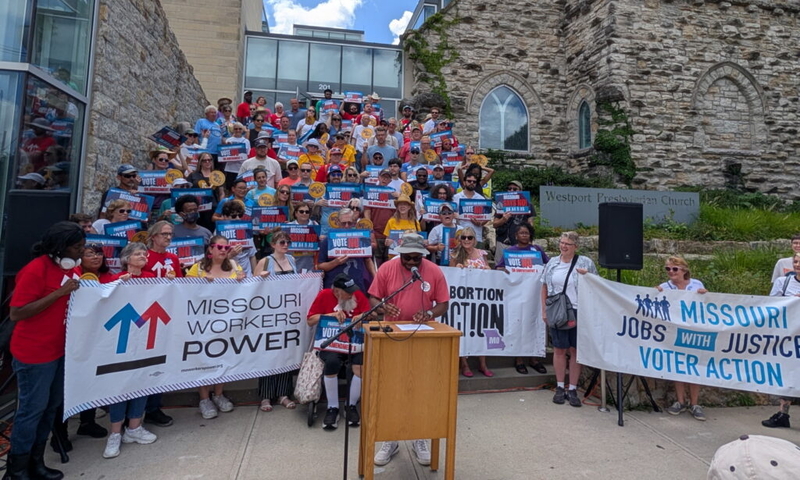
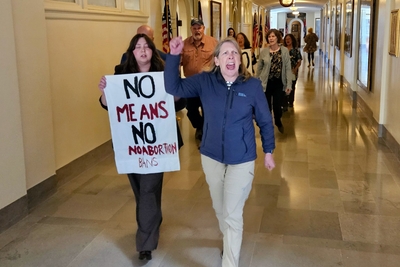
Missouri labor and reproductive rights groups came together ahead of the August 2026 election to rally against Amendments 4 and 5 (photo submitted).
A coalition of Missouri labor unions and reproductive rights groups announced a $1 million campaign this month aimed at defeating Republican lawmakers who voted to repeal the state’s paid sick leave requirement.
Not long ago, such a partnership would’ve seemed unusual and unlikely.
But years of organizing — and repeated battles with the Republican-controlled legislature over abortion rights, worker protections and the initiative petition process — have drawn the movements increasingly close together.
The results have been striking at the ballot box.
In 2018, voters overwhelmingly repealed a right-to-work law passed by lawmakers. In 2020, they expanded Medicaid. Four years later, they approved both abortion rights and a higher minimum wage with paid sick leave.
And this August, unions and reproductive rights groups worked together to help defeat Amendments 4 and 5, proposals dealing with the initiative petition process and elimination of the state income tax.
Now comes another test. In November, Missourians will be asked whether they want to repeal the abortion rights amendment they approved in 2024 and reinstate an abortion ban.
“We’ve tried to figure out in the kind of swing-back that we’ve seen from the legislature,” said Caitlyn Adams, executive director of Missouri Jobs with Justice. “How to not get picked off one-by-one, but stand as a united front against the attacks.”
M’Evie Mead, campaign director for Protect Majority Rule, a committee created to oppose Amendment 4, said by building an “incredibly powerful, interconnected movement of people,” goals like raising the minimum wage and expanding Medicaid eligibility were possible in a state dominated by Republicans.
“We can win these concrete victories,” she said, “that improve people’s economic and reproductive lives.”
Clarke Wheeler, a senior policy analyst with the National Women’s Law Center, said labor unions and reproductive rights groups in Missouri have excelled at connecting their issues in a way that resonates with voters.
Missouri, she said, is a “shining example of the power of cross-movement organizing and what it looks like on the ground in real life.”
Siloed efforts were futile
Decades ago, the two movements at times found themselves pitted against each other.
“The labor unions, back when the Democrats ran the state, had members and constituencies and legislators who were friendly to labor, but unfriendly to reproductive rights,” said Michael Wolff, a former chief justice of the Missouri Supreme Court and dean emeritus at the St. Louis University School of Law.
Nancy Cross, former vice president of SEIU Local 1, has been part of the conversations mobilizing union workers to support reproductive rights for decades. She moved to Missouri in 2004 to work for the Service Employees International Union, tasked with getting a local St. Louis union back on its feet.
Cross points to 2011 as a pivotal year, as more lawmakers began favoring right-to-work. It was the first time she recalls reproductive rights groups really backing the union fight.
“They understood from the beginning that if this happens, we’re all in jeopardy,” she said.
The Missouri Independent 100: Tracking the PACs funding state legislative races
Abortion rights advocates and union increasingly began sitting down together.
“The enemy of my enemy is my ally, so we began working more with others,” Cross said. “I personally believe in a big tent, that you should bring as many people as you can to your position in order to win, because nobody can really win by themselves.”
But it would take several more years for the partnership between unions and reproductive rights groups to become what it is today.
“It’s been a really long learning curve that outsiders think happened overnight, but, frankly, they were slogging it out before I got here,” Cross said. “And we’re still slogging it out.”
Leaders of both movements started meeting on a regular basis. Sometimes the goal wasn’t to reach an agreement on an issue, but rather to agree not to fight one another’s issues.
The most pushback came from Catholic union leaders in St. Louis, Cross recalled.
“Even if you’re pro-life, the ability to have a choice of whether or not you want to have a child or not, is a right that impacts your work,” she said. “Because maybe you don’t have a lot of benefits for working there. Maybe you don’t have health insurance.”
Then, in 2017, the legislature passed right-to-work.
“All of a sudden you realize, ‘they’re coming after me, even if I don’t get engaged with this issue,’” Cross said of labor leaders at the time.
Repro backs labor unions in pivotal moment
By the close of her career as president and CEO of Planned Parenthood Federation of America in 2018, Cecile Richards — whose career began as a labor organizer — had been promoting coalition-building with labor groups on the national level for years.
Among those paying attention was Mead, who moved to Missouri in 1994 to serve as executive director of NARAL Pro-Choice Missouri (now known as Abortion Action Missouri) before working at Planned Parenthood Advocates in Missouri.
“Abortion is often used in this state as a wedge issue,” she said. “So moving some of the political attitudes in labor from ‘how could they use abortion as a wedge’ to realizing that their members needed access to reproductive healthcare and viewing the issue as a political tool versus a reality of their members’ lives, that just took conversations and time.”
So in 2018, with Missourians set to vote on whether to repeal a right-to-work law passed by the legislature the year prior, Mead saw an opportunity for reproductive rights groups to get involved in what she framed as an economic justice fight.
If labor was to ever show up for abortion rights, she said, reproductive rights groups needed to fight alongside labor, too.
Planned Parenthood announced an official position against right-to-work. The organization sent out 17,000 mailers, 20,000 texts and 150,000 emails to their supporters.
That August, voters repealed right-to-work with about 67% of the vote.
Medicaid expansion, paid sick leave and abortion
For years, Michelle Trupiano, who at the time worked on government affairs for Planned Parenthood in Missouri, said she worked largely in a silo and watched as advocates in Jefferson City avoided talking about abortion. The fear of any blowback for supporting abortion rights was real, she said, and immobilizing.
As deals were made in the statehouse, reproductive rights issues were regularly “getting thrown under the bus,” said Trupiano, who now works as executive director of Beacon Reproductive Health Network.
Then in 2020, Trupiano headed a Medicaid expansion coalition, bringing together an unlikely crew of stakeholders that included reproductive rights groups, unions, hospitals and business interests.
“Medicaid expansion really specifically showed what can happen when you build broad-based coalitions to achieve something,” she said of the effort, which ultimately passed with about 53% of the vote.
Mallory Schwarz, who has served as executive director of Abortion Action Missouri since 2019, oversaw the organization as it committed to backing the Medicaid expansion effort in 2020. But the decision wasn’t without its “growing pains,” she said.
Some members and donors asked why Abortion Action Missouri was investing so much in the Medicaid effort when a fight to overturn a 2019 abortion trigger ban was also brewing.
“Because we know that the people that rely on Medicaid for reproductive healthcare and that the birth control they get from Medicaid or the postpartum support that you can get is as necessary to reproductive health as abortion is,” she told them.
By the time an effort to increase the minimum wage and guarantee paid sick leave, called Proposition A, was on the ballot four years later, Schwarz said she was no longer getting questions internally about how the issues were connected.
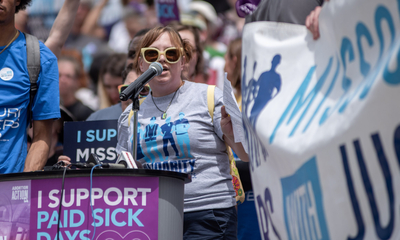
Also on the ballot that year was a citizen-led effort to overturn the state’s abortion ban. Schwarz helped lead a coalition that ultimately succeeded in placing the amendment on the ballot with the goal of protecting the right to abortion up to the point of fetal viability.
“I think for someone to have someone come to their door and talk about Prop A and abortion in the same breath was maybe a new experience for people,” she said.
Then came the endorsement of the reproductive rights amendment by the Missouri AFL-CIO, the first time the union took a public stance on abortion rights.
The amendment won with just shy of 52% of the vote. Proposition A won with more than 57% of the vote.
“They’ve done a lot of work to make sure partisan politicalness doesn’t creep in,” Schwarz said of the labor movement’s continued support of reproductive rights. “Attacks on abortion, reproductive health, impact workers more than anyone, really, because whether you can afford to get care often impacts your ability to get that care.”
Adams, with Missouri Jobs with Justice, helped lead the August campaign against attempts by lawmakers to both raise the threshold for changing the state constitution by initiative petition and an effort to eliminate the state income tax.
This summer, Abortion Action Missouri stood beside Missouri Workers Power and Missouri Jobs with Justice as union and reproductive rights leaders rallied voters across the state against Amendments 4 and 5.
“There’ve been so many opportunities over the last decade to throw down together,” said Adams.
That doesn’t mean the coalition agrees on everything.
The work isn’t rainbows and butterflies, Adams said, as they work with union leaders across political ideologies and diverse backgrounds to draw connections between healthcare and economics.
“The idea that it’s about control, and a voice over your own body and in your own family, goes way further than my opinion of abortions can save people’s lives,” she said, adding: “If we lose one thing, we’re likely to lose another. If we win one thing, we’re likely to be able to win another.”
Adams grew up in Buckner, a small town about 45 minutes outside of Kansas City. Her father was a Republican. Her mother is a Democrat.
“But when the school didn’t have enough supplies to hand out at the beginning of the year, my dad didn’t care that he was a Republican,” she said. “He was making sure the community came together to make that happen.”
That memory is her own testament to what Adams believes motivates Missourians, both in their communities and at the ballot box.
“Missouri can buck the idea that the legislature tries to push, that we need to be divided, that we should be so polarized,” she said. “People really care about their communities and their neighbors, and that can go beyond partisan politics.”
The coalition’s next test comes in November.
Schwarz said recent history gives her hope that Missourians will vote down the proposed abortion ban.
“Voters don’t want politicians to be able to change the rules. They want to be able to focus on their families,” she said. “They want to be able to live in a state that’s affordable, and where you can make a living wage, you can live on your paycheck and get the healthcare you need in your community. Those are all really basic, shared values that I think Missourians have. And it’s the politicians that muddy the rest of it.”

Jefferson City, MO