Idaho US Rep. Simpson hopes to increase resources for Missing and Murdered Indigenous Persons crisis
Aug 28, 2026 | 6:15 am ET
Description
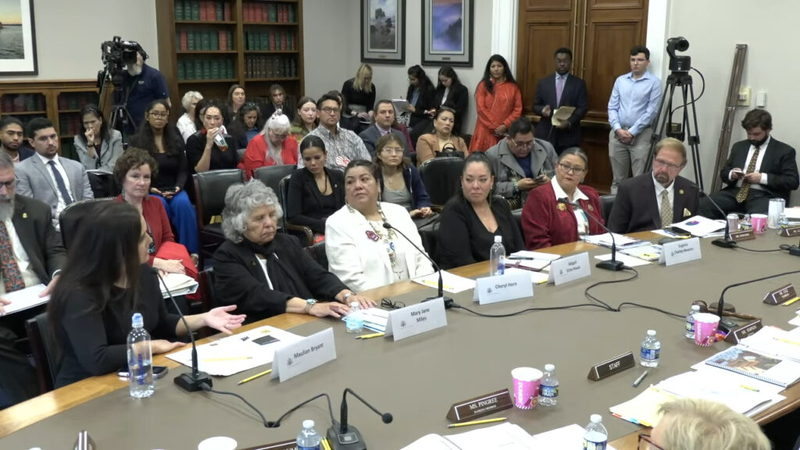
A panel of women testifying on Nov. 20, 2024, to the House Appropriations Committee oversight hearing, chaired by Idaho U.S. Rep. Mike Simpson, on Investigating the Crisis of Missing and Murdered Indigenous Women listen as Maulian Bryant (left) spoke about the challenges her Penobscot Nation faces in accessing resources to find missing people. From left to right: Mary Jane Miles, Cheryl Horn, Abigail Echo-Hawk and Eugenia Charles-Newton. (Screenshot via YouTube/House Appropriations Committee)
Idaho Republican U.S. Rep. Mike Simpson this year is looking to boost federal funding for tribes to address the ongoing Missing and Murdered Indigenous Persons crisis.
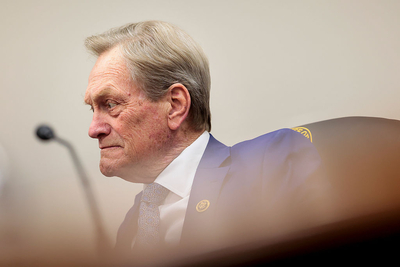
Simpson chairs the Interior, Environment, and Related Agencies Subcommittee of the House Appropriations Committee. The subcommittee in June advanced a budget with a 26% increase to the Bureau of Indian Affairs, which includes:
- an additional $142 million for criminal investigations and police services
- $17 million for law enforcement special initiatives
- $33 million specifically for missing and murdered Indigenous women, which is about a $14.5 million increase over the fiscal year 2026 appropriation.
- $5 million for the use of forensic genealogy to identify missing and murdered individuals in unsolved cases through the bureau’s Operation Spirit Return.
“We put a bunch more money into tribal justice, and that’s hard in a year when we’re trying to reduce spending at the federal level,” Simpson said in an interview.
As a result, he said other portions of the budget, such as funding for the Bureau of Land Management, the U.S. Forest Service and the Smithsonian Institution all saw reductions.
“But I’ve said from the beginning: We’re not going to try to balance the budget on the back of the tribes,” Simpson said. “These are trust and treaty responsibilities we’ve got with our Native American brothers and sisters, and we’ve got to keep those. ”
Coeur d’Alene Tribe Chairman Chief J. Allan told the Idaho Capital Sun in an emailed statement that the tribe supports the effort.
“The issue has gotten more attention in recent years, and Congressman Simpson recognizes that serious problems require adequate funding,” Allan said. “While the focus on MMIP is critical, he also recognizes that the tragic situation is the direct result of decades of public safety and justice deficiencies across Indian Country. Addressing those shortfalls across the system will help improve conditions overall, as well as prevent missing and murdered incidents in the future.”
Marco Ovando, spokesman for the Shoshone-Paiute Tribes, said there was still a lot of work to be done to address the MMIP crisis.
“The crisis of Missing and Murdered Indigenous People within Idaho and the United States is still largely being unaddressed despite national attention in recent years,” Ovando wrote in an emailed statement from the Tribes. “While the Idaho Legislature has created a taskforce in 2020 and a report 2021, state-tribal collaboration remains very limited. … We have a case as recent as this spring where the investigation has produced very little resulting in families without closure, frustrated leadership, and a community left on edge. We hope Congress will appropriate more funding to address these shortfalls because our people are tired of the pain and sorrow and lack of help.”
Leaders from the Nez Perce, Shoshone-Bannock, and Kootenai Tribes could not be reached for comment.
What is the scope of the MMIP crisis in Idaho?
A 2021 Boise State University report found that 75% of missing Indigenous people in Idaho were women, and the average missing persons rate was higher for Indigenous persons in Idaho.
Boise State report: 75% of missing Indigenous people in Idaho are women
Idaho’s average missing persons rate was approximately 10.59 per 100,000 persons. The average rate for Indigenous persons in Idaho rose to 18.99 per 100,000 persons, according to the report.
Boise State completed the study at the direction of the Idaho Legislature, which passed House Concurrent Resolution 33 in 2020 and declared the issue of missing and murdered Indigenous women a crisis.
There were 79 missing Native Americans in Idaho reported in the 2023 Idaho Missing Persons Clearinghouse.
Nationwide, Indigenous women are murdered at 10 times the national average, according to the National Indigenous Women’s Resource Center.
Simpson said as a Blackfoot native growing up along the border of the Fort Hall Reservation, he thought he understood issues affecting Native American tribes.
“And I realized I didn’t when I got on the Interior Appropriations Committee,” Simpson said.
He said a couple years ago, he saw an Idaho Public Television show in which an advocate cited national statistics that approximately 6,000 Indigenous people are murdered or go missing each year.
“I’m sitting there going, ‘That’s twice as many people as we lost on 9/11, and yet I’ve never heard this.’ And being as close as I was with Indian issues over the years, I’m kind of shocked that I’d never heard this,” Simpson said.
Jurisdictional, other changes may be needed to solve issue
Simpson, both in the interview with the Sun and at a July hearing held by the House Committee on Natural Resources regarding the MMIP crisis, highlighted issues with jurisdiction.
He said sometimes it can be unclear if Tribal police, local city or county law enforcement or the FBI has jurisdiction in cases, especially those that cross out of reservation boundaries. And these entities often don’t have formal agreements to work with each other. This uncertainty can lengthen the response time.
“Tribal police officers go through the same training as our county police officers do, our state police officers do. Their judges go through the same training as our judges do, and so forth. They’re every bit as competent to do the job as anybody else is, and we ought to let them do their job more,” Simpson said. “But there are still places where counties that are adjacent to reservations don’t have memorandums of understanding.”
Ovando, of the Shoshone-Paiute Tribes, said cross-jurisdictional barriers as well as limited funding are “are hampering efforts to create a more successful and comprehensive plan in adequately addressing the crisis.”
“Being a rural tribe on the Idaho-Nevada Stateline has also limited approach due to geography,” he said. “Simply gaining resources like law enforcement are a challenge. ”
Leaders from the Nez Perce Tribe also told Idaho Reports in 2023 that jurisdiction was an issue, including a lack of access to other law enforcement data systems. Data can also be an issue if a Tribal citizen is found dead outside of a reservation and their race is misidentified.
Nez Perce Chief Judge Natasha Anderson also noted to Idaho Reports that Idaho’s definition of peace officer doesn’t include tribal officers who attend the Indian Police Academy, rather than the state’s Peace Officer Standards Training Academy, called POST. Otherwise, the officers must be deputized by a county sheriff or city chief of police, which often doesn’t occur because of Tribal sovereignty, then-Nez Perce Tribe’s Interim Police Chief Leotis McCormack said at the time.
At the July hearing, Simpson questioned Charles Addington, principal director in the Office of Justice Services of the Bureau of Indian Affairs, about jurisdictional issues. Addington said the bureau was working on cross-deputization and trying to close jurisdictional gaps.
“This should not be this damn complicated,” Simpson said at the hearing, “and somehow we’ve got to change that.”
Boise, ID