Legislators could fix property tax, they ‘just don’t politically want to,’ says revenue chair
Aug 28, 2026 | 8:04 am ET
Description
(Photo: Hugh Jackson/Nevada Current)
If Nevada lawmakers want to reform the state’s complicated and widely criticized property tax structure, a number of already vetted options are available.
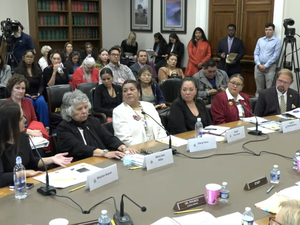
State Sen. Dina Neal (D-North Las Vegas) this week had the Legislature’s nonpartisan fiscal staff lay out several options to members of the interim committee on revenue, which she chairs. Neal said she included the “educational only” presentation after hearing rumblings about the need for the state to conduct a study on property tax.
“We should not spend another hot dime, or six pennies, on another property tax study,” said Neal. “Because we know what the answer is. We just don’t politically want to do any of these solutions.”
Studies have already been commissioned and presented by the Guinn Center and Applied Analysis within the last decade.
Options that have been proposed in prior legislative sessions include adjusting the existing 3% cap on increases, creating a property tax that exists outside of the capped one, or resetting the assessed value when a property is sold.
Property tax is not a major contributor to the state general fund, though it does contribute to the State Education Fund, according to Nakamoto. It is also one of the biggest sources of revenue for cities and counties.
Local leaders have for years made the case that Nevada’s property tax structure, which has kept tax burdens low for homeowners, comes at the grave expense of municipal services like law enforcement, firefighters, parks, libraries, and schools.
Sparks Mayor Ed Lawson, a longtime critic of the state’s property tax system, last year told lawmakers his city’s expenses increased 54% over five years while revenue went up only 16%.
“I challenge any of you to run any kind of government or business with those kinds of numbers,” he said.
Legislative Counsel Bureau fiscal analyst Michael Nakamoto on Thursday told legislators it is up to them to make value judgments and balance the competing forces at play.
“This is the reality of how property taxes work in this state,” he added.
In 2005, the Nevada State Legislature capped at 3% the amount an owner-occupied residential property’s tax bill could rise. Other properties were capped at 8%. Home values at the time were rising so rapidly that homeowners were facing property tax raises upwards of 20%.
Those caps, which are effectively tax abatements, are the limiter for lawmakers looking to increase property tax revenue, Nakamoto explained. The property tax rate itself could be raised, doubled or quadrupled even, but the amount people actually pay would not increase because of the cap.
An estimated $18.6 billion in property tax has been abated since 2007, according to an analysis by legislative staff.
Using his own three bed, three bath split-level in Reno as an example, Nakamoto detailed for lawmakers and the public how an owner-occupied home’s tax bill is determined in Nevada.
Then, Nakamoto estimated what he can expect to pay going forward under the current system, and what he would pay going forward if changes were adopted.
Under the state’s existing tax structure, he can expect to pay $1,873 in property taxes and have $1,711 abated in 2029. Without the abatement, he would owe $3,584. If Nevada lawmakers were to move the cap from 3% to 4%, he would pay $1,892 in property tax and have $1,693 abated in 2029.
If the cap was set at 5%, he’d pay $1,910. At 6%, he’d pay $1,928. And if the owner-occupied residential cap was 8% — the same as commercial properties — he’d pay $1,964.
The difference between the final tax bills under those scenarios is less than $100, though it would add up over time.
Nakamoto calculated that in 2039, under an 8% cap structure he’d pay $4,241 in property tax, whereas under the current structure, he can expect to pay $2,518.
And if lawmakers were to remove the abatement altogether, his tax bill in 2029 would be $3,584 — nearly double the abated prior year. If you zoom out to 2039, the tax bill would be $5,265.
Adjusting the 3% cap isn’t lawmakers only option.
The 2005 bill that established the cap also included language specifying that any new, separate tax on property enacted by the Legislature could exist outside of the partial abatement structure. That means lawmakers could impose a new tax and keep it from being abated.
Under that scenario, Nakamoto contemplated a new tax rate of 25-cents per $100 of assessed value that would not be subject to the 3% cap for the first year only. That would result in him paying $2,118 in property tax in 2029 — a 16.5% spike. But in subsequent years the tax burden would again rise by just 3%.
If lawmakers boldly got rid of the abatement entirely and increased the tax rate by 25-cents per $100 of assessed value, the tax burden on Nakamoto’s house would immediately go up to $3,829 — a 110.5% change.
Another option would be to leave the mechanics of the property tax structure as is but reset the depreciation and partial abatements upon the sale of the property.
Assemblymember Natha Anderson (D-Washoe) last year sponsored a resolution proposing amending the state constitution to do just that. It passed the Assembly mostly on party lines but was never put up for a Senate vote. (Lawmakers passed a similar resolution in 2017 but failed to pass it a second time in 2019. As a constitutional amendment, it would need to pass in two consecutive sessions and then go to voters for final approval.)
The impact of resetting at point of sale would be “fairly dramatic,” said Nakamoto, “especially on older properties.
Under that scenario, if Nakamoto sold his home in 2029, the new owners would pay $7,782 in property taxes — 327% more than he paid the year prior. But, as proponents of the proposal have argued, it would be their baseline and more closely reflect the current value of their home.
Legislators on the revenue committee did not discuss any of the proposals at great length after Nakamoto’s presentation. Neal noted that those conversations would likely come at a later date.
Previous efforts to adjust Nevada’s property tax structure have been met with heavy opposition from real estate developers and anti-tax groups. They’ve seen support from progressive groups, which argue the state is overly reliant on the regressive sales tax, and local governments, which would benefit most financially.
“The conversation around property taxes is at its heart about who pays, and in turn what is being provided,” said Andrew Clarke with the Nevada Revenue Coalition, which is pushing for the resurrection of Anderson’s resolution.
“Nevada’s property tax structure has failed to deliver affordable homes and essential services,” he said in a statement to the Nevada Current. “Institutional investors have come out on top in this system while local budgets have run dry. We look forward to ending this two-tiered system and delivering a budget that can offer affordable homes and essential funding to education, childcare, and Nevada’s many other competing needs.”
Las Vegas, NV