Voting Rights Act commemoration comes with warnings after Supreme Court rulings
Aug 06, 2026 | 2:42 pm ET
Description
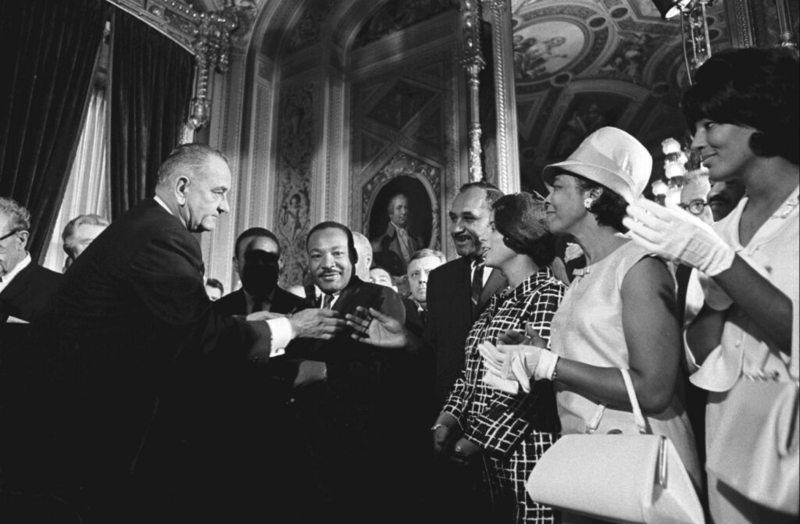
President Lyndon B. Johnson and Martin Luther King, Jr., Clarence Mitchell, and Patricia Roberts Harris exchange greetings after the signing of the Voting Rights Act on Aug. 6, 1965 in Washington, D.C. Speakers at an SPLC-sponsored event Thursday marked the 61st anniversary of the law, which has been gutted by recent Supreme Court rulings. (Courtesy of the LBJ Library)
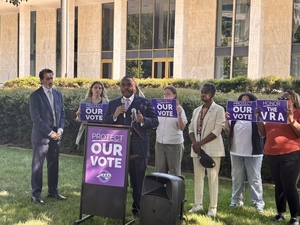
The Southern Poverty Law Center Thursday commemorated the 61st anniversary of the Voting Rights Act amid ongoing attacks on the landmark legislation.
Speakers at the event celebrated the impact of the law, which reversed decades of disenfranchisement across the South, but warned of recent attempts to roll back progress on voting rights.
“For generations, Black people were denied full participation in our democracy,” said Tafeni English-Relf, state director of Alabama for the SPLC. “And it was the passage of the Voting Rights Act that allowed those barriers to be broken down.”
The Voting Rights Act was passed months after peaceful voting rights marchers were attacked on the Edmund Pettus Bridge in Selma, an event known as Bloody Sunday. The attack led to the Selma-to-Montgomery March and sparked congressional action.
The law abolished barriers such as literacy and qualification tests, and allowed the U.S. Attorney General to challenge poll taxes in state and local elections. Within six months of President Lyndon Johnson signing the measure on Aug. 6, 1965, the number of Black registered voters in Alabama doubled from 110,000 to about 228,000.
However, the U.S. Supreme Court’s rulings in Shelby County v. Holder in 2013 and Louisiana v. Callais this spring wiped out key enforcement provisions of the law and allowed states to erect new barriers to voting.
The Holder ruling eliminated Section 5 of the law, which required states with histories of voting discrimination to have election law changes reviewed and approved by the U.S. Department of Justice. Callais made challenges to legislative maps under Section 2 considerably more difficult.
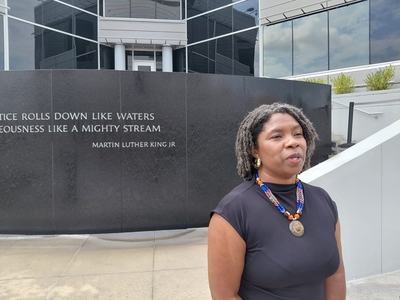
“While we are celebrating today, we must also tell the truth, that the progress we celebrate has not always been protected,” said Shalela Dowdy, a plaintiff in Allen v. Milligan that sought to add a second congressional Black district in the state. “The Voting Rights Act has been weakened. Section 5 has been gutted. Section 2 has been narrowed.”
Since Shelby County v. Holder, the disparity in voter participation between Black and white voters in Alabama has increased.
Associate U.S. Supreme Court Justice Samuel Alito wrote in the Callais majority opinion that those who would challenge election laws as racially discriminatory must prove there was intent to discriminate against minority voters, instead of showing discriminatory effects of a law.
The decision allowed Alabama to use a 2023 congressional map previously ruled racially discriminatory by the courts. The move substantially redrew Alabama’s 2nd Congressional District, currently represented by U.S. Rep. Shomari Figures, D-Mobile, and reduced its Black Voting Age Population from about 49% to under 40%.
At the event, SPLC announced the “We Decide” campaign to mobilize voters and increase voter participation in Alabama. This includes multiple days of canvassing starting in late August, along with community block parties in September.
“The Voting Rights Act was never meant to be a final chapter in American democracy,” said Jerome Dees, policy director for the SPLC. “It was the foundation for what could come next. So today, we honor that legacy by recommitting ourselves to the ongoing work of ensuring that every Alabamian has both the opportunity and the power to help shape our future.”
Montgomery