NC Democrats say voting rights are in danger again 61 years after passage of Voting Rights Act
Aug 06, 2026 | 3:44 pm ET
Description
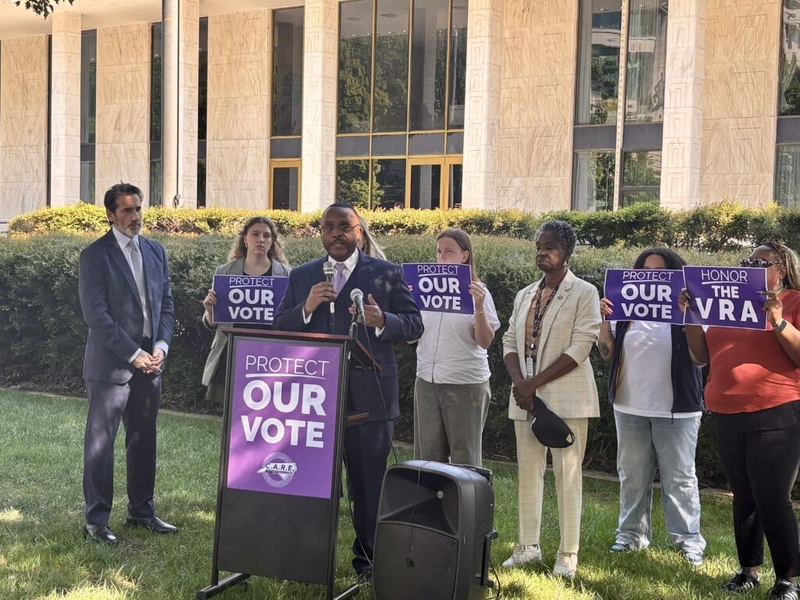
N.C. House Minority Leader Robert Reives speaks on the anniversary of the Voting Rights Act on Aug. 6, 2026. (Photo: Christine Zhu/NC Newsline)
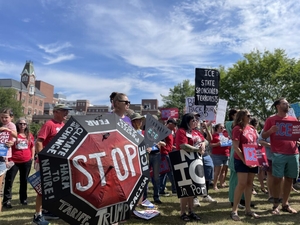
Democratic lawmakers and advocates gathered in front of the North Carolina legislative building Thursday to defend voting rights against what they say is growing pressure by Republicans to roll back years of progress.
Thursday marked the 61st anniversary of the 1965 Voting Rights Act, a landmark law prohibiting discrimination in voting based on race, color, or language-minority status.
But modern legislation hasn’t always reflected those principles, according to House Minority Leader Robert Reives, a Democrat from Chatham County.
The North Carolina General Assembly went 1,003 days without passing a comprehensive budget, yet the Republican majorities were able to pass other laws Reives said were aimed at weakening the voting power of minority communities.
Black advocates in NC warn Jim Crow era ‘never ended’ as voting maps shift across South
“At the president’s request, the Republican leaders in the state House and in the state Senate ran us back to session so that we could further gerrymander the most gerrymandered maps in the entire United States,” Reives said.
In October 2025, lawmakers approved a congressional map designed to make the state’s only toss-up district unwinnable for a Democrat, bringing North Carolina’s 14-member U.S. House delegation from 10 Republicans and four Democrats to 11 Republicans and three Democrats.
Previously, a court drew maps for the 2022 election resulting in a 7-7 split between the parties. However, Republicans in 2023 passed a new map leading to 10 Republicans and four Democrats in the 2024 cycle.
Republicans who drew the two most recent congressional voting maps said they were designed to maximize advantage for their own party, pointing out that partisan gerrymandering is not illegal. But in the process, several Black communities were divided up or “cracked” into Republican districts, diluting their voting power.
Reives also criticized his GOP colleagues for shifting control of the North Carolina Board of Elections to the state auditor — the only state auditor in the country with that power, he said.
NC Auditor Boliek expressed polling site preferences and looked to boost GOP turnout, messages show.
Following his election in 2024, state Auditor Dave Boliek appointed Republican chairs to lead local elections boards as they switched from Democratic to Republican control.
“Then the pressure campaign began,” Reives said. “They started moving voting sites, shortening voting hours, eliminating our early voting days entirely, and his staff has continued to push this.”
Sen. Val Applewhite, a Democrat from Cumberland County, spoke out against House Bill 958, a controversial election law measure that passed in the lower chamber on Tuesday. It shortens early voting in primaries from 17 to 10 days, along with other changes.
Republicans who supported the bill said voter turnout during primaries is too low to require county boards of elections to staff early voting sites for 17 days.
Democratic Gov. Josh Stein said Wednesday he plans to veto the bill.
Earlier versions of the legislation would’ve required military and overseas voters to include photo identification when mailing in their ballots. Republicans said the change is necessary to maintain election security among overseas voters.
Applewhite, a retired Air Force veteran, said she recently received a text from her son who’s deployed in the Middle East. He said he was confused about how to cast his ballot.
Her son, and others in military service, don’t have the luxury of figuring out how to vote while sitting in an air-conditioned office, Applewhite said. Instead, they’re often in harm’s way.
“Their focus is protecting one another and accomplishing a mission. That reality caused me to ask a simple question: When did we decide that people carrying the greatest burden should also carry more burden when it comes to voting?” Applewhite said.
North Carolina Voter Protection Alliance Executive Director Terence Everitt reminded listeners that the right to vote is fundamental to American democracy.
Everitt, who resigned from the Senate in April to focus on protecting voting rights, condemned Boliek’s demands for transparency within government while not providing the same from his office when questioned about his involvement with voting plans.
“Confidence in elections is earned through transparency, it’s not by demanding blind trust,” he said.
Raleigh, NC