Surveys for Piedmont power line can continue, appellate court rules
Aug 06, 2026 | 4:03 pm ET
Description
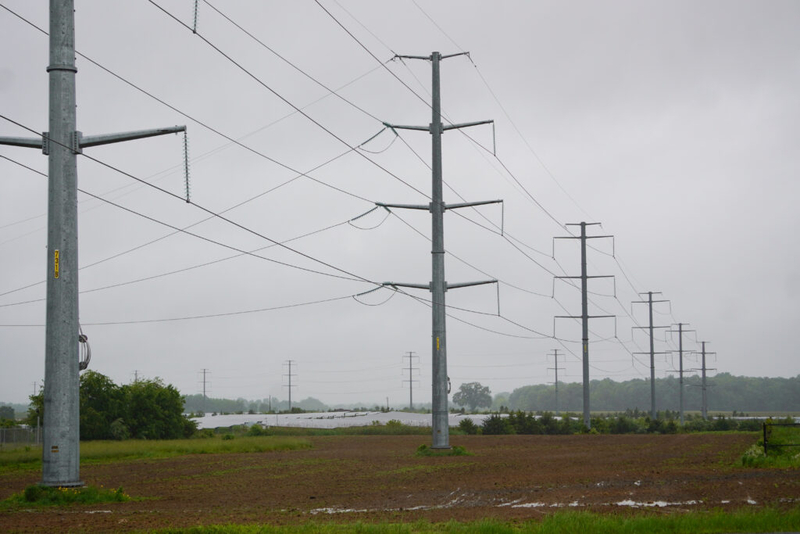
A power transmission line on Maryland's Eastern Shore. (Photo by Christine Condon/ Maryland Matters)
Land surveys for the planned Maryland Piedmont power line project can continue, despite landowner opposition, a federal appeals court ruled Thursday.
The ruling by a three-judge panel of the 4th U.S. Circuit Court of Appeals upheld a June 2025 ruling by the U.S. District Court in Baltimore that allowed the surveys to go forward. The appeals court, based in Richmond, Virginia, heard the case in May.
The project, a 67-mile power transmission line slated to run through rural parts of Baltimore, Carroll and Frederick counties, has attracted considerable opposition from landowners. PSEG, the New Jersey-based power company constructing the line at the behest of electric grid officials, sued hundreds of landowners who denied surveyors access for surveys needed for the line to receive a construction certificate from the state.
The 117 parties who appealed the lower court ruling argued that, if allowed to conduct the property surveys, PSEG would be exercising eminent domain, and that it should not be allowed to do so until it receives the construction certificate from the Maryland Public Service Commission.
But if that were required, PSEG would have “no viable path” to ever obtain approval for its certificate of public convenience and necessity, or CPCN, the 4th Circuit panel ruled in a published opinion, penned by Judge Nicole G. Berner.
Advocates, regulators both call for reforms at power grid operator PJM
“[Multistate electric grid operator] PJM has identified a significant need for additional power generation in the region. The Maryland General Assembly intended for prospective federal public utilities, like PSEG, to help bridge this gap,” Berner wrote. “To do so, PSEG must have a viable path to obtain a CPCN. The access it seeks is a necessary step on that path, and delaying this permitting process could exacerbate the very energy crisis that the MPRP was intended to prevent.”
Judge J. Harvie Wilkinson III joined in the opinion, while Judge Julius N. Richardson wrote a concurring opinion, focused on Maryland law, that agreed the lower court’s decision was correct.
In a statement, PSEG applauded the court’s ruling.
“We appreciate the Court of Appeals careful consideration of the facts and the law in affirming Judge [Adam] Abelson’s earlier decisions in our favor,” the statement said. “We remain committed to conducting this work responsibly, minimizing impacts, and engaging respectfully with property owners, local communities, and all stakeholders as the regulatory process continues to bring this essential energy solution to Maryland residents.”
Joanne Frederick, president of Stop MPRP, the nonprofit group advocating against the power line on behalf of local residents, said she was “deeply disappointed” by the court’s decision “allowing PSEG to enter private property to conduct surveys before the Maryland Public Service Commission has taken any substantive action on the proposed Maryland Piedmont Reliability Project.”
Frederick highlighted that the court’s ruling does not approve the construction of the power line or allow PSEG to acquire private land to build it. Those things are still before the Public Service Commission.
“We are carefully reviewing the court’s decision with legal counsel and evaluating all available options,” Frederick wrote. “Regardless of the next steps in this litigation, Stop MPRP, Inc. remains committed to protecting private property rights and advocating for Maryland landowners, communities, farms, and preserved lands throughout the Public Service Commission’s review process.”
The appellate judges agreed that Abelson’s preliminary injunction allowing the land surveys satisfied all of the needed tests: PSEG was likely to succeed on the merits of its arguments, it would suffer irreparable harm in the absence of the injunction, which is in the public interest, among others.
Since Abelson’s preliminary injunction was issued, landowners have been compelled to allow surveyors onto their properties to study forest delineations, wildlife and other natural attributes. But residents in a few instances have continued resisting surveyors. In July, for example, Abelson held one resident in contempt of court and ordered her to pay $2,000 in court fees to PSEG, after she obstructed and threatened surveyors several times and did not appear in court.
Abelson has also allowed U.S. marshals to accompany surveyors onto a handful of properties where residents had obstructed surveys, after initially denying a broad request for assistance from the U.S. Marshals Service.
The surveys are still underway and the power line is still before the Maryland Public Service Commission, which has issued a procedural schedule indicating that attorneys would file their final briefs in mid-February 2027. Grid officials, faced with increasing energy demand in the region — including from data centers — originally set a deadline of June 2027 for the line to come into service. That deadline is unlikely to be met.
“The Commission has confidence that PJM, the region’s grid operator, will efficiently maintain the grid during the duration of the Commission’s review,” a PSC statement said at the time.
In their arguments against Abelson’s injunction, the landowners noted that even with the injunction, PSEG was unlikely to meet its deadline. But the 4th Circuit judges dismissed that argument. The deadline “may be extended,” the court ruled, and therefore could “plausibly be met.”

Annapolis, MD