Ethics Commission to appeal decision that allowed former Speaker to seek Supreme Court seat
Aug 04, 2026 | 4:27 pm ET
Description
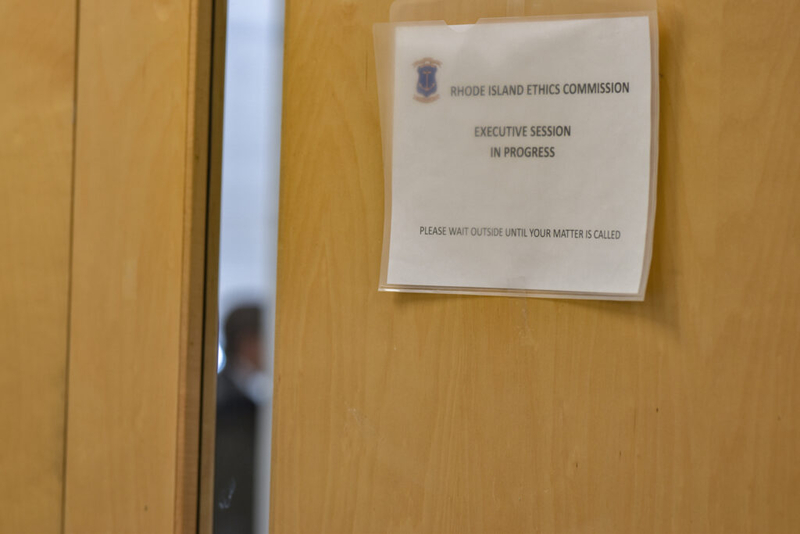
After meeting behind closed doors for about an hour Tuesday, the Rhode Island Ethics Commission voted 4-1 to authorize its executive director and attorneys to seek a declaratory judgment from the Rhode Island Supreme Court on whether former House Speaker K. Joseph Shekarchi's appointment to the judiciary would violate the state's ethics laws. (Photo by Christopher Shea/Rhode Island Current)
The Rhode Island Ethics Commission will appeal a recent Superior Court ruling that cleared the way for former House Speaker K. Joseph Shekarchi to seek a vacancy on the state’s Supreme Court.
Following an hour behind closed doors Tuesday, commissioners voted 4-1 to authorize its executive director and attorneys to seek a declaratory judgment from the state’s highest court on whether Shekarchi’s jump from the legislature to the judiciary violates the state’s ethics laws.
Commissioner Frank Cenerini, who voted against the initial investigation in June, was the lone opponent of the decision to appeal. Chairman Lauren Jones and commissioner Michael N. Browner were not present.
Executive Director Jason Gramitt told reporters after the meeting that a filing will be made before Aug. 18, the deadline to appeal the Superior Court’s July 27 judgment.
Shekarchi, a Warwick Democrat, stepped down as House speaker May 7 having applied to the Judicial Nominating Commission three days prior to fill the opening created by the March retirement of Justice Maureen McKenna Goldberg. That same day, Roger Williams University School of Law Professor Michael Yelnosky filed a complaint to the state Ethics Commission arguing that a lawmaker leaping directly from one branch of government to another would violate the state’s revolving door rule,which was written into state law in 1992.
The Ethics Commission voted to authorize a full investigation on June 2. After the Ethics Commission twice rejected petitions to end its investigation, Shekarchi’s legal team filed a Superior Court lawsuit seeking to halt the probe and have a judge declare that Shekarchi did not violate the state ethics rules.
The law prohibits sitting legislators from seeking or accepting employment with any state government agency for at least one year after leaving elected office. But it exempts lawmakers who seek or accept election to a constitutional office.
Shekarchi and his attorneys have argued the Supreme Court is a constitutional office, which Superior Court Judge Richard Licht agreed with in his July 27 decision to allow the former speaker’s application to move forward.
But Licht’s ruling did not formally toss the Ethics Commission’s investigation, instead tasking both parties to work with the court to prepare the final order and judgment. The probe remains paused following a July 2 consent order.
“And it likely will be stayed for a while,” Gramitt told reporters Tuesday.
Shekarchi and his attorneys were not present at Tuesday’s hearing. Thomas Dickinson, one of his lawyers, said in an email to Rhode Island Current the appeal was not a surprise.
“We’re prepared to move forward with the appeal process, and we are confident that Judge Licht’s decision is correct based on the facts, the law, and precedent,” Dickinson wrote.
The Ethics Commission’s move comes one week after the state Judicial Nominating Commission forwarded Shekarchi’s name and four others to Gov. Dan McKee for consideration. Four members of the panel who voted for his nomination were criticized after GoLocal Providence reported they had donated to Shekarchi’s campaign, including earlier this year.
A review of Shekarchi’s second quarter campaign forms showed no donations from any of the nine members of the Judicial Nominating Commission.
John Marion, executive director of Common Cause Rhode Island who has been an outspoken opponent of Shekarchi’s judicial application, supported the Ethics Commission’s decision to appeal.
“Judge Licht’s decision left some ambiguity about the state of the law,” he told reporters after the meeting.
But he acknowledged the Rhode Island Supreme Court is now in a tricky position as it must decide whether someone is allowed to join its bench, along with whether one of its justices should recuse after taking a similar path to judicial branch.
In 2020, then-Sen. Erin Lynch Prata sought an advisory opinion from the Ethics Commission before submitting her application for the Supreme Court seat she now occupies. Ethics Commission staff concluded Lynch Prata could not join the judiciary under the rule, but commission members voted 5-2 to reject the recommendation and opened the door for then-Gov. Gina Raimondo to appoint her to the bench.
“The same set of facts were in question six years ago,” Marion said. “She should recuse.”

Providence, RI