Fifty for 150: Colorado State Fair incorporated in Pueblo in 1886
Jul 27, 2026 | 3:06 pm ET
Description
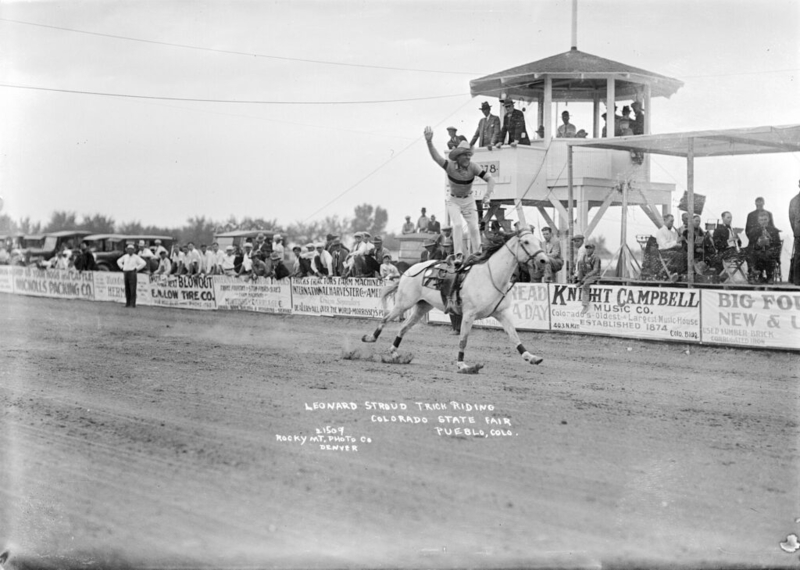
Leonard Stroud trick rides on a horse at the Colorado State Fair rodeo in Pueblo in this undated photograph from between 1910 and 1930. The State Fair Association officially incorporated in Pueblo in 1886. (Courtesy of Denver Public Library Special Collections, Z-693)
The Southern Colorado Agricultural and Industrial Association, after holding multiple fairs in Pueblo County since the 1870s, incorporated as the State Fair Association on Nov. 17, 1886. That established Pueblo as the host of Colorado’s annual state fair, now entering its 140th year of the tradition.
Previous official state agricultural and industrial fairs took place near Denver, but there was general dissatisfaction with the events and the agricultural displays. A lot of Colorado’s cultivated land at the time was along the South Platte and Arkansas Rivers and their tributaries, making southern Colorado a prime location for a permanent state fair.
The fair purchased 50 acres of land near what is now Mineral Palace Park in Pueblo and held the first fair the next year. Horse races were especially popular in the early years of the fair.
“The state fair opens today, and every citizen should make it his special duty to visit it and induce others to do so,” reads an Oct. 4, 1887 article in The Pueblo Daily Chieftain. “Everything is in excellent shape at the fairgrounds for the reception of visitors, and those who go will see many things that they never dreamed were to be seen in Pueblo.”
Many local businesses decided to close on the Thursday of that first fair so their employees could attend and “and contribute not only to their own personal pleasure, but to the success of an undertaking in which we should all feel a pride.”
In 1890, the fair sold that original location and bought a new site west of Lake Minnequa. The association then moved to the current Colorado State Fairgrounds on Beulah Avenue in 1900 and built a new half-mile racetrack, grandstand, exhibition hall and stables. Attendance at the new site boomed to nearly 16,000 people.
The SFA deeded that land to the state in 1917, and the Legislature then created a commission to run the fair.
During World War I in 1917, the fairgrounds served as a training base for the Colorado Army National Guard. New Deal-era funding helped the construction of new buildings, including the Palace of Agriculture, and other infrastructure at the fairgrounds. Fiesta Day, dedicated to Pueblo’s Hispanic culture, was introduced in 1966 and now includes a parade and pageant.
Today, the fairgrounds span over 100 acres and the event, a point of pride for Pueblo, lasts 11 days. It includes concerts, rodeos, agricultural and livestock exhibits, fine art competitions and a carnival. In 2025, about 430,000 people attended the fair, down from a recent peak of over 509,000 in 2023.
Denver, CO