Fifty for 150: Colorado state troops sent to Cripple Creek miners’ strike in 1894
Jul 23, 2026 | 5:50 am ET
Description
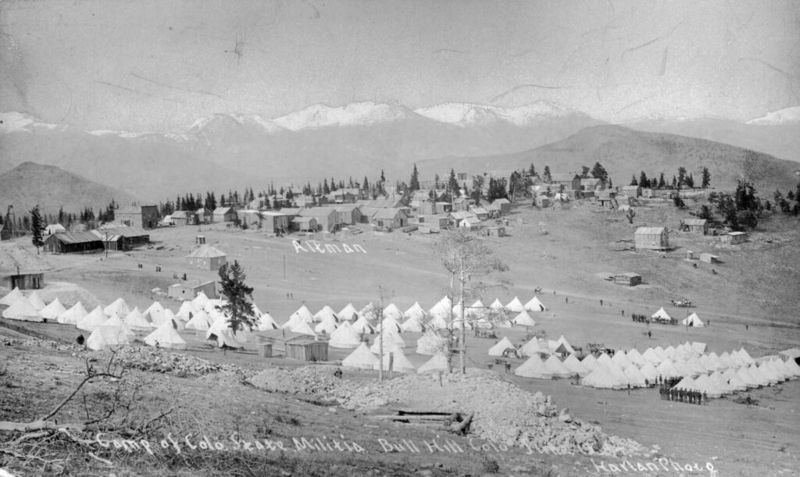
An 1894 photograph shows the Colorado state militia's camp in the Cripple Creek mining district, where troops were sent to enforce the terms of a union agreement with mine owners for an eight-hour workday. (Courtesy of Denver Public Library Special Collections, Z-2742)
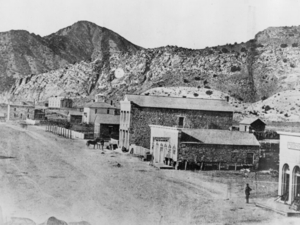
After gold was discovered in a high mountain valley southwest of Pikes Peak in 1890, thousands of fortune-seekers flocked to the overnight boomtown of Cripple Creek, along with satellite settlements like Victor and Goldfield.
It was the last major gold rush in Colorado history, and within a few short years it was minting newly made millionaires like Winfield Scott Stratton, a lowly “grubstaker” whose 1891 claim on the Independence mine proved to be one of the Centennial State’s richest gold strikes ever.
Most miners weren’t so lucky. After the price of silver crashed permanently during the Panic of 1893, the owners of gold mines like those at Cripple Creek found themselves with an oversupply of available labor, and wages and working conditions suffered. In January 1894, mine owners — who included wealthy Colorado industrialists like J.J. Hagerman and David H. Moffat — colluded to fix wages at $3 per day while lengthening the workday from eight to 10 hours.
Organized by the Western Federation of Miners, a union founded just a year earlier, Cripple Creek miners went on strike for an eight-hour day on Feb. 7, 1894. The ensuing four-month strike presaged similar eruptions of labor strife in Colorado in 1903, 1913 and beyond, as organized labor battled the wealthy monopolists who came to control much of the coal and hardrock mining industries.
But the 1894 Cripple Creek strike would end far differently thanks in large part to one man: Gov. Davis H. Waite, who’d been elected as Colorado’s eighth governor in 1892.
A newspaper publisher and social reformer described by historian Stewart Holbrook as “a Moses with a flowing white beard and a voice like Rocky Mountain thunder,” Waite had been elected as the candidate of the People’s Party, also known as the Populists, amid a wave of voter dissatisfaction with the two major parties across the West.
He and other Populists were a driving force behind anti-corruption efforts in Denver and the passage of a women’s suffrage referendum in 1893. Waite remains the only third-party candidate ever to have been elected governor of Colorado.
As the strike went on at Cripple Creek, mine owners enlisted sheriff’s deputies and private security and began to clash with striking miners in the streets. At the urging of El Paso County Sheriff M.F. Bowers, Waite in March sent a detachment of state militia to the town but quickly ordered them back, accusing the business lobby of exaggerating the threat to public safety.
Some mine owners — including Stratton, the grubstaker-turned-millionaire — conceded to the miners’ demands, recognizing their union and affirming the eight-hour workday for full wages. Others, like Hagerman and Moffat, held out, and Bowers, subsidized by the defiant mine owners, deputized a private army of 1,200 men to battle the striking miners. Tensions rose further. Strikers seized and dynamited the entrance to a mine on May 24, and one miner and one sheriff’s deputy were killed in the gunfight that followed.
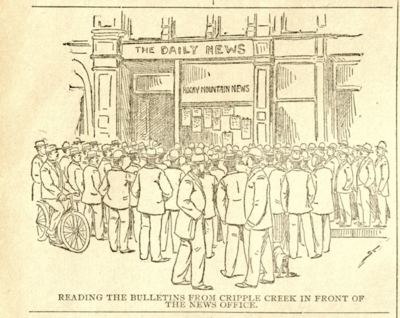
For two weeks, the Cripple Creek district teetered on the brink of all-out war. Waite sought to force both sides into arbitration and threatened to call out the National Guard again — this time not at the sheriff’s request, but against his force of deputized strikebreakers, which Waite deemed illegal.
“They will not act as guards to mine owners’ property,” Waite told the Rocky Mountain News of his plans for the state militia on May 28. “Isn’t it about time for the mine owners to explain why they are gathering armed forces in El Paso County?”
Under pressure from Waite, mine owners on June 4 agreed to the strikers’ core demand — an eight-hour day at full daily wages. The compromise “call(ed) a halt in the civil war which was about to burst forth in the state,” reported the News.
In the end, however, Waite had to follow through on his threat, sending the state militia to enforce the terms of the agreement. His intervention on the miners’ behalf is considered one of the only occasions in U.S. labor history in which state troops were called out on the side of the strikers, rather than against them.
On June 8, when sheriff’s deputies under Bowers advanced towards a strikers’ encampment, the state militia met them in force.
“The state troops marched in ahead of the deputies and between them and the hill of defense,” the News recounted. “Gen. Brooks directed the deputies to withdraw, and, seeing that the game was up, they went back to camp. It was as close a call as any war time ever knew.”
Denver, CO