Fifty for 150: Women in Colorado lobbied male voters to approve 1893 referendum on suffrage
Jul 24, 2026 | 6:00 am ET
Description
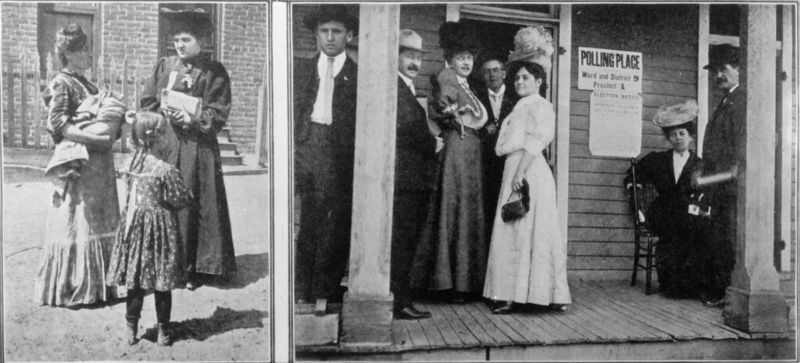
Women voters are pictured outside of a polling place in the early 1900s. (Courtesy of Denver Public Library Special Collections, Z-8811)
A popular vote on a referendum granted women the right to vote in Colorado on Nov. 7, 1893.
Just under 55% of male voters supported the measure — 35,798 votes for, and 29,551 votes against.
While it’s debated which state was actually the first to grant women the right to vote, Colorado was the first to do so by popular vote. Wyoming gave women the right to vote when it was still a territory in 1869, and they maintained that right when Wyoming became a state in 1890.
The Non-Partisan Equal Suffrage Association worked for more than 30 years to get women the right to vote in Colorado, spreading the word through speakers, newspaper articles and leaflets. The association led the campaign backing the referendum in 1893, working to convince the male voters of the state to support a woman’s right to vote.
Leaders supporting women’s suffrage in Colorado included Ellis Meredith and Minnie Reynolds, two prominent journalists; Alida Cornelia Avery, the first woman licensed to practice medicine in Colorado; Louise Tyler, who organized with the American Woman Suffrage Association and led the Colorado Women’s Christian Temperance Union; Elizabeth P. Ensley, who advocated the rights of Black women; physician Mary Bates; and teacher Martha Pease.
Meredith, known as the Susan B. Anthony of Colorado, got national suffragettes to back the Colorado campaign. She convinced National American Woman Suffrage Association organizer Carrie Chapman Catt to come to Colorado, telling her, “If Colorado goes for woman suffrage, you may count on a landslide in that direction throughout the West.”
The Rocky Ford Enterprise said after Chapman Catt spoke in the town between Pueblo and Lamar that she “is very able, eloquent and magnetic and made a splendid plea for simple justice to one half of the citizens of the state.” The vast majority of newspapers throughout the state endorsed women’s suffrage, largely with the help of Meredith and Reynolds.
Gov. Davis Waite, a Populist, and former Gov. John Routt, both endorsed the referendum.
A precursor organization to the Non-Partisan Equal Suffrage Association formed to advocate for women’s suffrage shortly before the state’s constitutional convention in 1876. Women initially sought suffrage during the convention, but they were only granted the right to vote in school board elections.
A year after Colorado became a state, Routt supported a referendum for women’s suffrage in 1877. Susan B. Anthony and Lucy Stone, national leaders in the women’s suffrage movement, campaigned around Colorado supporting the referendum as well, but an all-male electorate struck it down.
Eliza Pickrell Routt, the first first lady of Colorado, was the first woman to register to vote in the state.
In 1894 — the first statewide election women could vote in — Clara Cressingham became the first woman elected to the Colorado Legislature. It wasn’t until 1972 that Colorado elected a woman to Congress, when U.S. Rep. Pat Schroeder won the election to represent Colorado’s 1st Congressional District.
Denver, CO