On the eve of Colorado statehood in 1876, 2 men were lynched by a Cañon City mob
Jul 24, 2026 | 6:10 am ET
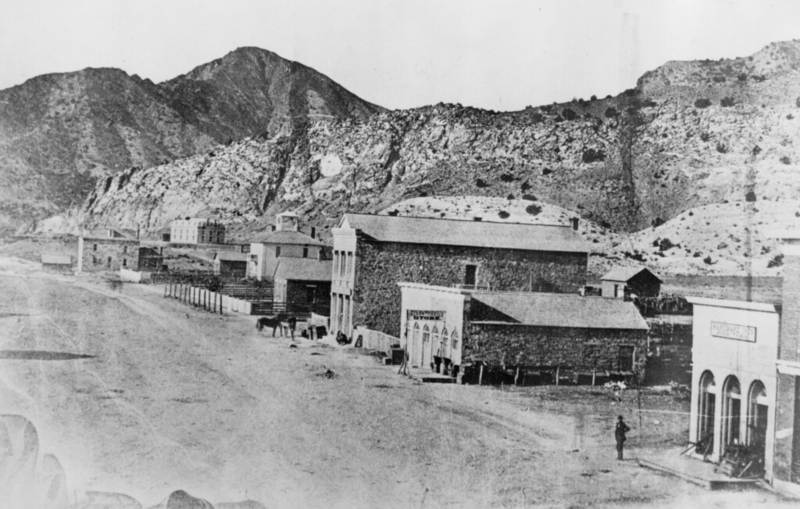
Description
A view of a street in Cañon City in a photograph dated between 1871 and 1874.
(Courtesy of Denver Public Library Special Collections, Z-6637)
The official canvass of the Colorado Territory’s referendum approving a state constitution was completed at Gov. John Routt’s office on July 24, 1876.
The final tally was 15,443 votes for the constitution and statehood, and 4,030 votes against. Routt, the Civil War infantry captain appointed territorial governor by President Ulysses S. Grant the previous year, affixed his signature to the canvass and dispatched it to Congress and the White House.
“Mr. Reigart, private secretary to Gov. Routt, will leave for Washington tomorrow as the bearer of the official vote,” reported the Denver Times.
Seventeen years on from the start of the Pikes Peak gold rush, and roughly 30 years since the Hispano settlers of the San Luis Valley became Colorado’s first non-Indigenous permanent residents, Colorado was on the verge of becoming the 38th state admitted to the union.
“Closing out all our TERRITORIAL goods,” read an ad from Salomon’s grocery store, at 15th and Larimer streets in Denver, “so as to fill up with now at STATE prices.”
The story leading many territorial newspapers that week, however, wasn’t Grant’s imminent proclamation of Colorado statehood but a brutal act of vigilante justice in southern Colorado.
A horse trader named Newman had traveled to the Colorado Territory earlier in 1876 and was seen with two other men in the Wet Mountain Valley, in present-day Custer County, in early July. A party of cattle herders discovered Newman’s dead body a week later, and his wagon and team of horses were missing.
Suspicion immediately fell on his two companions, and two men were captured and accused of the murder in the days that followed: Jose Talmage, identified as the son of a Mexican mother and a Hungarian-Italian father, and Felipe Salazar, both “well known” residents of Cañon City, the Pueblo Chieftain would report.
Newspaper accounts show considerable confusion about the two men’s identities in the aftermath of Newman’s killing. At least one of the dead man’s companions was first reported to be an “American” — that is, white — man, possibly named Jim, but when caught, Talmage and Salazar were branded as the “two Mexican murderers.” Talmage was initially characterized as having been “always considered a quiet and steady young man,” but after his arrest the Chieftain declared he had “heretofore born(e) a bad reputation, and that of his father is no better.”
The “shocking murder … has cast a gloom over the whole valley,” wrote the paper’s Wet Mountain correspondent, “and the persons who committed the horrible deed, if caught, had as well be a thousand miles from land, in an open boat, with sails of lead and oars of iron and purgatory his nearest port.” Among the valley’s ranchers, there was little doubt as to who the killers were.
“It is the general opinion among those who understand the facts in the case, that Talmage and (Salazar) murdered Mr. Newman,” reported the Chieftain.
That was all a mob needed to storm the Cañon City jail where the two men were being held on the night of July 21, and bring them “before Judge Lynch’s court,” as the Chieftain put it. They purportedly confessed to killing Newman, and were promptly hanged. As was often the case in such acts of vigilantism, a subsequent coroner’s inquest said the two men had “come to their death from hands unknown.”
“Cañon City is not a place where we would expect mob law would be enforced, and the people there have the reputation of being among the most law-abiding in the state,” the Chieftain observed. “In our eight years experience in southern Colorado, we have never known man to be lynched there.”
Vigilantism on the frontier
The Chieftain and other Colorado newspapers were mostly supportive of this act of mob justice, albeit with some throat-clearing ambivalence about lynchings in principle. They were quick to blame the act on territorial criminal statutes that barred capital punishment in the case of a guilty plea, as in the case of several Italian-American men convicted of murder in Denver earlier that year.
“However much we may deprecate the exercise of lynch law, the very peculiar statutes which we have regarding murder is the direct father of this affair at Cañon City,” said the Golden Globe.
In Denver, the Rocky Mountain News was even more direct in excusing the extralegal executions: “The atrocity of the Wet Mountain murder was such as to call for swifter and surer retribution than is commonly reached by legal process,” declared an editorial. “The News has no sympathy to waste on the hardened wretches who met their fate at the hands of men who, in the absence of a law adequate to the punishment of the crime committed, framed an admirable substitute.”
“It is, perhaps, unfortunate that the law was not permitted to take its course with these culprits,” allowed the Chieftain. “But so many murderers have escaped their just dues of late in Colorado, and the jails are so exceedingly leaky, that some allowance must be made for a little extra haste and zeal on the part of the citizens in punishing these cut-throats.”
“The Mexican population of Cañon City are the only people in that section who are not pleased with the action of the vigilantes,” the Chieftain added in passing.
At least 19 of the 175 documented lynchings that occurred in Colorado between 1859 and 1919 targeted Hispanic people, according to historian Stephen J. Leonard. Hispanos accused of crimes were especially at risk from vigilantism in Arkansas River Valley towns like Cañon City, where the diverging demographics of northern and southern Colorado clashed.
“At those points of contact, where Anglo Americans held the power, Mexican Americans were more likely to be lynched on a per capita basis than they were in Trinidad and other heavily Hispanic places south of the Arkansas,” writes Leonard. “In Trinidad, where Mexican Americans could elect sheriffs and other officials, Anglos could not kill with impunity.”
By the mid-1880s, pro-lynching attitudes “rapidly fell out of favor” in Colorado, Leonard writes. Shortly after being appointed territorial governor in 1875, Routt had dealt with a plague of deadly feuds and extrajudicial violence among settlers in the frontier region of Lake County, which included the murder of a county judge who had issued arrest warrants for members of a vigilance committee. In his message to the final territorial Legislature in January, he called for the funding of a standing militia in part “to check mob violence, and to enforce the civil authority when resisted.”
Though widespread in 1876, the Colorado Territory’s approval of the lynchings of Talmage and Salazar — rooted in a belief in the “frontier justice” of its Wild West days — wasn’t unanimous. The Colorado Springs Gazette was among those unafraid to say, in a July 29 editorial, that the act was a “disgrace” to the soon-to-be state of Colorado.
“There is no security for any, in person, rights, or property, except under a vigilant, impartial, firm administration of the law, and it is the duty of good citizens to obey and to aid in enforcing it,” wrote the Gazette. “The act of this lawless mob, although with different motives, was just as much murder as the act they assumed authority to punish.”
Denver, CO