How the Colorado Territory in 1876 reacted to reports of the Battle of the Little Bighorn
Jul 10, 2026 | 12:18 pm ET
Description
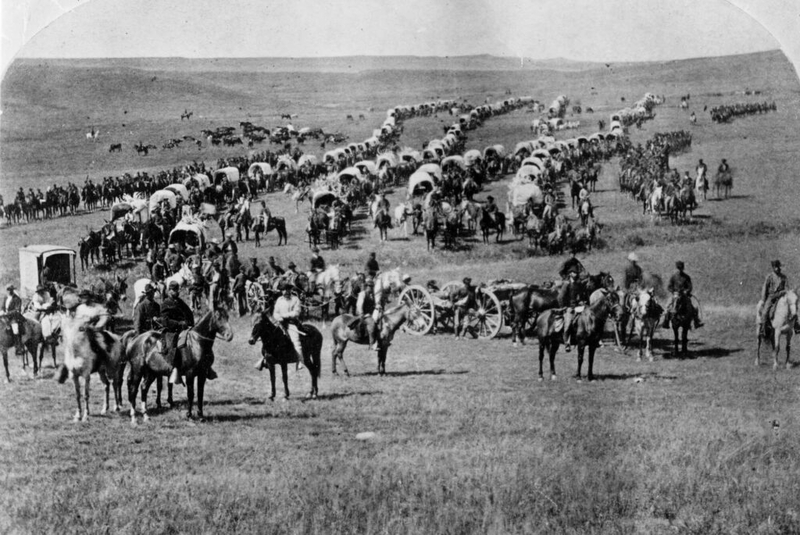
This 1874 photograph shows Lt. Col. George Armstrong Custer's expedition into the Black Hills, which led to a gold rush and ultimately to the war with the Lakota Sioux that climaxed with the Battle of the Little Bighorn. (Courtesy of Denver Public Library Special Collections, X-31704)
The jubilant sounds of music and fireworks on the “Centennial Fourth” had barely faded away when newspaper editors and telegraph operators began spreading alarming reports of a major defeat suffered by the U.S. Army in the Montana Territory.
To the Lakota Sioux — whom the Army had declared “hostile” in early 1876 when they resisted pressure to negotiate the sale of the Black Hills, where a gold rush by white settlers was underway — the June 25 battle that led to the annihilation of Lt. Col. George Armstrong Custer and more than 200 of his cavalry soldiers was known as the Battle of the Greasy Grass.
The Great Sioux War of 1876 would ultimately end in defeat for the Lakota, after the Army regrouped and launched a series of winter campaigns that scattered and drove some of them into Canada. But Custer’s defeat left a powerful impression on an American public that had assumed the Plains Indians were “no match for the army of a modern industrial nation,” writes historian Richard White in “The Republic for Which It Stands,” a history of the U.S. during Reconstruction and the Gilded Age.
“The Little Bighorn was a minor battle compared not only to the Civil War but to the losses American armies suffered against Indians in the wars of the early republic, but shocking because of its timing,” writes White. “When news of the battle came during the (Centennial) Exposition, Americans greeted it with incredulity and outrage.”
Gen. Alfred Terry’s official report of the defeat to Army headquarters was printed in the Rocky Mountain News on July 9.
“Confirmation of the Custer Catastrophe,” said the News headline. “Gen. Terry Tells the Sad Story — How No Soldier or Officer Has Been Found Alive.”
The Colorado Territory had followed the events of the war more closely than much of the rest of the country. After gold was discovered in the Black Hills in 1874, thousands of fortune-seekers had gradually left Colorado’s mountain mining camps to try their luck in the Dakotas instead.
Colorado, too, had a long history of bloody conflict with the Indian tribes who had been gradually dispossessed of their lands on both the Eastern Plains — from which the Cheyenne and Arapaho tribes had been expelled following a U.S. militia’s slaughtering of hundreds of tribespeople in the 1864 Sand Creek Massacre — and the Western Slope, much of which still belonged to the Ute people in the centennial year.
Alongside the Lakota, a handful of Cheyenne and Arapaho people had fought Custer at the Greasy Grass, including Lame White Man, a Cheyenne chief who had fled north after the Sand Creek Massacre.
John Stands In Timber, a Cheyenne tribal historian and Lame White Man’s grandson, collected oral histories from many members of the tribe, including recollections of “the Custer fight,” and published them in the 1967 book “Cheyenne Memories.” Some of those who looted and mutilated the bodies of Custer’s men in the aftermath of the battle, he wrote, had had family members killed in the Colorado massacre 12 years earlier.
“Some claimed they never touched them while others said they took things,” Stands In Timber wrote. “But those who had relatives at Sand Creek might have done plenty.”
‘Justification for conquest’
William Byers, the Rocky Mountain News editor who had endorsed a campaign of “active extermination” of Plains Indians in the months leading up to the Sand Creek Massacre, now called for another militia force of volunteers to be raised to fight the Lakota and their allies.
“If a volunteer force is authorized for the Sioux campaign, as seems now probable, the requisite number of men can be quickly raised in Colorado and neighboring states and territories,” declared the News. “To do the job up right and finish it for all time, there ought to be about ten regiments of frontier volunteers called into the field.”
No such step would be taken by the Army, and most Lakota bands surrendered by the following spring, leading to the formal annexation of the Black Hills in 1877. Just over a century later, the U.S. Supreme Court ruled in United States v. Sioux Nation of Indians that the tribe had not been compensated for the seizure, issuing an award — which the nation has refused to accept — that now totals over $1.5 billion.
Historians today generally agree that there’s little evidence that a valiant “Last Stand” was fought by Custer and his troops, who in fact made a chaotic retreat from a much larger force of Lakota, Cheyenne and Arapaho soldiers. But the defeat quickly attained the status of American myth, anyway.
That was due in large part to William Frederick “Buffalo Bill” Cody, whose long-running Wild West Show would feature sensationalized reenactments of the battle — sometimes by Plains Indians performers who had been combatants at the real thing — before Cody’s death in Denver in 1917.
“Why celebrate defeat, particularly catastrophic defeat, at the hands of what by any measure was a weaker foe?” asks White. “The answer was that such defeats provided justification for conquest.”
“An invasion of Lakota lands became the noble defense of outnumbered white men against savage warriors,” he continues. “Americans, by this logic, did not invade Indian lands; they simply defended themselves against ruthless enemies. Their ultimate victory was not the work of invasion, conquest, and empire. It was the product of self-defense.”
Denver, CO