Fifty for 150: 10th Mountain Division leaves Colorado’s Camp Hale in 1944, bound for war in Europe
Jul 07, 2026 | 6:00 am ET
Description
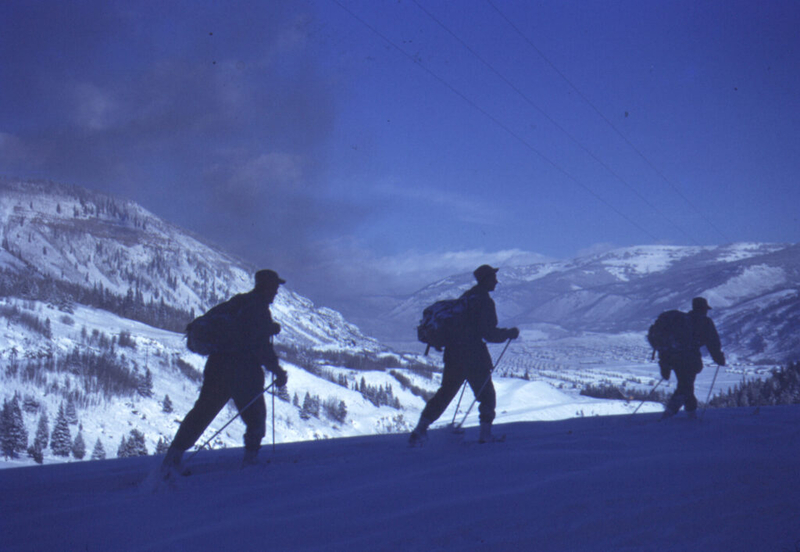
Three silhouetted 10th Mountain Division soldiers are pictured cross-country skiing above Camp Hale in this January 1944 photo. (Courtesy of 10th Mountain Division Resource Center, Denver Public Library, TMD-777)
When news of the successful D-Day landings in Normandy reached Colorado’s Camp Hale in early June 1944, it provoked mixed feelings among the men of the 10th Mountain Division.
After spending the previous year and a half training for Alpine combat in the snowy high-altitude Army camp near Leadville, infantrymen now wondered if the war in Europe would soon be won, and feared they might be sent to the sweltering Pacific Theater instead.
“Most (of) the boys think now that they will be … stuck in Burma or thereabouts for two or three years yet before the (Japanese) are finished,” wrote Jean Cummings, wife of Staff Sgt. Stan Cummings of the 85th Mountain Regiment, on the day of the Normandy invasion.
When they marched out of Camp Hale for the final time two weeks later, the 10th Division troops boarded trains bound for another Army camp in Texas, where they spent nearly six months undergoing further training and exercises as the war in Europe dragged on. Just after Thanksgiving 1944, their letters home began to be censored — “We’ve arrived at another camp but I’m not permitted to say where or what or when,” wrote Pvt. Harris Dusenberry to his wife — as the first mountain warfare unit in U.S. military history was deployed in full for the first time.
They weren’t headed to Burma. They were, in fact, headed to where many of the men had expected to fight all along — northern Italy, where resistance from experienced and well-fortified German mountain troops had slowed the Allies’ advance over the previous 18 months.
The men of the 10th Mountain Division stood apart from most other World War II infantry units, writes Maurice Isserman in “The Winter Army,” his book on the division’s formation and service through V-E Day in May 1945.
On average, they were better-educated and from more privileged class backgrounds, and their numbers included Germans, Austrians, Norwegians, Swedes and Swiss. Many had been placed into the specialized mountain warfare unit — known colloquially as the “ski troops” — on the recommendation of the National Ski Patrol, which recruited from college ski teams and outdoor organizations on the “thesis that it would be easier to turn skiers into soldiers than the reverse,” Isserman writes.
At Camp Hale, which some soldiers dubbed “Camp Hell,” they endured long, hard months of training in skiing, climbing and cold-weather survival in the rugged Rocky Mountain landscape. But there was also a certain glamour to the ski troops, and nationwide interest from the public, thanks to the Army’s PR machine, Time Magazine covers and Hollywood films like the 1943 short “Mountain Fighters.”
All the publicity had its downsides, as the division learned when it was deployed to the Italian front just after New Year’s Day 1945. Within days, propaganda leaflets raining from German artillery shells greeted them: “Welcome, men of the 10th Mountain Division. It’s a long way from Camp Hale.”
The 10th Division fought on the frontlines for much of the remaining four months of the war in Europe. Its most famous action came in late February, during an assault on the fortified German position upon Mount Belvedere, when soldiers undertook a daring nighttime ascent of a 2,000-foot vertical cliff, known as Riva Ridge, to launch a surprise attack on the Nazi troops.
It was a crucial part of an offensive that finally pierced the Germans’ so-called Gothic Line in the Apennine Mountains, the last major Nazi defensive line to be broken through by the Allies. Further fighting took place in Italy’s Po Valley in March and April before the final capitulation of the Italian Social Republic, a Nazi puppet government, on May 1, followed by Germany’s unconditional surrender a week later.
Camp Hale, which was dismantled shortly after the war, proved pivotal in the history of skiing in Colorado. In the postwar years, many 10th Division veterans returned to the Rocky Mountains and, with the skills they’d learned at Camp Hale, helped build the state’s growing alpine skiing industry.
Many others never made it home. Nearly a thousand 10th Mountain Division soldiers were killed in action in those four months of combat in early 1945. Another 3,100 were wounded.
Former President Joe Biden invoked the story of the assault on Riva Ridge when he established a new national monument on the site of Camp Hale in 2022.
“Imagine. It’s pitch-black. The punishing cold. The mission high in the mountains that hinged on the skills, strength and stamina that could have only been gained in a place like this,” Biden said. “Imagine the courage, the daring, the genuine sacrifice they all made.”
Denver, CO