Fifty for 150: Depression-era Colorado closes its border with New Mexico in 1936
Jul 09, 2026 | 6:00 am ET
Description
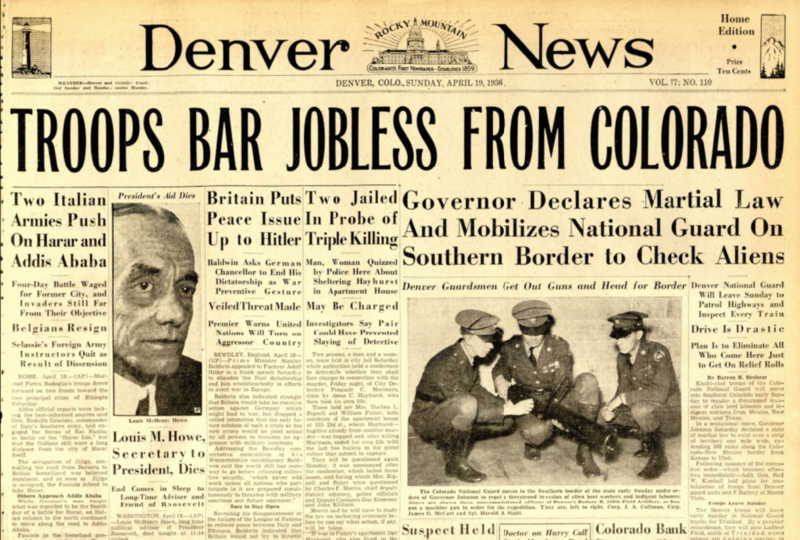
The front page of the Rocky Mountain News on April 19, 1936 announced Gov. Edwin Johnson's order closing the state border with New Mexico. (Courtesy of the Colorado Historic Newspapers Collection, Colorado State Library)
It’s the stuff of science fiction, like the future dystopia envisioned in Colorado author Paolo Bacigalupi’s 2015 thriller “The Water Knife”: Western states militarizing their borders and turning on each other in a time of crisis.
In 1936, as the Great Depression reached its lowest lows in Colorado, it really happened, albeit briefly.
Gov. Edwin “Big Ed” Johnson was a towering figure in Colorado politics in the mid-20th century, serving two different stints as governor on either end of a three-term tenure in the U.S. Senate between 1937 and 1955. A conservative Democrat, Johnson was a thorn in the side of President Franklin D. Roosevelt and the rest of the party’s New Deal faction, which oversaw a sweeping expansion of social welfare programs and other government interventions in the economy after coming to power in 1933.
Though Coloradans had voted for FDR and his New Deal in 1932, they’d also elected Big Ed Johnson, a plainspoken rancher from Craig who called for “less of government rather than more, and … a curtailment and not expansion of public service.”
As the Great Depression deepened, Johnson and other Colorado leaders clashed with the Roosevelt administration over the implementation of relief programs and new regulations on businesses. Average Colorado incomes, which had declined roughly 40% between 1929 and 1933, were slow to recover. Relief programs stalled in both state and federal courts, and the onset of the Dust Bowl in 1934 and 1935 further worsened conditions in eastern Colorado.
Seeking scapegoats for all this economic misery, a growing number of Coloradans blamed a lack of jobs in the state on its Mexican-American population, which swelled seasonally as employers, like sugar beet growers and other agricultural industries, hired temporary workers sometimes known as “braceros.”
“‘No Mexicans Served Here’ and ‘White Trade Only’ were commonplace signs in Colorado restaurants and stores,” wrote historian James F. Wickens in “Colorado in the Great Depression.” “To most Coloradans ‘alien’ meant ‘Spanish-speaking’ and these individuals, regardless of their birthplace, were ‘Mexicans.”’
Ahead of an anticipated influx of seasonal workers in spring 1936, Johnson, who was preparing a run for Senate, mobilized the Colorado National Guard and sent troops to the southern border — the southern border of Colorado, where they set up highway checkpoints and began turning away hundreds of suspected “indigent” people arriving from New Mexico.
To carry out his shutdown, Johnson on April 18 invoked martial law across a one-mile area running east-west along the border.
“If they do not have money, or means of support, do not let them pass,” Johnson’s order to the guardsmen said. “Colorado cannot care for indigents from other states, and these people become charges of the state after the brief spring labor season ends.”
At Raton Pass, one pair of brothers from Maxwell, New Mexico, was turned away by guardsmen, the Rocky Mountain News reported on April 21, when they were asked if they had money and “could show the patrol only $3.50.”
“An elderly man in (another) car had a postcard apparently from a farmer near Ault, explaining that he might have a job for him and his family in the beet fields this year, but that he couldn’t yet be sure,” the News recounted. “There were tears in the eyes of several members of this party as the car turned back toward New Mexico.”
The border shutdown quickly proved to be a political “fiasco” for Johnson, Wickens wrote. New Mexico lodged protests in Congress and threatened to retaliate with boycotts of Colorado businesses.
“Organized labor, liberal theologians, the Roman Catholic church, Spanish-speaking groups and political radicals all charged Johnson with racial prejudice and an abridgment of privileges and immunities guaranteed in the 14th Amendment to the Constitution,” Wickens noted.
Johnson rescinded his order on April 29, just 11 days after issuing it. In a statement, he blamed “unforeseen complications of a serious nature” for derailing his plan, regretting that it had cast “Colorado in a most unfavorable light.”
But he doubled down on what he called the “national problem” of migrant labor, still attempting to parlay the situation into a political advantage as a soon-to-be senator, and voicing restrictionist views that have distinct echoes in today’s revived “America First” movement.
“Restrictive federal laws must be enacted,” Johnson’s statement continued, “and all immigration laws rigidly enforced if an undersupply of American jobs is to be preserved for an oversupply of American labor.”
Denver, CO