SD court system eyes third circuit consolidation in 50 years, raising concerns about ‘mega circuit’
Jul 11, 2026 | 12:00 pm ET
Description
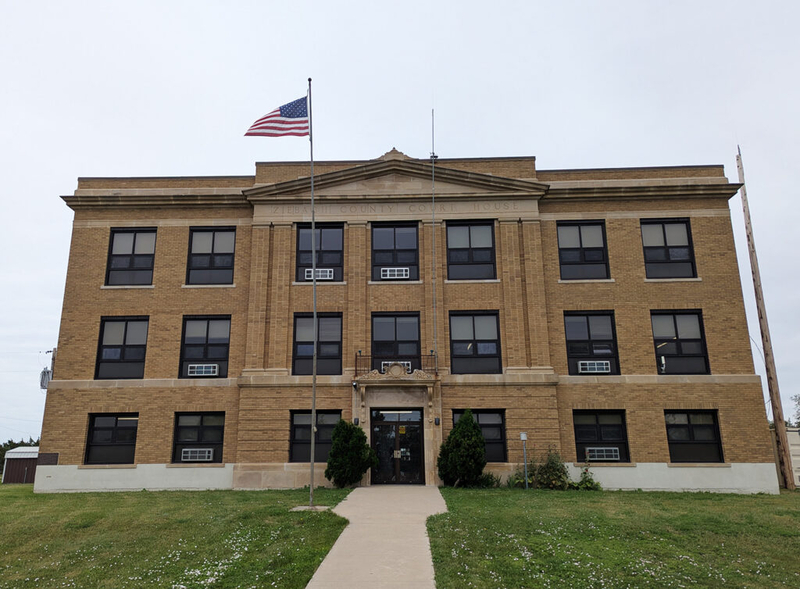
Ziebach County Courthouse in Dupree, SD. (John Hult/South Dakota Searchlight)
South Dakota’s court system intends to merge the Fourth and Seventh judicial circuits, creating one that will cover nearly a third of the state’s land area.
The Fourth Judicial Circuit encompasses the northwestern quarter of the state, including Butte, Corson, Dewey, Harding, Lawrence, Meade, Perkins and Ziebach counties. The Seventh Judicial Circuit includes the southwestern corner: Custer, Fall River, Oglala Lakota and Pennington counties.
The merged circuit would have the largest population and geographic footprint of any in the state, and the second-largest caseload.
The merger of the Fourth and Seventh circuits would “increase operational efficiencies” within the system, according to a news release from the Unified Judicial System.
The merger would result in one presiding judge, one chief court services officer and one deputy chief court services officer for the combined circuit, said court system spokeswoman Alisa Bousa. Each county would retain its own clerk of court.
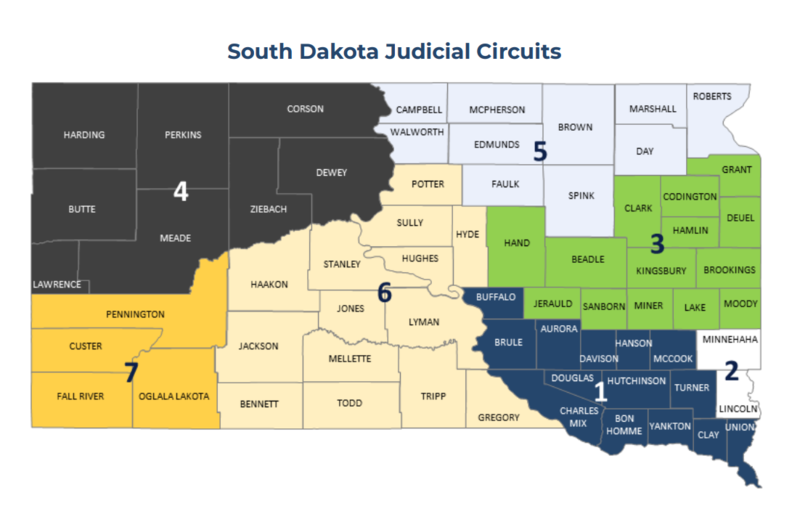
If approved by the state Supreme Court, it would be the third circuit consolidation since the system was implemented more than 50 years ago. At least one state’s attorney in northwestern South Dakota worries the consolidation will hurt access to justice for rural residents.
“The way circuits are set up right now makes sure rural counties are always properly served with the right amount of resources so we can do what we need to do,” said Shane Penfield, state’s attorney for Perkins, Dewey, Ziebach and Corson counties. “I think there could be some potential pitfalls with a circuit that large in geographic size.”
The system has not yet presented a formal rule proposal to the state Supreme Court, State Court Administrator Greg Sattizahn said in an email. Sattizahn declined an interview request. He said the system is “focusing on providing information to the public” through in-person forums planned for Aug. 26:
- 8:30 a.m. at the Pennington County Courthouse in Rapid City.
- 11 a.m. at the Meade County Courthouse in Sturgis.
- 3:30 p.m. at the Lonesome Dove Conference Center in Lemmon.
History of consolidation
The Unified Judicial System consists of the Supreme Court and seven circuits, each of which includes more than one county.
The term “unified” stems from the system’s setup, in which the state serves as the administrative overseer while counties manage and fund many day to day operations. Prosecutors and public defenders are paid for by counties; judges, court services officers and clerks of court are paid by the state.
The system was established by constitutional amendment in 1972, originally with nine circuit courts and 37 judges. The Supreme Court reduced that number of circuits to eight in 1976 and to seven in 2000, after an internal report recommended equalizing court costs and workloads to balance declining rural populations with growing urban areas, according to Rapid City Journal reporting at the time.
Neil Fulton, dean of the University of South Dakota’s Knudson School of Law, worked in the Sixth Circuit during the 2000 reorganization.
“In general, these have been responses to the balance of workload,” said Fulton, who characterized the proposed consolidated operations for western South Dakota as a “mega circuit.”
Some circuits, like the Second Circuit serving the Sioux Falls metro area, handle significantly higher caseloads than rural districts, which cover a larger geographic area that involves more travel time. Fulton said the allocation of cases among judges was more balanced after the 2000 consolidation.
“It makes the work of the judiciary more sustainable,” Fulton said. “If we run our judges to the bone then they won’t be able to do things. That consolidation made coverage more reliable and regular so you saw a more predictable schedule in those courthouses.”
Balancing rural population shifts and representation
Currently, South Dakota’s circuit court system has 46 circuit court judges among its seven circuit courts.
The Seventh Circuit has eight judges serving 144,356 residents and reported 21,042 criminal filings and 9,213 civil filings during fiscal year 2025, according to the annual report. The Fourth Circuit has four judges serving 84,181 residents. It had 11,185 criminal filings and 4,622 civil filings in fiscal year 2025 — the second-fewest in the state.
The proposed merger is a “reflection of reality,” Fulton said.
“We have to consolidate services more in some areas to get judges, clerks and court service officers needed to deliver services,” Fulton said. “You see that with a lot of stuff: healthcare and education, to a degree. I’m not surprised court services is in the same boat.”
Fulton added that the consolidation would expand the pool of potential judges, since there are more lawyers in Rapid City than in the rural northwest.
“I’m 100% confident that UJS’s goal is to provide effective administration of justice for all South Dakotans,” Fulton said. “I think everyone has a shared goal, so let’s be patient working toward that.”
Penfield is open, but more skeptical.
Rapid City may have more lawyers, but Penfield argues it is culturally and economically distinct from the northern Black Hills and northern plains. A larger Rapid City presence could mean more Rapid City-based judges, who he said have different perspectives than those from less populated counties.
“Combining those two would be a disservice not only to folks in the northern plains but to folks in the northern hills as well,” Penfield said.
If finding lawyers to serve as judges is the issue, Penfield said, the court system should increase salaries and offer judges additional staffing.
The merger “sends a mixed message,” Penfield said. The court system has invested in incentive programs to draw lawyers to rural areas for over a decade, through the Rural Attorney Recruitment Program and Public Service Pathway pilot program. But the rural-urban divide for South Dakota lawyers has worsened over the past decade.
Rural lawyer recruitment efforts show local results, but fail to alter urban-rural divide
When Penfield moved back to Lemmon from Rapid City in 2007, he was the fifth lawyer in town. When Lemmon had a circuit judge in the 1980s, there were more. Now there are two lawyers in town, he said.
“If there was still a judge seated in Lemmon, I’m guessing there’d be a few more lawyers in town,” Penfield said. “There were other economic changes, but those things have impacts and send messages.”
Penfield said he doesn’t see “where the numbers justify” the consolidation.
The Fourth Circuit has a greater population than the Fifth Circuit, which includes Aberdeen, and a comparable caseload. Its workload and population also exceed those of the Sixth Circuit, which serves Pierre.
Penfield worries that the Seventh Circuit’s existing criminal caseload could create problems for representation in smaller counties and result in reduced services.
“My criminal caseload in my four counties is just a blip — probably not even a week’s worth of cases in Pennington County or a couple of days,” Penfield said. “I see that getting lost.”
Penfield plans to research the impact of the 1976 and 2000 consolidations, and said he plans to keep an open mind about the process.
Written comments on the proposed merger may be submitted by email to [email protected] or by mail to the State Court Administrator’s Office. The comment period ends Oct. 1.

Pierre, SD