Fifty for 150: Red Rocks Amphitheatre, iconic Colorado live music venue, opens in 1941
Jul 08, 2026 | 6:00 am ET
Description
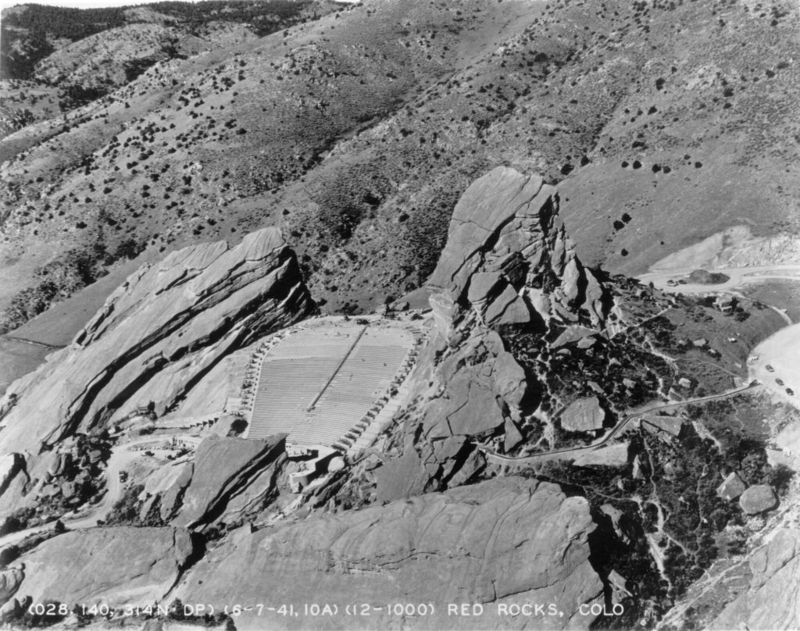
Red Rocks Amphitheatre in Morrison is pictured in June 1941, the same month of its official dedication and opening ceremony. (Courtesy of Denver Public Library Special Collections, Z-8890)
Red Rocks Amphitheatre, one of Colorado’s most renowned tourist destinations and a bucket-list venue for musicians from around the world, opened with a formal dedication ceremony on June 15, 1941.
Various performances occurred at the amphitheater before it got the Red Rocks name, but the grand opening and dedication of Red Rocks followed years of work by the Civilian Conservation Corps to make it the live music spectacle it is today. The dedication featured speeches from elected officials, musical performances, and a ceremony to honor the Indigenous people who first discovered the unique natural acoustics at Red Rocks.
The National Park Service designated Red Rocks and the Mount Morrison Civilian Conservation Corps Camp as a National Historic Landmark in 2015. Between two massive red sandstone formations, named Creation Rock and Ship Rock, 70 rows of bleacher-style seating look down onto the venue stage and the Denver skyline.
Playing Red Rocks is a key milestone in many musicians’ careers, and the venue’s Hall of Fame celebrates artists who have made their own mark on the venue. The Red Rocks Visitor Center has a display celebrating its Hall of Fame members, including The Grateful Dead, Carlos Santana, Bonnie Raitt, U2, John Denver, Big Head Todd and the Monsters, Stevie Knicks and James Taylor.
A hidden tunnel connecting the backstage area to the sound booth in the middle of the stadium seating includes its own exhibit on Red Rocks history: walls and stairs covered in hundreds of signatures from performers, crew and visitors.
Red Rocks hosted its first rock concert in August 1964, when The Beatles played to about 7,000 fans. Their show at Red Rocks was the only show on their tour that year that did not sell out.
After an August 1968 Aretha Franklin show did not go on as planned following a contract dispute, fans in attendance stormed the stage and destroyed a piano. That led to a year-long ban on rock music in 1969, which was “arguably the most important year of rock music history,” as CPR put it.
That wasn’t the last time rock music was kept out of the amphitheater. Following what Red Rocks calls a “tumultuous and legendary” 1971 Jethro Tull concert at the venue, city leadership again banned rock and roll music from the venue for five years.

Over 1,000 fans who did not have tickets came to the venue for Jethro Tull’s show. Attendees without tickets were allowed to listen to the concert from a parking area behind the stage. But after some people charged a police line and threw rocks while trying to enter the venue, authorities deployed tear gas, which wind carried into the venue and affected paying concert goers.
U2 played a Red Rocks show in June 1983 through high winds and rain. The performance became a turning point that accelerated the band’s career through their concert film and album “Under a Blood Red Sky.” Dozens of bands have since recorded and released their Red Rocks shows as live albums.
In 2008, Widespread Panic surpassed all other performers with its 32nd consecutive sold-out show at Red Rocks. The band’s historic Red Rocks residency has continued to grow: Widespread Panic played its 78th sold-out Red Rocks show at the end of June.
Diana Ross performed at Red Rocks in 2019, 50 years after she first performed at the amphitheater as lead singer of The Supremes in 1969.

Denver, CO